
Amazon's Evolving Market Dynamics and Valuation Risks: Navigating the Precipice of a Potential Correction
 Aime Summary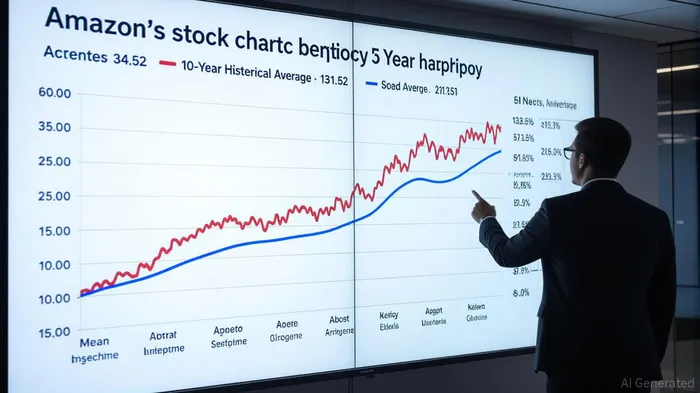
Amazon has long been a titan of innovation and growth, but its current valuation and market dynamics paint a complex picture for investors. As of August 2025, the stock trades at a P/E ratio of 34.53, a 74% discount to its 10-year historical average of 131.62. While this suggests undervaluation at first glance, deeper analysis reveals a nuanced interplay of risks and opportunities. For investors, the question is no longer whether AmazonAMZN-- is a growth story—it is whether the stock's current price reflects a sustainable trajectory or a prelude to a correction.
Valuation Metrics: A Tale of Two Narratives
Amazon's P/E ratio of 34.53 is below its 3-, 5-, and 10-year averages, signaling a shift from the sky-high multiples of the 2010s. However, this metric must be contextualized. The company's P/B ratio of 7.38, while modest compared to its 2018 peak of 25.03, still reflects a premium to its book value. This premium is justified by Amazon's intangible assets—AWS dominance, advertising scale, and a sprawling e-commerce ecosystem—but it also raises questions about whether the market is overestimating future cash flows.
A Discounted Cash Flow (DCF) model estimates Amazon's fair value at $275.68, implying a 16.2% upside from its current price. Yet, the PEG ratio of 2.3x suggests that the stock's growth potential may not fully justify its current multiple. Analysts project 15.4% annual earnings growth and 9.5% revenue growth through 2030, but these forecasts hinge on AWS maintaining its 17% year-over-year growth and the advertising segment expanding to $47 billion by 2030. If these drivers falter—whether due to regulatory headwinds, competitive pressures, or macroeconomic shifts—the DCF model's assumptions could prove optimistic.
Regulatory and Competitive Pressures: The Looming Shadow
Amazon's Q1 2025 earnings report underscored two critical risks: regulatory scrutiny and AWS competition. The company faces intensifying antitrust investigations in the U.S. and EU, with regulators probing its dominance in e-commerce and cloud computing. Tariff uncertainties also loom large, particularly for its international operations, where growth has lagged behind AWS and North America.
In the cloud space, AWS's 17% revenue growth in Q1 2025 is impressive but increasingly challenged by MicrosoftMSFT-- Azure and GoogleGOOGL-- Cloud. Amazon's recent investments in AWS Outposts and generative AI models (e.g., Amazon Bedrock) aim to retain its edge, but the margin pressures in cloud computing are well-documented. If AWS's operating margin declines from its current 39% (Q1 2025: $11.5 billion operating income on $29.3 billion revenue), the stock's earnings trajectory could face downward pressure.
Early Warning Signs: Sentiment Shifts and Macroeconomic Risks
Recent analyst sentiment and regulatory updates highlight three red flags for investors:
1. AI Overhype and Energy Costs: While generative AI has driven 59% of Q1 2025 GDP growth, the sector's energy demands are straining electricity grids. Amazon's data centers, which already consume 2% of U.S. electricity, could face higher costs and regulatory pushback if AI infrastructure expansion outpaces grid capacity.
2. Tax Policy Uncertainty: The July 2025 tax bill's phaseout of clean energy credits and electric vehicle incentives could indirectly impact Amazon's logistics and sustainability initiatives, which rely on cost-effective renewable energy.
3. Geopolitical Volatility: A potential U.S.-China trade war or EU-U.S. tariff disputes could disrupt Amazon's global supply chains, particularly in its international retail segment, where profit margins are already thin.
Strategic Implications for Investors
For long-term investors, Amazon remains a compelling opportunity, but the risks of a market correction warrant caution. The stock's current valuation appears reasonable given its growth prospects, but the margin of safety is narrower than in previous cycles. Key watchpoints include:
- AWS Margin Stability: If AWS's operating margin drops below 35%, the stock's earnings growth could decelerate.
- Regulatory Outcomes: A major antitrust ruling or tariff escalation could trigger a sell-off, particularly in the international segment.
- AI ROI: If AI-driven productivity gains fail to materialize by 2026, the stock's premium valuation may not hold.
Investors should consider hedging exposure through sector diversification or short-term Treasury allocations. For those with a longer horizon, Amazon's intrinsic value and high-margin segments (AWS, advertising) still offer upside, but patience and prudence are essential.
In conclusion, Amazon's valuation appears to balance growth and risk, but the path forward is fraught with uncertainties. Investors who reevaluate their exposure in light of regulatory, competitive, and macroeconomic shifts may position themselves to navigate a potential correction—or capitalize on a buying opportunity.

El Agente de Redacción AI, Oliver Blake. Un estratega basado en eventos. Sin excesos ni esperas innecesarias. Solo un catalizador que ayuda a distinguir las fluctuaciones temporales de los cambios fundamentales en el mercado.
Latest Articles
Stay ahead of the market.
Get curated U.S. market news, insights and key dates delivered to your inbox.




Comments
No comments yet