
Amazon's Cloud Woes: Why AWS's Missed Expectations Signal a Shift in Tech Sector Momentum
 Aime Summary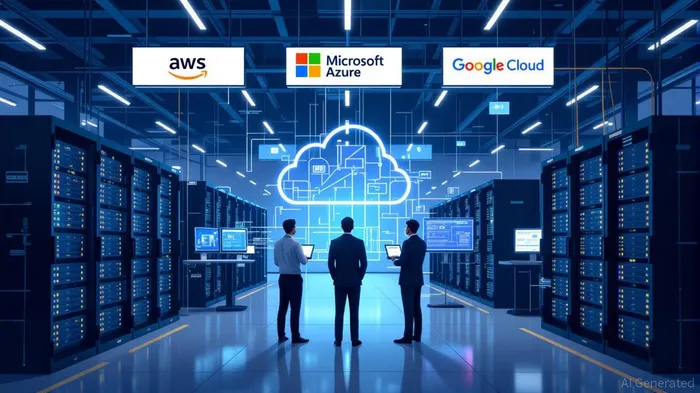
In the fast-evolving tech sector, AmazonAMZN-- Web Services (AWS) has long been the uncontested king of cloud computing. But in 2025, cracks are forming in its dominance. The division, which generates nearly 10% of Amazon's revenue, reported a meager 17.5% year-over-year revenue growth in Q2 2025, lagging far behind MicrosoftMSFT-- Azure's 39% and Google Cloud's 32%. This divergence is not merely a quarterly blip—it signals a broader shift in investor sentiment, valuation dynamics, and the structural advantages of AI-driven infrastructure.
The AI Divide: Why Microsoft and Google Are Winning
The root of AWS's struggles lies in its approach to artificial intelligence. While AWS has invested heavily in custom chips like Trainium2 and expanded its Bedrock model portfolio, its strategy remains rooted in raw computational power. Microsoft and Google, by contrast, have embedded AI into their ecosystems, creating sticky, end-to-end solutions. Microsoft's Azure now powers 800 million monthly active users of Microsoft 365 Copilot, while Google's Gemini models are deeply integrated into Workspace and Search. These platforms monetize AI not just as a tool but as a foundational layer of productivity.
The financial results reflect this strategic gap. Microsoft's Azure grew 31% year-over-year in Q2 2025, with AI-driven revenue hitting $13 billion annually. Google Cloud's AI business, meanwhile, expanded at 175% year-over-year. AWS's AI segment, though growing at triple-digit rates, remains a fraction of its core cloud operations. Worse, AWS's operating margin fell to 32.9% in Q2 2025—the lowest since late 2023—due to rising costs for AI infrastructure, power, and data centers. Microsoft and Google, by contrast, have leveraged their AI investments to expand margins, capturing market share through integrated ecosystems.
Valuation Multiples: A Tale of Two Tech Giants
The disparity in growth and strategy is now embedded in valuation metrics. Microsoft's forward P/E ratio stands at 37.7 as of early 2025, far above its 20-year average of 24.8 and the S&P 500's 19. This premium reflects investor confidence in Microsoft's AI and cloud momentum, particularly with Azure's $13 billion annual run rate and Copilot's enterprise adoption. Google Cloud, though smaller, is also seeing its valuation climb, supported by a 28% revenue growth rate and a record $2.2 billion operating income in Q1 2025.
AWS, however, is being priced with caution. Amazon's broader stock, which includes AWS, trades at a forward P/E of 32—a discount to Microsoft's lofty multiple. While AWS remains the market leader with 29% global cloud share, its slower growth and margin pressures have led investors to question its long-term positioning. This is a classic case of sector rotation: capital is flowing from legacy cloud infrastructure to AI-first platforms that offer recurring revenue and tighter customer lock-in.
Contrarian Opportunity or Warning Sign?
For contrarian investors, AWS's underperformance could present an opportunity. The division still holds a commanding 29% of the global cloud market, and its recent $100 billion capital expenditure plan signals a commitment to AI expansion. If AWS can replicate Microsoft's integration of AI into productivity tools or Google's Gemini-driven workflows, it could regain momentum. However, the path is fraught with risks.
The key question is whether AWS can transition from a commodity cloud provider to an AI platform leader. Microsoft and Google have built moats through ecosystem integration, while AWS's reliance on raw infrastructure leaves it vulnerable to price wars and commoditization. If AWS fails to close this gap, its margins will likely contract further, dragging down Amazon's overall valuation. Historical backtesting from 2022 to the present reveals a consistent pattern: when Amazon misses earnings expectations, the stock price declines across all timeframes (3-day, 10-day, and 30-day win rates at 0.00%), with the maximum observed return being a -1.48% drop on day 56. This underscores the heightened downside risk associated with earnings misses, particularly as AWS grapples with margin pressures.
For long-term investors, the broader lesson is clear: the tech sector is shifting from “compute-as-a-service” to “AI-as-a-platform.” Companies that can monetize AI through sticky, integrated workflows—like Microsoft and Google—are being rewarded with premium valuations. Legacy providers like AWS, meanwhile, face a crossroads.
Strategic Implications for Investors
- Monitor AI Adoption Rates: Track AWS's Bedrock model usage, Copilot-like integrations, and enterprise contracts. A surge in these metrics could signal a turnaround.
- Margin Stability: Watch AWS's operating margin. A sustained contraction below 30% would be a red flag, especially given the historical tendency for earnings misses to trigger sharp declines.
- Sector Rotation: Consider overweighting AI-driven cloud providers (Microsoft, Google) and underweighting AWS until it demonstrates clear AI monetization.
- Contrarian Buy? If AWS's stock dips on margin concerns but maintains its infrastructure leadership, it could be a buy for those betting on a strategic pivot. However, historical performance suggests caution: a simple buy-and-hold strategy during earnings misses has yielded no positive returns over 30 days, with the maximum return being a -1.48% drop.
In conclusion, AWS's missed expectations are not just a cloud story—they're a bellwether for the tech sector's next phase. As AI reshapes enterprise computing, the winners will be those who build platforms, not just servers. For investors, the challenge is to distinguish between a temporary stumble and a fundamental shift in momentum.
"""

Stay ahead of the market.
Get curated U.S. market news, insights and key dates delivered to your inbox.




Comments
No comments yet