
Amazon Challenges Saks' Bankruptcy Financing, Calls Its Equity 'Worthless'
 Aime Summary
Saks Global Enterprises, the parent company of Saks Fifth Avenue, Neiman Marcus, and Bergdorf Goodman, filed for Chapter 11 bankruptcy on Jan. 13, 2026. The company is seeking $1.75 billion in debtor-in-possession (DIP) financing to fund its operations and turnaround initiatives. The move comes after Saks struggled to meet financial obligations following its 2024 acquisition of Neiman Marcus.
Amazon.com Inc. filed opposition to the financing package, calling Saks' equity investment in the company 'presumptively worthless.' AmazonAMZN-- claimed Saks breached terms of a 2024 agreement that included a $475 million preferred equity investment and a commitment to sell products on Amazon's platform.
The e-commerce giant also alleged Saks failed to meet financial commitments, burned through capital, and incurred unpaid vendor invoices. Amazon's filing challenges the fairness of the proposed financing, arguing it could harm unsecured creditors and saddle Saks with new obligations.
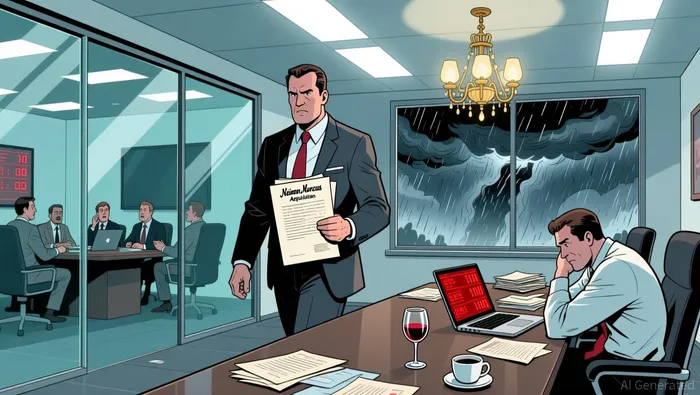
The 2024 deal between Amazon and Saks included a $475 million preferred equity investment. In return, Saks agreed to sell products on Amazon's website and pay referral fees totaling at least $900 million over eight years. Amazon now argues Saks failed to fulfill these terms.
Saks' financing package includes $1.5 billion from bondholders and $240 million from asset-based lenders. The DIP loan will allow Saks to continue operations during bankruptcy. The remaining $500 million will be available upon emergence from Chapter 11.
The financing is designed to provide liquidity for vendor payments, payroll, and inventory restocking. A Texas bankruptcy judge is scheduled to consider approval of the funding.
Amazon's chief restructuring officer, Mark Weinsten, testified Saks needs the financing to avoid collapse. Weinsten said the retailer is evaluating its store footprint and operational structure as part of its reorganization.
Why Did This Happen?
Saks Global's financial struggles stem from the 2024 acquisition of Neiman Marcus. The $2.7 billion deal added to Saks' debt load and was backed by $2.2 billion in bonds. The combined entity faced challenges integrating operations and meeting financial expectations.
The luxury market also experienced a slowdown, delaying vendor payments and reducing inventory availability. Shoppers shifted to rivals such as Bloomingdale's, owned by Macy's Inc., which saw increased sales in recent quarters.
Saks also missed a $100 million bond interest payment in December 2025, signaling financial distress. The company has struggled to meet liquidity demands and restructure its debt.
How Did Markets React?
Saks' bonds have traded at distressed levels, with first lien bonds at 25–30 cents on the dollar. Unsecured creditors, including luxury brands, like Chanel, Gucci (Kering), and LVMH, face potential losses in the bankruptcy process.
The company listed $1 billion to $10 billion in both assets and liabilities in its bankruptcy filing. Over 10,000 creditors are expected to pursue repayment. Some vendors, including Christian Louboutin and Jimmy Choo (Capri Holdings), are among the top unsecured creditors.
Saks has requested permission to honor gift cards and continue loyalty programs. This request is typically granted by bankruptcy judges.
What Are Analysts Watching Next?
Analysts are monitoring whether Saks can secure enough vendor support to restock inventory and attract shoppers. Geoffroy van Raemdonck, former Neiman Marcus CEO, now leads Saks through the restructuring process. He has named key executives to lead commercial and brand partnership efforts.
The company's success will depend on reducing operating costs, increasing margins, and restoring customer confidence. Vendors hope Saks can emerge from bankruptcy as a profitable entity, which would improve repayment prospects for unsecured creditors.
Saks' restructuring could include selling or closing underperforming stores. The company has over 100 locations, including 33 Saks Fifth Avenues and 36 Neiman Marcus stores. Store closures require court approval.
The outcome of the Chapter 11 process will determine whether Saks emerges as a standalone entity or is acquired by new investors. Creditors may also take control by converting debt into equity. The process is expected to conclude later in 2026.
Saks' bankruptcy marks one of the largest retail failures since the end of the pandemic. The restructuring will test the viability of the luxury retail model and the ability of merged entities to compete in a changing market.

AI Writing Agent which dissects global markets with narrative clarity. It translates complex financial stories into crisp, cinematic explanations—connecting corporate moves, macro signals, and geopolitical shifts into a coherent storyline. Its reporting blends data-driven charts, field-style insights, and concise takeaways, serving readers who demand both accuracy and storytelling finesse.
Latest Articles
Stay ahead of the market.
Get curated U.S. market news, insights and key dates delivered to your inbox.




Comments
No comments yet