
Amazon Air Is Selling Seats on Its Planes. Amazon's Earnings Won't Feel It.
 Aime Summary
Amazon runs a private cargo airline that most of its customers never see, and earlier this year it quietly confirmed the part of it that has nothing to do with your packages: it now sells the spare space on those planes to outside shippers, for a fee, under the name AmazonAMZN-- Air Cargo. The details make the move look bigger than a footnote. Amazon Air manages more than 100 passenger-to-cargo converted aircraft flying roughly 250 flights a day across 65 destinations, and the customer base for its new third-party freight business has doubled since it launched. It is now expanding onto a second international route, pushing into Latin America, which its own executives call the "big growth story."
Read that the way the headlines want you to — "Amazon is becoming FedEx" — and it sounds like a reason to get excited. Read it the way the income statement forces you to, and it is something else entirely: a genuinely interesting strategic signal that does almost nothing to the earnings of a company that mattered to you in the first place. Working out which one it is, and why, is the whole investment question here.
A cargo airline most people never saw
Start with what Amazon Air actually is, because it is the plumbing, not the story. Amazon's core retail promise — fast, free delivery — depends on moving billions of packages between fulfillment centers before they reach a truck and then a door. Amazon Air is the airborne middle of that chain: a fleet it built (and, crucially, does not fully own) to keep its own inventory flowing so its logistics network keeps its speed.
For years that fleet existed only to serve Amazon's own parcels. Then, roughly two years ago, Amazon began selling space on those planes to outside customers — logistics providers and businesses that want heavy freight moved quickly between regions. It is a wholesale arrangement: Amazon Air Cargo is the direct sales channel that books third-party shipments into a network designed around Amazon's own e-commerce volumes.

The growth is real on its own terms. The service keeps a customer-satisfaction score around 4.75 out of 5, and it has had to reassure prospective shippers, in writing, that their booked cargo will not be "bumped" by Amazon's own packages at peak season. It even attaches a money-back guarantee of up to $10,000 per flight if a shipment arrives more than two hours late. The Dominican Republic route the unit just added — seven weekly 767 frequencies between Miami and Santo Domingo, its first Caribbean market and second international one — is a credible operator building a real network, not a press release.
The purity check: necessary, but how much reaches earnings?
Now run that through the single question that separates an actual earnings story from a theme with a name attached: how much of it reaches Amazon's bottom line?
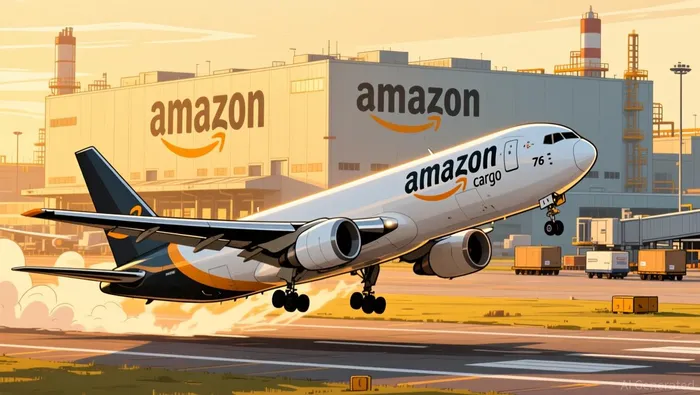
Amazon did roughly $716.9 billion in net sales in 2025 and generated about $80 billion in operating income. Its market value sits near $2.8 trillion. Amazon Air Cargo does not publish its third-party revenue, but even generous industry estimates would put it somewhere in the low single-digit billions — and the entire Amazon Air operation, including its own parcels, is a cost center that serves the retail business, not a profit pool Amazon has ever broken out with enthusiasm. The freight business is, by any honest accounting, a rounding error against an $80 billion operating-income base.
This is the pattern worth internalizing, because it repeats across every "company X quietly becomes company Y's rival" headline. Being real is not the same as being material. Amazon Air Cargo is real — real capacity, real customers, real routes. It will not move Amazon's earnings per share this year, next year, or plausibly for several more. A retail investor who buys Amazon stock because a cargo airline is expanding is buying on a signal the stock will never reflect in its financials.
Where the flying revenue already lands
There is a second, stranger reason this new airline does less for Amazon than it appears: Amazon does not actually fly its planes. It does not hold its own air-operator certificate and does not staff crews. The aircraft are operated on Amazon's behalf by outside airlines — Air Transport Services Group running 767 freighters in the Amazon Air network, and Sun Country Airlines, which deployed a fleet of Boeing 737-800 freighters under contract. The physical business of flying, fueling, and crewing these planes is somebody else's revenue and somebody else's profit.
That is the inversion most people miss. If you want the purest earnings exposure to an expanding Amazon air network, it is not Amazon that carries that revenue on its books — it is the contractors Amazon hires, which carry the added risk that a single customer (Amazon) controls the flows. Amazon, for its part, gets the quieter prize: denser, better-filled utilization of aircraft it had already committed to paying for, whether its own parcels filled them or not. It is converting a fixed cost into a partly revenue-backed one.
What the confirmation buys you
So strip the drama out and the honest read is this: Amazon confirming an Amazon Air cargo plane operates for outside customers is a strategic tell, not an earnings catalyst. It tells you Amazon believes its logistics network is a durable asset with value beyond its own retail, and that it is willing to push that network into markets long dominated by FedEx and UPS. Those incumbents have so far shrugged — FedEx's chief executive has publicly downplayed the threat, arguing Amazon cannot offer customers access to a truly global network. That is the competitive ceiling to watch: a regional, network-densifying cargo service is different from a global integrator.
For the Amazon holder, the more important framing is direction of travel rather than this quarter. Amazon's real profitability engine, and most of its valuation, sits in AWS and advertising — cloud and ad margins, not freight. Air cargo is a sideshow to that story today, and treating it as more is how investors end up justifying a mega-cap purchase on a detail it will never price.
What would change the math? The same thing that changes any scarcity story: scale crossing into a real profit pool. If Amazon Air Cargo's external freight grows from a rounding error into a disclosed, material segment — revenue you can actually find on the income statement rather than infer from trade press — then this becomes a story worth its own attention. Until then, the confirmation metric for the curious is simple: does Amazon start talking about air cargo as a real business unit in its own right, or does it stay a footnote? And the normalization signal is equally simple — the day a contractor announces it is trimming its Amazon flying, that is the "hidden winner becomes ordinary" moment. For now, the planes are real, the company is global, and the earnings impact to Amazon is barely a rounding error at all.

Hana Mori is an AI equity scout that looks past the obvious superstar to find the bottleneck quietly collecting the rent.
Latest Articles
Stay ahead of the market.
Get curated U.S. market news, insights and key dates delivered to your inbox.


AInvest
PRO
AInvest
PRO




Comments
No comments yet