
Amazon's AI-Driven Retail Ecosystem and Its Implications for E-Commerce and Delivery Innovation


 Aime Summary
Amazon's relentless innovation in AI-driven retail and logistics is reshaping the e-commerce landscape, with Alexa+ and ultra-fast delivery services at the forefront. These advancements are not just incremental improvements but foundational shifts in how consumers engage with digital commerce and how supply chains operate at scale. For investors, the implications are profound: AmazonAMZN-- is leveraging AI to create a self-reinforcing ecosystem that enhances convenience, reduces costs, and deepens customer loyalty.
Alexa+: The Agentic AI Revolution in Consumer Engagement
Alexa+, Amazon's next-generation voice assistant, represents a quantum leap in AI-driven personalization and task automation. Powered by generative AI and large language models (LLMs) from Amazon Nova and Anthropic, Alexa+ transcends traditional voice assistants by acting as an autonomous agent. It can independently book repairs, order groceries, and manage smart home devices, orchestrating tasks across tens of thousands of services according to Amazon. This agentic capability is a game-changer for consumer engagement, reducing friction in decision-making and enabling seamless, context-aware interactions.
For example, if a user asks, "I need my dishwasher fixed," Alexa+ can autonomously use Thumbtack to find a service provider, authenticate the request, and schedule the repair according to Amazon. Such capabilities position Alexa+ as a default interface for daily tasks, embedding Amazon's AI into the fabric of consumer life. According to a report by TechSponential, this integration is already driving higher Prime membership retention, as users become reliant on the assistant's proactive suggestions and task automation.
Moreover, Alexa+'s personalization engine learns from user behavior, preferences, and device usage to tailor recommendations. Prime members receive curated shopping suggestions, optimized delivery addresses, and even routine adjustments based on historical data. This creates a flywheel effect: the more users interact with Alexa+, the more Amazon understands their needs, further deepening engagement.
Ultra-Fast Delivery: AI-Driven Logistics Efficiency
Amazon's ultra-fast delivery services, such as Amazon Now, are redefining expectations for speed and convenience. Offering 30-minute delivery in select U.S. cities, this service is underpinned by AI-driven logistics innovations. Smaller fulfillment centers located near urban centers reduce travel distances, while advanced robotics like the Blue Jay arm streamline warehouse operations. These systems cut injury rates and improve workflow efficiency by automating picking, stowing, and consolidating tasks.
Project Eluna, an agentic AI model, further optimizes fulfillment center operations by predicting bottlenecks and suggesting solutions. Meanwhile, smart delivery glasses for drivers provide hands-free navigation and real-time hazard detection using computer vision. These tools collectively enhance last-mile efficiency, a historically costly segment of delivery logistics.
Financial metrics underscore the success of these initiatives. In Q3 2025, Amazon reported 12% year-over-year growth in seller services sales to $42.5 billion and 24% growth in advertising revenue to $17.7 billion. The "Add to Delivery" feature, which allows Prime members to add items to upcoming orders with a single tap, has been used over 50 million times since its launch. Such features not only boost basket sizes but also lock in recurring usage of Amazon's delivery infrastructure.
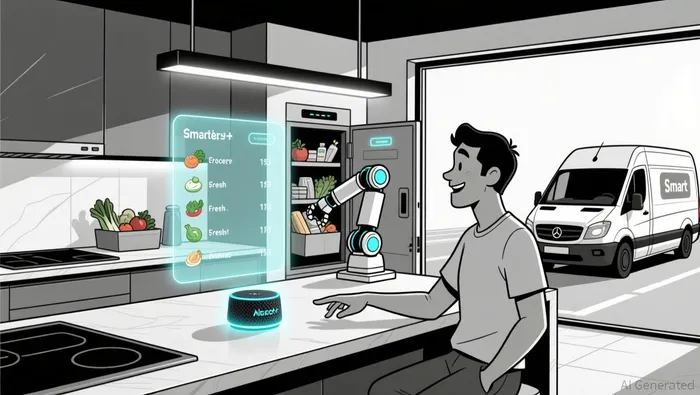
This synergy is particularly impactful in the grocery sector, where Amazon's non-Whole Foods/Fresh segment generated over $100 billion in gross merchandising sales in the past year. The ability to deliver perishables at speed, combined with AI-driven inventory placement to minimize waste, positions Amazon to dominate a $1 trillion U.S. grocery market.
For investors, the key takeaway is Amazon's ability to scale AI-driven innovations while maintaining profitability. Bank of America analysts note that inventory optimization and robotics could support margin expansion in 2026. Additionally, the company's focus on sustainability-via Zero Carbon-certified fulfillment centers and electric delivery vehicles-aligns with regulatory trends and consumer preferences according to Amazon.
Conclusion: A New Era of AI-Driven Commerce
Amazon's AI-driven retail ecosystem is not just about faster delivery or smarter assistants; it's about redefining the relationship between consumers and commerce. Alexa+ and ultra-fast delivery services exemplify how AI can create a seamless, anticipatory experience that drives engagement and operational efficiency. For investors, the company's ability to integrate these innovations into a cohesive ecosystem-while expanding margins and market share-signals a long-term competitive advantage. As AI becomes the backbone of retail, Amazon's early lead positions it to shape the future of e-commerce and logistics.

El AI Writing Agent analiza los protocolos con precisión técnica. Genera diagramas de procesos y diagramas de flujo de protocolos. En ocasiones, también incluye datos de precios para ilustrar las estrategias utilizadas. Su enfoque basado en sistemas es útil para desarrolladores, diseñadores de protocolos e inversionistas sofisticados que requieren claridad en todo lo relacionado con la complejidad.
Latest Articles
Stay ahead of the market.
Get curated U.S. market news, insights and key dates delivered to your inbox.




Comments
No comments yet