
Amazon's $13.77B Trading Volume Surges 49.59% but Stock Falls 0.78% as Bond Sale and AI Partnerships Fuel Investor Uncertainty Fourth in Daily Activity
 Aime Summary
Market Snapshot
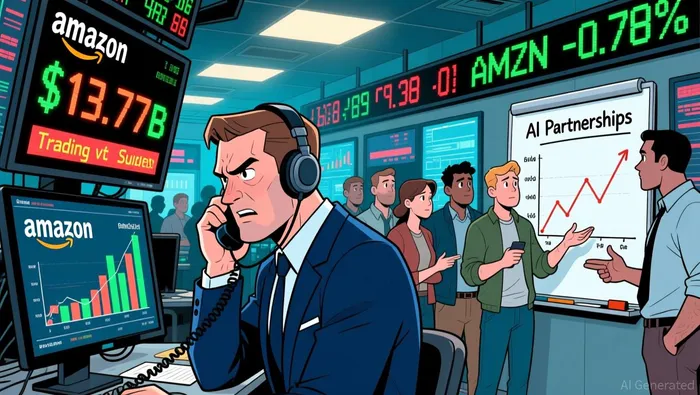
On November 17, 2025, AmazonAMZN-- (AMZN) reported a trading volume of $13.77 billion, reflecting a 49.59% surge from the previous day’s activity. Despite this significant increase in liquidity, the stock closed with a 0.78% decline, underperforming broader market benchmarks. The elevated volume positioned AMZNAMZN-- as the fourth most actively traded security of the day, underscoring heightened investor interest amid a mix of corporate developments and market dynamics. The divergence between volume and price movement suggests potential short-term uncertainty, possibly linked to strategic announcements and capital-raising initiatives detailed in recent news.
Key Drivers
The stock’s mixed performance was influenced by a confluence of strategic moves, financial maneuvers, and sector-specific developments. The most immediate catalyst was Amazon’s reported plan to raise $12 billion through a U.S. corporate bond sale, as disclosed in a Bloomberg report. While large-scale bond offerings often signal corporate confidence in expansion or debt restructuring, the timing and scale of this move could have triggered investor caution. The lack of immediate commentary from Amazon on the matter left room for speculation about its use of proceeds, with some analysts interpreting it as a sign of aggressive capital allocation in anticipation of growth opportunities or liquidity needs.
Simultaneously, Amazon’s broader ecosystem saw activity through its subsidiary Amazon Web Services (AWS), which deepened its AI partnerships. A multi-year collaboration with Box, an enterprise content management platform, expanded AWS’s integration into agentic AI capabilities, including tools like Amazon Quick Suite and Amazon Bedrock AgentCore. These developments reinforced AWS’s position as a leader in AI-driven enterprise solutions, a segment critical to Amazon’s long-term revenue growth. However, the market’s muted reaction to such a strategic partnership may reflect investor skepticism about the near-term monetization potential of AI initiatives, particularly in light of broader industry challenges in translating AI capabilities into sustainable profitability.
Another indirect factor was Amazon’s foray into the automotive retail space via a partnership with Ford. The collaboration, enabling Ford to sell certified used cars on Amazon’s platform, expanded Amazon’s reach into physical goods beyond its traditional e-commerce domain. While this move could enhance Amazon’s market share in the automotive sector, the limited financial details provided—such as revenue-sharing models or projected transaction volumes—left the initiative’s impact on Amazon’s top-line growth ambiguous. Investors may have discounted the significance of this partnership given its focus on used vehicles, a segment with lower profit margins compared to Amazon’s core businesses.
The most speculative influence came from reports of Jeff Bezos’s new AI venture, Project Prometheus, which received $6.2 billion in initial funding. Though Bezos stepped down as Amazon CEO in 2021, his continued involvement in high-profile ventures could sway perceptions about Amazon’s strategic direction. The absence of direct ties between Prometheus and Amazon’s operations means the venture’s impact on AMZN’s stock is largely indirect, though it may indirectly affect investor sentiment by highlighting Bezos’s ongoing commitment to AI—a sector in which Amazon has substantial exposure through AWS.
Collectively, these factors illustrate a stock navigating a complex landscape of growth opportunities and execution risks. While Amazon’s AI and cloud divisions remain cornerstones of its value proposition, the market’s focus on short-term financial metrics and competitive pressures in its core markets may have dampened enthusiasm for long-term strategic bets. The bond sale announcement, in particular, underscores Amazon’s balancing act between capital preservation and aggressive reinvestment, a dynamic that will likely remain central to its stock’s trajectory in the coming months.

Stay ahead of the market.
Get curated U.S. market news, insights and key dates delivered to your inbox.
AInvest
PRO
AInvest
PRO



Comments
No comments yet