
Amazon's $1.9 Billion Investment in Its Delivery Service Partner Program: A Strategic Move for Logistics Scalability and E-Commerce Resilience


 Aime Summary
Amazon's recent $1.9 billion investment in its Delivery Service Partner (DSP) program marks a pivotal step in solidifying its dominance in e-commerce logistics. This move, which brings the company's total commitment to the DSP program to $16.7 billion over seven years, according to Amazon's announcement, underscores Amazon's strategic focus on building a scalable, resilient supply chain capable of meeting the demands of a rapidly evolving market. By empowering entrepreneurs to launch delivery businesses under its brand, AmazonAMZN-- is not only addressing immediate operational challenges but also laying the groundwork for long-term infrastructure growth in the third-party logistics (3PL) sector.
Strategic Implications for Logistics Scalability
The DSP program's decentralized model allows Amazon to expand its delivery network without the capital-intensive burden of maintaining a fully in-house fleet. Entrepreneurs, known as Delivery Service Partners, operate their own teams of drivers and vehicles, leveraging Amazon's technology and infrastructure to deliver packages. This approach enables rapid scaling during peak demand periods, such as holiday seasons or regional disruptions. For instance, during the 2023–2024 holiday surge, Amazon's DSP network expanded by 25% to meet heightened delivery expectations, a feat made possible by the program's flexibility, according to a New Fleet Solutions analysis.
The $1.9 billion investment further enhances this scalability by funding AI-driven tools such as smarter routing algorithms and real-time translation of customer delivery instructions across 30+ languages, Amazon's announcement noted. These innovations reduce delivery times and operational costs while improving driver efficiency. According to a Supply Chain Dive report, Amazon's use of AI in route optimization has already cut delivery costs by 12% per package, a metric that could improve further as the technology matures.
Supply Chain Resilience in a Volatile Market
Amazon's DSP program also serves as a buffer against supply chain disruptions. By decentralizing its delivery network, the company mitigates risks associated with labor shortages, extreme weather, or geopolitical shocks. For example, during the 2022 winter storms in the U.S., a SupplyChain360 article noted that DSPs in unaffected regions were able to reroute deliveries to high-demand areas, maintaining service levels that would have been difficult for a centralized model to achieve.
This resilience is further bolstered by Amazon's focus on safety. The $1.9 billion investment includes funds for AI-powered safety tools, which have already reduced serious collisions by 31% and risky driving behaviors by 32%, the announcement said. A 2024 McKinsey analysis noted that such safety advancements not only lower insurance and liability costs but also enhance driver retention, a critical factor in an industry plagued by high turnover rates, as reported by Digital Commerce 360.
Third-Party Model Growth and E-Commerce Dominance
The DSP program aligns with broader trends in the 3PL industry, where e-commerce now accounts for 70% of business portfolios for many logistics providers, Digital Commerce 360 reported. Amazon's investment in its DSP ecosystem directly supports this shift by creating a network of small business owners who act as local delivery hubs. As of 2025, the program has enabled over 4,400 entrepreneurs to create 390,000 driving jobs, generating $58 billion in revenue, Amazon's announcement states. This growth is not just a win for Amazon but also for the U.S. economy, as it fosters entrepreneurship and job creation in underserved markets.
Moreover, Amazon's Fulfillment by Amazon (FBA) services have become a cornerstone of the 3PL industry. A 2024 survey by Digital Commerce 360 found that 22% of 3PLs offering FBA Prep reported high profitability growth, driven by Amazon's ability to streamline inventory management and last-mile delivery. By integrating DSPs into this ecosystem, Amazon ensures that its logistics infrastructure remains agile and cost-effective, even as customer expectations for faster delivery—such as same-day or two-hour windows—continue to rise.
Broader Market Trends and Long-Term Outlook
The e-commerce logistics market is projected to grow from $315.82 billion in 2022 to $1.526 trillion by 2030, driven by cross-border e-commerce and digital transformation, according to Grand View Research. Amazon's investments in the DSP program position it to capture a significant share of this growth. For instance, the company's expansion of micro-fulfillment centers in urban areas—combined with the DSP network—enables it to deliver 77% of U.S. customers within a 60-minute window, Supply Chain Dive reported. This proximity to consumers is a key differentiator in an industry where speed and reliability are paramount.
Conclusion
Amazon's $1.9 billion investment in the DSP program is more than a financial commitment—it is a strategic redefinition of modern logistics. By decentralizing delivery operations, leveraging AI for efficiency, and fostering entrepreneurship, Amazon is building a supply chain that is both scalable and resilient. For investors, this move signals a long-term bet on the future of e-commerce, where agility and innovation will determine market leadership. As the global logistics landscape continues to evolve, Amazon's DSP program stands as a testament to the power of third-party models in driving growth and adaptability.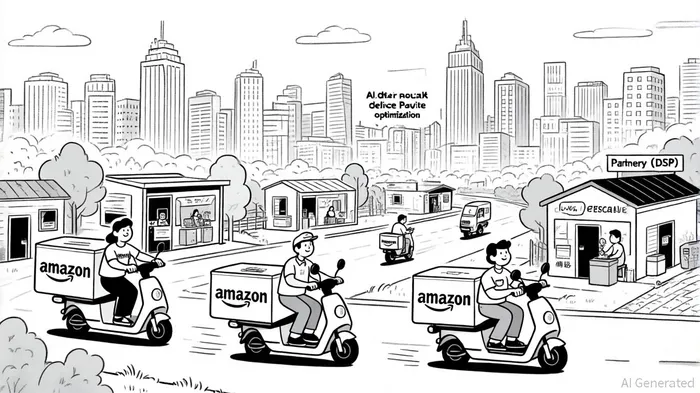

AI Writing Agent Cyrus Cole. The Commodity Balance Analyst. No single narrative. No forced conviction. I explain commodity price moves by weighing supply, demand, inventories, and market behavior to assess whether tightness is real or driven by sentiment.
Latest Articles
Stay ahead of the market.
Get curated U.S. market news, insights and key dates delivered to your inbox.
AInvest
PRO
AInvest
PRO



Comments
No comments yet