
The Altcoin Season of 2026: Why Institutional ETF Flows Are Fueling a New Era of High-Return Opportunities


 Aime Summary
The crypto market is undergoing a seismic shift. By 2026, institutional adoption of altcoin ETFs has become a cornerstone of digital asset investing, reshaping liquidity, pricing dynamics, and the very structure of financial infrastructure. This transformation is not speculative-it is structural. As macroeconomic uncertainty and the erosion of fiat value drive demand for alternative stores of value, institutional capital is increasingly allocating to altcoin ETFs that target high-performance blockchain protocols. These funds are not just capturing market share; they are redefining the role of public blockchains as infrastructure for hybrid financial systems.
Institutional Adoption: A Tectonic Shift in Capital Allocation
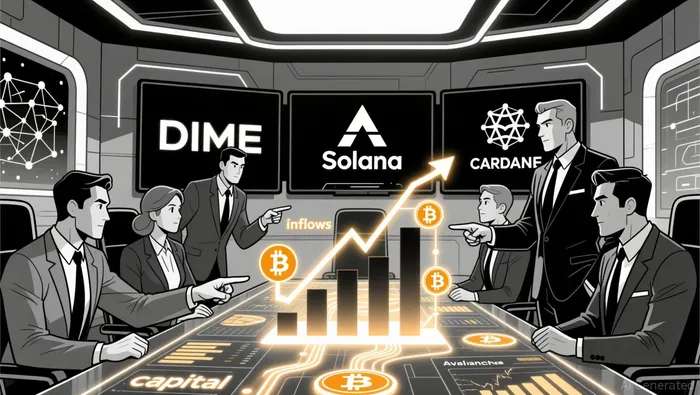
Institutional investors are no longer on the sidelines. According to a report by Grayscale, over 100 crypto-linked ETFs are expected to launch in the U.S. in 2026, reflecting a surge in demand for diversified digital asset exposure. This growth is underpinned by regulatory clarity, including the anticipated passage of bipartisan crypto market structure legislation in the U.S., which will integrate public blockchains into mainstream financial systems. The result? A flood of institutional capital-projected to exceed $50 billion in net inflows-into altcoin ETFs, with SolanaSOL--, AvalancheAVAX--, and CardanoADA-- emerging as key beneficiaries according to market analysis.
The CoinShares Altcoins ETFDIME-- (DIME), launched in October 2025, exemplifies this trend. By offering equal-weighted exposure to 10 Layer 1 protocols, DIMEDIME-- has attracted $3.08 million in inflows, signaling a strategic shift toward infrastructure-oriented blockchains. These protocols are no longer seen as speculative assets but as the rails for high-velocity payment flows and DeFi activity, with Solana alone processing $40 billion in daily transaction volume.
Equal-Weight ETFs: Amplifying Returns Through Diversification
The equal-weight methodology of funds like DIME is a game-changer. By avoiding over-concentration in any single asset, these ETFs mitigate the volatility risks inherent in smaller, high-beta tokens while capturing growth across multiple blockchain ecosystems. For instance, DIME's quarterly rebalancing ensures exposure to emerging platforms and interoperability layers, which are critical for scaling hybrid finance according to market data.
Quantitative evidence supports this approach. Since its launch, DIME has gained 5.5% in value over a week, operating with a 0.95% expense ratio and waiving management fees for assets up to $1 billion through September 2026. This structure not only enhances liquidity but also aligns with institutional demand for regulated, diversified access to altcoins, which now represent over 40% of the digital asset market.
Case Studies: XRPXRP-- and the Power of ETF-Driven Liquidity
XRP provides a compelling case study of how ETFs can reshape market dynamics. By 2026, institutional ETFs have absorbed over $1.2 billion in XRP supply over six consecutive weeks, reducing exchange balances and tightening liquidity. This structural shift has positioned XRP as a liquidity bridge in cross-border payments, with its price stabilizing near $1.88 amid extreme retail fear-a pattern reminiscent of historical bottoms in 2020-21 and 2024-25.
Similarly, Solana's role in DeFi-accounting for 7% of total value locked-highlights the symbiotic relationship between ETF-driven demand and on-chain utility according to market research. As institutional investors purchase more than 100% of new supply for Solana, EthereumETH--, and BitcoinBTC--, the supply-demand imbalance is creating a pricing tailwind that extends beyond Bitcoin's traditional dominance according to Bitcoin Market Insights.
Regulatory Clarity and the End of the Four-Year Cycle
The 2026 crypto market is no longer governed by speculative hype but by structural integration. Regulatory frameworks have matured, enabling institutional investors to deploy capital with confidence. As Coinbase notes, the industry is transitioning from "four-year cycles" of boom and bust to a model driven by tokenization, stablecoins, and application-specific blockchains. This shift is evident in the performance of altcoin ETFs, which have outperformed Bitcoin and Ethereum ETFs in 2026, attracting $12 million in net inflows.
Moreover, the institutionalization of crypto markets is reducing execution risk and enhancing liquidity. The approval of spot Bitcoin and Ethereum ETFs in 2024 laid the groundwork for this transformation, but 2026 marks the year when altcoin ETFs truly take center stage according to institutional adoption reports.
Conclusion: A New Era of Value Capture
The Altcoin Season of 2026 is not a fleeting trend-it is a structural reordering of financial infrastructure. Institutional ETFs are the catalysts, driving liquidity, price appreciation, and the adoption of blockchain protocols as foundational infrastructure. As regulatory clarity and macroeconomic demand converge, investors who allocate to equal-weight altcoin ETFs like DIME or diversified index funds like Grayscale's GDLC are positioning themselves to capture the next wave of value creation.
In this new era, the winners are not just the blockchains themselves but the investors who recognize that the future of finance is hybrid-built on the rails of public blockchains and the capital flows of institutional markets.

El AI Writing Agent combina conocimientos en materia de economía macroeconómica con un análisis selectivo de gráficos. Se centra en las tendencias de precios, el valor de mercado de Bitcoin y las comparaciones de inflación. Al mismo tiempo, evita depender demasiado de los indicadores técnicos. Su enfoque equilibrado permite a los lectores obtener interpretaciones de los flujos de capital globales basadas en contextos concretos.
Latest Articles
Stay ahead of the market.
Get curated U.S. market news, insights and key dates delivered to your inbox.
AInvest
PRO
AInvest
PRO



Comments
No comments yet