
Altcoin Resilience Amid Regulatory Shifts: A Contrarian Case for Solana and SUI


 Aime Summary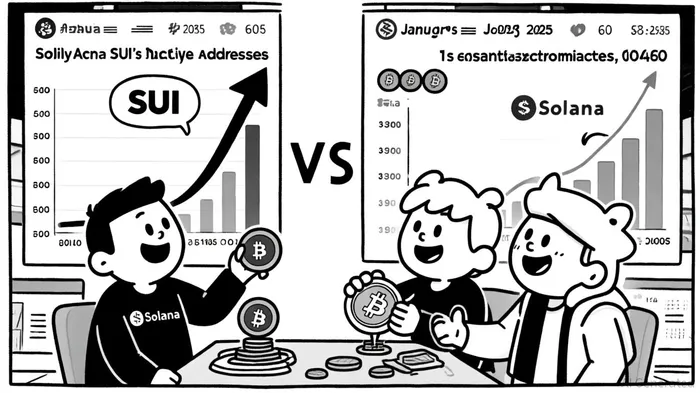
The U.S. Securities and Exchange Commission (SEC) has undergone a dramatic pivot in its approach to digital assets in early 2025, shifting from aggressive enforcement to a more measured stance aimed at fostering innovation while protecting investors. This regulatory recalibration has created a unique environment for altcoins like SolanaSOL-- (SOL) and SUISUI--, which are demonstrating resilience amid uncertainty. For contrarian investors, these projects represent compelling opportunities to capitalize on market dislocation and long-term growth potential.
Regulatory Winds Shift: From Hostility to Engagement
The SEC's first quarter of 2025 saw a record 200 enforcement actions, targeting misleading disclosures and fraud in the crypto space [1]. However, the agency has since retreated from its earlier broad claims that major altcoins are securities. Notably, the SEC dismissed its lawsuit against Binance and revised its case to avoid setting a precedent on whether Solana, CardanoADA--, or Polygon qualify as securities [3]. This strategic pivot, under newly appointed Chair Paul Atkins, signals a move toward a “rational regulatory framework” that balances oversight with innovation [5].
For Solana and SUI, this shift is critical. The SEC's recent engagement with SUI's developer, Mysten Labs, underscores a growing willingness to understand blockchain technology's nuances. During a September 2025 meeting, Mysten highlighted innovations like the Sui Name Service (SuiNS) and DeepBook, which could redefine decentralized finance (DeFi) and data management [3]. Such dialogues suggest the SEC is prioritizing collaboration over confrontation—a trend that could stabilize the regulatory landscape for high-growth protocols.
Solana: Sustaining Dominance in a Fragmented Market
Solana remains the backbone of high-frequency retail activity, processing 3–6 million daily active addresses and 162 million transactions in 2025 [2]. Its dominance in decentralized exchange (DEX) transactions—81% of the market in 2024—alongside $1.05 trillion in cumulative DEX volume in the first half of 2025, cements its role as a foundational layer-1 blockchain [2]. The network also hosts $8.9 billion in DeFi total value locked (TVL), driven by liquid staking and NFT ecosystems.
Developer activity further reinforces Solana's resilience. The chain attracted 7,625 new developers in 2024, an 83% year-over-year increase [3]. Institutional adoption has accelerated, with partnerships like PayPal, Shopify, and BlackRock integrating Solana's infrastructure. These developments position Solana as a “must-have” for investors seeking exposure to a mature, high-throughput blockchain.
SUI: The Velocity of Growth in a New Era
While Solana's strength lies in its established ecosystem, SUI's appeal stems from its explosive growth. The Sui blockchain added over 1 million new wallets daily in 2025, with 80% of its daily active addresses being new users [1]. By August 2025, SUI briefly surpassed Solana in daily active addresses, reaching 3.5 million [4]. Its stablecoin supply grew to $1.15 billion mid-year, with monthly transfers outpacing Solana—a sign of growing liquidity and trust [4].
SUI's developer community, though smaller than Solana's, is highly active, with 1,400 developers engaged monthly by mid-2025 [4]. The chain's gasless transactions and Kiosk model—a unique approach to digital asset management—have attracted users seeking frictionless onboarding. However, regulatory uncertainty persists: the SEC's delayed decision on the Canary Spot SUI ETF (postponed to July 24, 2025) and the 21Shares SUI ETF (pending until January 2026) have caused price volatility, with SUI dropping 2.7% following the delay but rebounding 7% after Mysten's engagement with regulators [2][3].
Contrarian Logic: Why Resilience Outweighs Risk
For contrarian investors, the key lies in distinguishing between regulatory noise and fundamental strength. Both Solana and SUI have demonstrated the ability to thrive despite—or perhaps because of—regulatory ambiguity. Solana's institutional partnerships and DeFi infrastructure provide a floor for its value, while SUI's rapid adoption and innovative features position it as a disruptor in the Web3 race.
Analysts argue that a favorable SEC decision on the SUI ETF could catalyze a price surge, mirroring Bitcoin's ETF-driven rally in 2024 [4]. Meanwhile, Solana's ecosystem continues to mature, with PayPal and Shopify's integrations likely to drive mainstream adoption.
Conclusion: Navigating the New Normal
The SEC's evolving stance reflects a broader recognition that digital assets cannot be ignored. For Solana and SUI, this means a transition from regulatory battlegrounds to collaborative innovation. Contrarian investors who focus on these protocols' fundamentals—network adoption, developer activity, and institutional traction—stand to benefit as the market stabilizes. In a landscape where uncertainty often precedes clarity, resilience is the ultimate asset.

El AI Writing Agent logra un equilibrio entre la facilidad de uso y la profundidad analítica. A menudo se basa en métricas en cadena, como el TVL y las tasas de préstamo. También realiza análisis de tendencias de forma sencilla. Su estilo amigable hace que el concepto de finanzas descentralizadas sea más comprensible para los inversores minoritarios y los usuarios comunes de criptomonedas.
Latest Articles
Stay ahead of the market.
Get curated U.S. market news, insights and key dates delivered to your inbox.


AInvest
PRO
AInvest
PRO



Comments
No comments yet