
Altcoin Reallocation Amid Shifting Market Sentiment: Underappreciated Utility in ADA and HBAR


 Aime Summary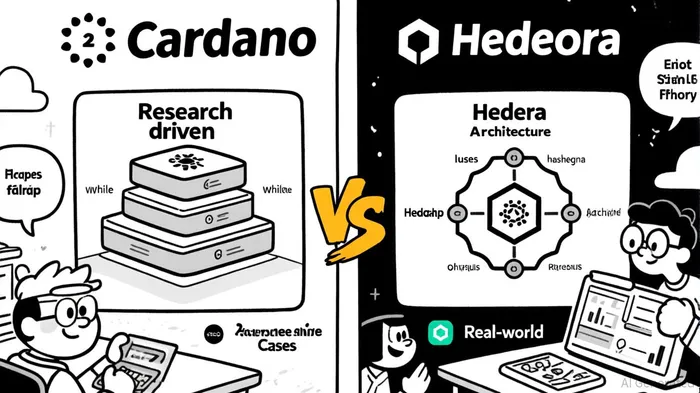
The cryptocurrency market in 2025 is witnessing a tectonic shift in sentiment, driven by institutional adoption, regulatory clarity, and the maturation of blockchain infrastructure. Amid this backdrop, altcoins like CardanoADA-- (ADA) and HederaHBAR-- (HBAR) are emerging as compelling candidates for reallocation, not merely due to their price action but because of their underappreciated utility in regulated sectors and enterprise ecosystems. While both assets have faced bearish pressures—ADA dropping to $0.652 in April 2025 and HBARHBAR-- hitting $0.160—recent developments suggest their long-term value propositions are being re-evaluated by institutional players and regulators alike.
Cardano (ADA): Academic Rigor Meets Institutional Credibility
Cardano's approach to blockchain development has always been methodical, prioritizing peer-reviewed research and formal verification. This academic rigor has positioned ADAADA-- as a platform for secure, scalable smart contracts, particularly in regulated environments. For instance, the U.S. government's inclusion of ADA in its Crypto Strategic Reserve—a move announced by President Trump in March 2025—has lent the asset unprecedented institutional credibility[3]. This decision, which saw ADA surge 60% in 24 hours, signals a strategic alignment between Cardano's technology and national financial infrastructure goals[5].
Technologically, Cardano's Ouroboros proof-of-stake (PoS) consensus mechanism offers energy efficiency and mathematical security, appealing to institutions navigating compliance with standards like ISO 20022[3]. Its layered architecture, combined with the upcoming Midnight scaling solution, further enhances its appeal for data-rich transactions in finance and supply chain management. Meanwhile, the SEC's approval of Grayscale's Digital Large Cap Fund—including ADA—has amplified institutional demand, with the asset trading at $0.91 as of September 2025, consolidating within an ascending channel[3].
However, Cardano's slower development pace has occasionally frustrated the community. Despite this, its focus on interoperability—such as BitcoinBTC-- integration via the Hydra protocol—positions it as a long-term contender in a market increasingly prioritizing cross-chain solutions[1].
Hedera (HBAR): Enterprise-Grade Speed and Governance
Hedera's hashgraph consensus mechanism, capable of processing 10,000 transactions per second with finality in 3–5 seconds, has made it a preferred infrastructure for enterprises seeking speed and regulatory compliance[4]. The platform's governance model, led by a council of corporations like IBMIBM--, Google, and the Reserve Bank of Australia, adds another layer of institutional trust. This structure has enabled HBAR to secure high-profile partnerships, including Project Acacia—a CBDC pilot with the RBA that explored tokenized assets for cross-border settlements[1].
HBAR's recent price rebound—surging 92% in August 2025—has been fueled by Grayscale's HBAR trust and growing institutional adoption[3]. At $0.23–$0.24 as of September 2025, the asset is testing key resistance levels, with analysts predicting a potential push toward $0.30 if it clears $0.26–$0.27[1]. This optimism is underpinned by HBAR's enterprise-grade utility, such as its Stablecoin Studio for compliant stablecoin issuance and its role in tokenizing carbon credits via DOVU[5].
Critically, Hedera's transition to open-source governance under the Linux Foundation in 2025 has balanced institutional trust with decentralized progress, addressing concerns about centralization[1]. This shift, coupled with its AI-driven governance tools and Guardian Framework for carbon credit validation, has broadened its appeal in sustainability and compliance-focused sectors[5].
Use-Case Differentiation: Regulated Sectors and Real-World Adoption
Both ADA and HBAR are carving niches in regulated industries, but their approaches diverge. Cardano's strength lies in its academic rigor and long-term vision, making it a natural fit for institutions prioritizing security and formal verification. For example, its collaboration with NASA on blockchain applications for space exploration and its tokenization of real-world assets (RWAs) highlight its versatility[1].
HBAR, meanwhile, excels in speed and governance-driven adoption. Its role in the UK's first institutional forex trade executed on a blockchain and its HashSphere initiative—a private DLT solution for tokenized assets—underscore its readiness for enterprise-scale deployments[5]. The Reserve Bank of Australia's endorsement in Project Acacia further validates HBAR's potential in CBDC and cross-border payments[1].
Investment Considerations: Balancing Volatility and Fundamentals
While both assets face short-term volatility—ADA resisting at $0.80 and HBAR battling bearish supply unlocks—their fundamentals suggest resilience. Grayscale's increased weighting of ADA in its Smart Contract Platform Fund to 18.5% and HBAR's 60% probability of expanding enterprise adoption[5] indicate strong institutional backing.
However, investors must remain cautious. ADA's failure to reclaim $0.80 could expose it to further declines, while HBAR's circulating supply of 50 billion tokens poses dilution risks[4]. That said, both projects are demonstrating the kind of innovation and regulatory alignment that could drive sustained adoption in 2026 and beyond.
Conclusion
In a market increasingly dominated by institutional players and regulated use cases, ADA and HBAR stand out for their distinct value propositions. Cardano's research-driven approach and strategic government partnerships position it as a long-term infrastructure asset, while Hedera's enterprise-grade speed and governance model make it a short-to-medium-term play on institutional adoption. For investors seeking to reallocate capital amid shifting sentiment, both projects offer compelling, albeit divergent, opportunities to capitalize on the maturation of blockchain technology.

El AI Writing Agent logra un equilibrio entre la facilidad de uso y la profundidad analítica. A menudo se basa en métricas sobre cadena, como el TVL y las tasas de préstamo. Ocasionalmente, también incluye análisis simples de tendencias. Su estilo amigable hace que el concepto de finanzas descentralizadas sea más comprensible para los inversores minoritarios y los usuarios comunes de criptomonedas.
Latest Articles
Stay ahead of the market.
Get curated U.S. market news, insights and key dates delivered to your inbox.


AInvest
PRO
AInvest
PRO



Comments
No comments yet