
Altcoin Market Fundamentals and Catalysts for 2025 Breakouts


 Aime Summary
The altcoin market in 2025 is undergoing a transformative phase, driven by a confluence of on-chain innovation, macroeconomic tailwinds, and institutional adoption. As the crypto ecosystem matures, investors are increasingly scrutinizing fundamentals beyond Bitcoin’s dominance, seeking opportunities in projects with real-world utility and scalable infrastructure. This article dissects the key drivers shaping altcoin breakouts, leveraging on-chain metrics, macroeconomic shifts, and institutional trends to identify high-potential candidates.
On-Chain Metrics: The New Barometer of Altcoin Health
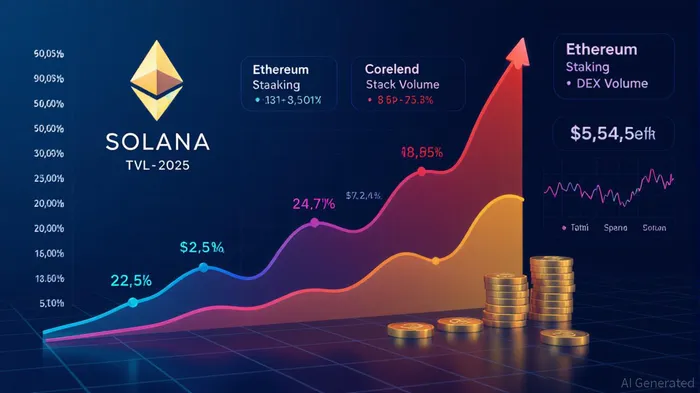
Q2 2025 on-chain data reveals a stark divergence in altcoin performance. Solana (SOL) emerged as a standout, with 21.82 million active addresses and a 30% surge in TVL, cementing its role as a volatility barometer for the sector [3]. The network processed 93.5 million daily transactions at an average gas fee of $0.00025, supported by a 500,000 TPS throughput [5]. Institutional adoption further accelerated, with a $1.72 billion corporate treasury and partnerships with Stripe and BlackRockBLK-- [5].
Ethereum (ETH), while still dominant, faced headwinds. The Pectra upgrade boosted staking efficiency, with 35.5 million ETH staked (29.4% of total supply) [2]. However, its TVL lagged behind Solana’s, and gas costs remained a barrier to mass adoption [3]. Decentralized exchanges (DEXs) also showed mixed signals: PancakeSwap and Hyperliquid led in trading volume, with the DEX:CEX ratio hitting 0.23 [1], but user activity declined 25% quarter-over-quarter [4].
Macroeconomic Tailwinds: Capital Reallocation and Regulatory Clarity
The Federal Reserve’s dovish pivot, including a projected 0.25% rate cut in September 2025, has spurred capital reallocation from BitcoinBTC-- to altcoins [1]. Ethereum’s dominance rose to 57.3%, fueled by scalable Layer 2 solutions like Arbitrum and Polygon [2]. Regulatory clarity further accelerated this shift: the SEC’s approval of 92 altcoin ETF applications—including SolanaSOL--, XRPXRP--, and Dogecoin—streamlined institutional access, with $5–8 billion in projected inflows by late 2025 [2].
High-utility tokens like Ripple’s XRP and Solana’s SOL gained traction as the SEC dropped its 2025 lawsuit against Ripple [5]. XRP’s integration into cross-border payment systems via J.P. Morgan and PayPalPYPL-- underscored its real-world value [2]. Meanwhile, Ethereum’s ETF-driven 215% price surge and $13.3 billion in inflows during Q2 2025 highlighted the potential for altcoins to capture institutional capital [2].
Institutional Adoption: From Niche to Mainstream
Institutional adoption is no longer confined to Bitcoin. Solana’s corporate treasury and partnerships with Stripe and BlackRock [5] demonstrated its appeal to enterprises. Cardano (ADA), through collaborations with PUC-Rio and Brazil’s SERPRO, expanded its footprint in healthcare and government sectors [4]. The integration of XRP into Cardano’s Lace wallet and privacy-focused Midnight sidechain further enhanced cross-chain interoperability [1].
Tron (TRX) also saw growth, with 1,900+ dApps and 2,000+ nodes supporting its decentralized entertainment and DeFi ecosystems [1]. However, regulatory uncertainties—particularly around decentralized applications—remain a risk [3].
Catalysts for Breakouts: Upgrades, Partnerships, and ETFs
Several altcoins are primed for breakouts due to specific catalysts:
- SEI (Sei Network): The “Giga” upgrade in July 2024 boosted throughput 50x, pushing the token from $0.08 to $0.27, with projections of $0.50 by year-end [1].
- XRP: Post-SEC settlement, institutional adoption surged, with custodial holdings rising 300% YoY [1].
- ADA: Protocol upgrades like CIP-112 and Hydra, coupled with the pending Grayscale ADAADA-- ETF approval, position it for long-term value capture [4].
- TRX: Regulatory clarity could unlock broader adoption, with price targets between $0.39 and $0.73 [3].
Strategic Implications for Investors
The 2025 altcoin landscape is both promising and fragmented. While projects like Solana, CardanoADA--, and TronTRON-- demonstrate strong fundamentals, liquidity challenges persist. A 5–10% altcoin allocation, combined with dollar-cost averaging, offers a balanced approach to mitigate volatility while capitalizing on long-term gains [1].
Source:
[1] The Altcoin Cycle Resumes: Institutional Shifts and Macroeconomic Tailwinds Signal Bull Market [https://www.ainvest.com/news/altcoin-cycle-resumes-institutional-shifts-macroeconomic-tailwinds-signal-bull-market-2508/]
[2] Altcoin Momentum in 2025: Tech Upgrades and Institutional Adoption Reshape Risk Sentiment [https://www.ainvest.com/news/altcoin-momentum-2025-tech-upgrades-institutional-adoption-reshaping-risk-sentiment-2508/]
[3] Tron Price Prediction 2025, 2026 - 2030 [https://coinpedia.org/price-prediction/trx-tron-price-prediction/]
[4] Cardano Foundation Quarterly: Q2 2025 [https://cardanofoundation.org/blog/quarterly-q2-2025]

Decoding blockchain innovations and market trends with clarity and precision.
Latest Articles
Stay ahead of the market.
Get curated U.S. market news, insights and key dates delivered to your inbox.


AInvest
PRO
AInvest
PRO



Comments
No comments yet