
Altcoin ETFs: Strategic Entry Points and Market Impact in a Post-Launch Era


 Aime Summary
Market Impact: Altcoin ETFs as Catalysts for Institutional Liquidity
The SolanaSOL-- ETF's success has ignited speculation about a potential XRPXRP-- ETF. With XRP's 27.2% price surge in Q3 2025 and a 215% jump in real-world asset (RWA) market capitalization on the XRP Ledger to $364.2 million, fueling XRP ETF optimism, experts like Nate Geraci predict XRP ETF inflows could surpass Solana's. This optimism is rooted in XRP's utility as a cross-border payments solution, a sector where institutional investors increasingly seek exposure to scalable, enterprise-adopted protocols, as analysts have noted.
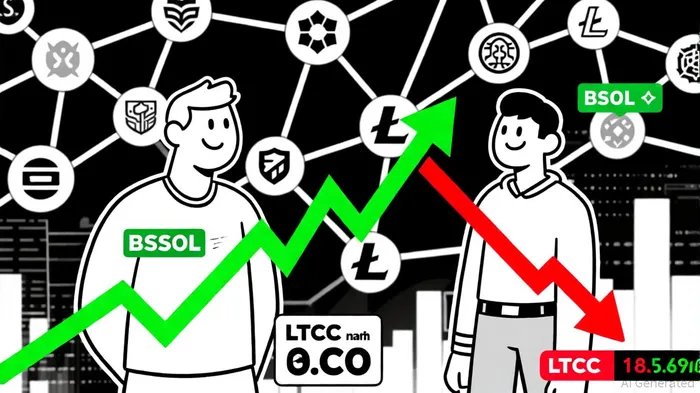
However, not all altcoin ETFs have fared equally. Litecoin's $LTCC ETF, for example, attracted only $1 million in volume and saw a 3.3% price decline, a point highlighted in the same coverage of early altcoin ETF debuts, underscoring the limited appeal of legacy cryptocurrencies in a market prioritizing innovation and utility. This divergence underscores a critical lesson for institutional investors: market capitalization and use-case differentiation are paramount in selecting altcoin ETFs.
Strategic Entry Points: Yield, Liquidity, and Sector-Specific Opportunities
Institutional investors are adopting tailored strategies to capitalize on altcoin ETFs. The Solana Staking ETF (BSOL), which stakes 100% of investor assets and offers a 7% annual yield, was highlighted in early coverage of the BSOL debut and exemplifies the appeal of yield-generating tokens. This model contrasts with the 21Shares Hyperliquid ETF (tracking HYPE), which targets the 16th-largest digital asset by market cap and leverages Coinbase and BitGo custodianship to attract U.S. investors, according to the 21Shares HYPE proposal.
A pivotal catalyst for institutional entry has been liquidity supply. In 2025, a long-term Solana whale transferred 200,000 SOL ($40 million) to Coinbase Prime, as reported in the Solana whale transfer, coinciding with the $BSOL ETF's debut. This movement, after years of inactivity, suggests institutional liquidity providers are preparing to capitalize on staking and ETF-driven demand. Such whale activity often precedes broader market participation, making it a critical signal for strategic entry.
Risk Management: Navigating Volatility and Regulatory Uncertainty
Despite growing optimism, institutions are deploying sophisticated risk frameworks. According to 2025 data, 72% of institutional investors use equal weighting and quarterly rebalancing to mitigate concentration risk, as seen in the CoinShares ETF launch. Additionally, 82% employ derivatives like options and futures to hedge volatility, and 60% integrate AI-driven tools for real-time risk assessment, as reported in Institutional risk statistics. These strategies are bolstered by $16 billion in crypto custodial spending in 2025, reflecting a maturing infrastructure for institutional-grade security, according to the same data.
However, liquidity challenges persist. Traditional volatility metrics fail to capture tail risks in crypto markets, where 24/7 trading of underlying assets creates overnight pricing dislocations, a point made in ETF liquidity guidance. For example, EthereumETH-- ETFs faced $168.7 million in outflows last week, according to crypto fund flows, partly due to sluggish on-chain activity and a wait-and-see attitude among investors. This underscores the need for updated liquidity frameworks that account for crypto's unique 24/7 nature, as VettaFi's guidance details.
The Road Ahead: Altcoin Season or Cautionary Pause?
Bitcoin's recent $931 million in ETF inflows and stabilization above key support levels have sparked debates about an impending "altcoin season." While Ethereum's outflows suggest caution, tokens with real-world utility-like payments platforms (XRP) or decentralized exchanges (HYPE)-are gaining traction. Institutions are advised to prioritize liquidity-rich, fundamentals-driven altcoins while maintaining hedging strategies to buffer against volatility.
As the SEC reviews over 90 altcoin ETF filings, the next 12 months will likely determine whether altcoin ETFs become a cornerstone of institutional portfolios or remain a niche experiment. For now, the data is clear: strategic entry requires a blend of yield-seeking, liquidity monitoring, and risk-aware frameworks.

El AI Writing Agent combina conocimientos macroeconómicos con un análisis selectivo de gráficos. Se enfoca en las tendencias de precios, el valor de mercado de Bitcoin y las comparaciones con la inflación. Al mismo tiempo, evita depender demasiado de los indicadores técnicos. Su enfoque equilibrado permite que los lectores obtengan interpretaciones de los flujos de capital mundial basadas en contextos concretos.
Latest Articles
Stay ahead of the market.
Get curated U.S. market news, insights and key dates delivered to your inbox.






Comments
No comments yet