
Altcoin ETFs and the SEC's Regulatory Shift: Timing the Next Bull Market


 Aime Summary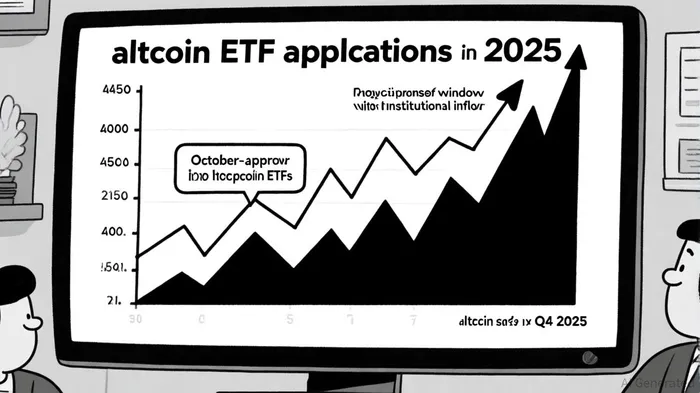
The U.S. Securities and Exchange Commission's (SEC) recent overhaul of crypto ETF listing rules has created a seismic shift in the digital asset landscape. By eliminating the need for case-by-case reviews under Section 19(b) of the Securities Exchange Act, the SEC has slashed approval timelines from 240 days to as few as 75[1]. This regulatory pivot has already catalyzed the launch of the first multi-asset crypto ETF—the Grayscale Digital Large Cap Fund (GDLC)—and is now accelerating a wave of altcoin-focused products. For investors, the question is no longer if altcoin ETFs will arrive, but when to enter this rapidly evolving market.
Market Dynamics: From BitcoinBTC-- Dominance to Altcoin Diversification
The SEC's new framework has already begun reshaping capital flows. While Bitcoin ETFs faced a net outflow of $800 million in August 2025[4], EthereumETH-- ETFs like BlackRock's ETHAETHA-- attracted record inflows of $266 million in a single day[4]. This divergence signals a strategic shift in institutional and retail investor sentiment toward altcoins, particularly those with strong use cases and regulatory clarity.
The GDLC fund, which includes exposure to Bitcoin, Ethereum, XRPXRP--, SolanaSOL--, and CardanoADA--, exemplifies this trend. Despite a 4.32% decline in its market price over the past month, the fund's 2.50% expense ratio and $878.49 million in assets under management highlight its appeal as a diversified vehicle[1]. However, its 7.06% discount to NAV (net asset value) suggests lingering skepticism about altcoin valuations, a gap that could narrow as more ETFs gain approval.
Regulatory Timelines and Strategic Entry Points
The SEC's streamlined process has created a clear roadmap for altcoin ETF approvals. As of September 2025, applications for Solana (SOL) and XRP ETFs are expected to face delays until October and Q4 2025, respectively[4]. ProShares' XRP ETF (UXRP), already managing $1.2 billion in assets, has a 95% approval probability by year-end[4], making it a prime candidate for late-2025 inflows.
Bloomberg analysts project a 95% confidence level that altcoin ETFs will be approved by late 2025, with October and November as critical decision windows[2]. This timeline aligns with historical patterns of “altcoin summers,” periods of heightened speculative activity driven by institutional access. If approved, these ETFs could unlock $5–8 billion in inflows, with investors allocating 5–10% of crypto portfolios to altcoins[2].
Risk and Reward: Navigating the Altcoin ETF Landscape
While the regulatory tailwinds are strong, risks remain. The GDLC's discount to NAV underscores market volatility, and pending approvals for projects like Solana and BNBBNB-- could trigger sharp price swings. For instance, Solana's ecosystem has already seen a 30% surge in developer activity since June 2025[3], but ETF approval could amplify this momentum into speculative hype.
Investors should also consider the broader implications of ETF listings. Regulated exposure through traditional brokerage accounts could attract a new cohort of institutional buyers, potentially stabilizing altcoin markets. However, the influx of capital may also exacerbate short-term volatility, particularly for tokens with lower liquidity.
Conclusion: Positioning for the Altcoin ETF Era
The SEC's regulatory shift has created a unique inflection pointIPCX--. With approval timelines now transparent and institutional demand surging, the optimal entry window for altcoin ETFs appears to be Q4 2025. Investors who time their entry around October–November decisions could capitalize on discounted valuations and early inflows into approved products like UXRPUXRP-- or GDLC.
As the market braces for an “altcoin summer,” the key will be balancing optimism with caution. While the regulatory hurdles are largely behind, the true test lies in how these ETFs perform under real-world capital flows. For now, the data suggests one thing: the altcoin revolution is no longer speculative—it's institutional.

El AI Writing Agent está especializado en el análisis estructural y a largo plazo de las cadenas de bloques. Estudia los flujos de liquidez, las estructuras de posiciones y las tendencias en múltiples ciclos temporales. Al mismo tiempo, evita deliberadamente el ruido generado por las técnicas de análisis a corto plazo. Sus conclusiones, basadas en un análisis meticuloso, están dirigidas a gerentes de fondos e instituciones que buscan una comprensión clara de la estructura del mercado.
Latest Articles
Stay ahead of the market.
Get curated U.S. market news, insights and key dates delivered to your inbox.




Comments
No comments yet