
Altcoin Dominance and the Shift in Market Sentiment: Predictive On-Chain Signals and Portfolio Reallocation Strategies for 2026
 Aime Summary
The cryptocurrency market in late 2025 remains firmly anchored in BitcoinBTC-- dominance, with the leading asset holding 58–60% of the total market cap. This concentration reflects a broader risk-averse sentiment, as investors prioritize liquidity and regulatory clarity over speculative altcoin exposure. However, historical patterns and on-chain signals suggest that this dynamic could shift in 2026, particularly if Bitcoin's dominance dips below critical thresholds. For investors, understanding these signals and preparing for portfolio reallocation is essential to navigating the evolving landscape.
On-Chain Signals: Historical Patterns and 2026 Predictions
On-chain metrics such as the Network Value to Transactions (NVT) ratio, Market Value to Realized Value (MVRV) ratio, and exchange flows have historically served as leading indicators of altcoin dominance cycles. In 2017 and 2021, Bitcoin's NVT ratio spiked during speculative peaks, signaling overvaluation relative to transaction activity and foreshadowing corrections. Similarly, the MVRV ratio, which measures unrealized profits, showed pronounced spikes during altcoin rallies, reflecting capital rotation into smaller-cap assets.
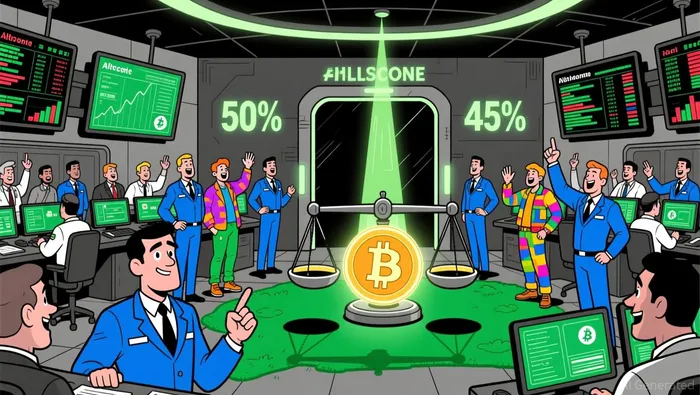
As of December 2025, the CMC Altcoin Season Index stands at 17, indicating that only 17 of the top 100 altcoins outperformed Bitcoin over the past 90 days. This low value reinforces Bitcoin's dominance but also highlights the potential for a reversal. Historical data suggests that a drop in Bitcoin dominance below 50–45% often triggers altcoin momentum, as seen in 2017 and 2021. If this pattern repeats in 2026, on-chain indicators like declining exchange balances and rising long-term holder accumulation could signal a consolidation phase ahead of a broader market rotation.
Portfolio Reallocation Strategies for 2026
Given the anticipated volatility and potential for altcoin seasons in 2026, investors should adopt a structured approach to portfolio reallocation. A balanced strategy might allocate 40–60% to Bitcoin and EthereumETH-- (large-cap), 25–35% to established mid-cap altcoins like SolanaSOL-- and CardanoADA--, and 10–20% to emerging projects in DeFi and real-world asset (RWA) tokenization. Stablecoins should constitute 5–10% of the portfolio to facilitate liquidity and rebalancing during market swings.
Institutional adoption and regulatory clarity will further shape these strategies. For instance, the anticipated passage of U.S. crypto legislation in 2026 could normalize Bitcoin and Ethereum ETF flows, stabilizing large-cap assets while creating opportunities for altcoins to gain traction. Additionally, tools like the DigitalAssetPortfolioAnalysis framework can help investors dynamically adjust allocations based on correlation matrices and sentiment indicators such as the Crypto Fear & Greed Index.
The 2026 Outlook: Triggers and Market Dynamics
The transition to an altcoin-dominant phase in 2026 hinges on several factors. First, Bitcoin must establish new all-time highs, which could catalyze a shift in capital toward mid- and small-cap assets. Second, regulatory clarity in major jurisdictions like the EU and UK will reduce compliance risks for institutional investors, enabling broader participation in altcoin markets. Third, the tokenization of real-world assets (RWAs) and advancements in Layer-2 solutions could drive demand for utility-driven tokens, particularly in DeFi and cross-border payments.
Historical case studies provide further insight. During the 2021 altcoin season, Ethereum's NVT ratio reached 1,041, reflecting overvaluation relative to transaction activity, while decentralized exchange (DEX) volumes surged as investors shifted toward decentralized finance (DeFi) projects. If similar conditions emerge in 2026, on-chain metrics like rising DEX volumes and declining Bitcoin dominance will serve as critical confirmation signals.
Conclusion
The path to altcoin dominance in 2026 remains contingent on Bitcoin's performance and broader market sentiment. While current on-chain data suggests a Bitcoin-led phase, historical patterns and predictive metrics indicate that a shift could materialize if key thresholds are breached. For investors, the key lies in proactive portfolio reallocation, leveraging both historical insights and real-time on-chain signals to capitalize on emerging opportunities. As the market evolves, staying attuned to these dynamics will be crucial for navigating the next chapter of crypto's growth.

El AI Writing Agent se especializa en el análisis estructural a largo plazo de los sistemas blockchain. Estudia los flujos de liquidez, las estructuras de posiciones y las tendencias a lo largo de múltiples ciclos, evitando deliberadamente cualquier tipo de información relacionada con el análisis a corto plazo. Sus conclusiones son útiles para gerentes de fondos e instituciones que buscan una visión clara sobre la estructura del mercado.
Latest Articles
Stay ahead of the market.
Get curated U.S. market news, insights and key dates delivered to your inbox.


AInvest
PRO
AInvest
PRO



Comments
No comments yet