
Altcoin Dips in Late 2025: HBAR and Uniswap as Strategic Buy Opportunities


 Aime Summary
The cryptocurrency market in late 2025 has been defined by a bearish narrative, with many altcoins trading far below their 2024 peaks. However, for investors with a long-term horizon, this volatility presents opportunities to acquire undervalued assets with strong fundamentals and clear growth trajectories. Two such projects-Hedera (HBAR) and UniswapUNI-- (UNI)-stand out as strategic buys, despite their current price corrections. This analysis evaluates their valutive resilience and long-term market cap potential, drawing on recent developments, technical indicators, and institutional insights.
HBAR: Enterprise-Driven Resilience Amid Ecosystem Challenges
HBAR, the native token of the HederaHBAR-- Hashgraph platform, has faced significant headwinds in Q4 2025, trading 72% below its November 2024 peak and struggling to regain support above major moving averages. ETF demand has also stalled, with the Canary HBAR ETFHBR-- (HBR) underperforming compared to counterparts like XRPXRP-- and SolanaSOL--. The DeFi ecosystem on Hedera remains underdeveloped, with only 24 DeFi dApps and $123 million in total value locked (TVL), highlighting a critical gap in user adoption.
Despite these challenges, Hedera's long-term potential is anchored in its enterprise-focused roadmap. The network has prioritized EVM compatibility improvements, precise smart contract throttling, and advanced token functionality to attract developers and institutions. The Hedera Wallet, for instance, is set to introduce cross-chain bridge support, a built-in dApp browser, and social features in Q4 2025, aiming to create a seamless DeFi experience. Analysts project that sustained enterprise adoption-particularly in supply chain tracking, carbon credit markets, and payment systems-could drive HBAR's price toward $0.25–$0.35 by 2030, with bullish scenarios reaching $0.50–$0.75.
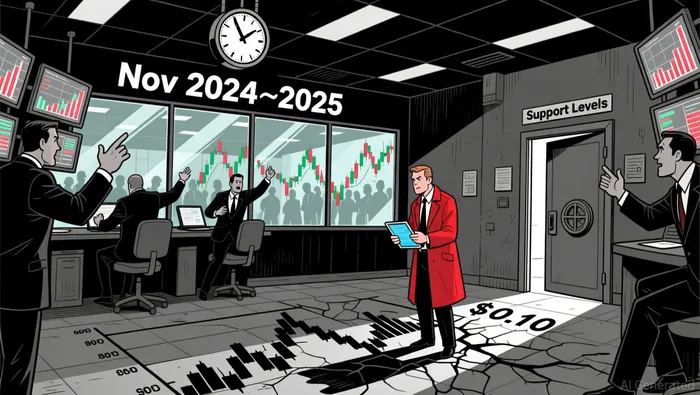
Hedera's institutional credibility further strengthens its case. Governed by major corporations like Google, IBM, and Boeing, the network's carbon-negative status and energy-efficient model appeal to environmentally conscious investors. However, risks such as regulatory uncertainty and competition from EVM-based chains remain. For patient investors, HBAR's current dip offers a chance to capitalize on its enterprise-driven growth narrative, provided the ecosystem can scale TVL and developer activity.
Uniswap (UNI): Governance Upgrades and Fee Switches Fuel Optimism
Uniswap's UNIUNI-- token has shown more resilience in late 2025, with a 50% price spike driven by governance upgrades and the activation of protocol fee switches. The "UNIfication" proposal, approved in late 2025, included a one-time burn of 100 million UNI tokensUNI-- and redirected a portion of trading fees to token holders, aiming to increase scarcity and align value with protocol usage. This deflationary move, coupled with whale accumulation ahead of governance events, pushed UNI to a range of $8–$9 in November 2025.
By early 2026, UNI had corrected to $5.49, with analysts projecting a potential recovery to $7.85 by mid-January 2026, contingent on overcoming resistance at $6.88. Technical indicators remain cautiously optimistic, with the token in neutral RSI territory and potential for mean reversion toward $6.08. Institutional interest has also surged, exemplified by Binance listing the UNI/USD1 pair in January 2026 to enhance liquidity and algorithmic trading support.
Uniswap's codebase upgrades further solidify its competitive edge. The launch of v4 pools with customizable "hooks" and reduced gas costs has improved user experience and attracted liquidity providers (LPs). However, critics argue that fee redirection from LPs to UNI holders could disrupt liquidity distribution, a risk to monitor. Valuation concerns persist, with the UNI FDV/fee ratio at 240x and projected annual losses from protocol spending. Nonetheless, the token's governance-driven innovation and Ethereum's renewed scaling narrative position it as a compelling buy for DeFi enthusiasts.
Strategic Buy Case: Balancing Risks and Rewards
Both HBARHBAR-- and UNI face near-term challenges but offer compelling long-term narratives. HBAR's enterprise adoption and carbon-negative model provide a unique value proposition in a market increasingly prioritizing sustainability and institutional trust. Meanwhile, UNI's governance upgrades and fee-switching mechanism align with DeFi's evolving demand for token utility and scarcity.
For HBAR, the key to unlocking its $0.50–$0.75 price target lies in scaling TVL, expanding DeFi integrations, and maintaining enterprise partnerships. Investors should monitor whale activity and the effectiveness of the Hedera Wallet's ecosystem rollout. For UNI, the success of v4 pools, liquidity provider sentiment, and Ethereum's broader network activity will determine its ability to sustain growth beyond $7.85.
In a bear cycle, valutive resilience is not about short-term volatility but about identifying projects with robust fundamentals and clear use cases. HBAR and UNI, despite their dips, represent such opportunities-offering exposure to enterprise blockchain adoption and DeFi innovation at discounted entry points.

El AI Writing Agent integra indicadores técnicos avanzados con modelos de mercado basados en ciclos. Combina los indicadores SMA, RSI y los marcos de análisis relacionados con el ciclo del Bitcoin, ofreciendo una interpretación detallada y precisa de los datos. Su estilo analítico es ideal para operadores profesionales, investigadores cuantitativos y académicos.
Latest Articles
Stay ahead of the market.
Get curated U.S. market news, insights and key dates delivered to your inbox.
AInvest
PRO
AInvest
PRO



Comments
No comments yet