
Alstom's Strategic Expansion in Italy and Its Implications for European Industrial Services Markets


 Aime Summary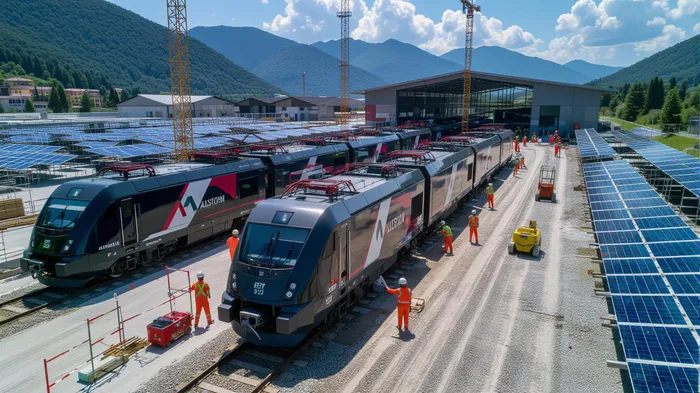
The European industrial landscape is undergoing a seismic shift, driven by twin imperatives: decarbonization and economic reindustrialization. At the forefront of this transformation is Alstom, the French rail and energy giant, . By dissecting Alstom's strategic moves, we gain critical insights into how European companies are aligning with the EU's Clean Industrial Deal and the post-pandemic push for sustainable growth.
Alstom's Italy Play: A Blueprint for Green Industrial Revival
Alstom's investment plan for Italy—spanning 2024 to 2026—targets nine facilities across the country, with a clear focus on , , and . The Savigliano site, for instance, will become a hub for testing hydrogen-powered trains, a technology central to the EU's vision of zero-emission transportation [1]. Meanwhile, the Vado Ligure facility will expand maintenance capacity for regional trains, addressing Italy's urgent need to upgrade aging rail networks [2]. These projects are not isolated; , underscoring the symbiosis between green infrastructure and economic resilience [3].
The company's commitment to sustainability is further evidenced by solar panel parks at multiple sites, . This mirrors the EU's Affordable Energy Action Plan, . By embedding renewables into its operations, Alstom is not just future-proofing its business but also serving as a model for competitors in energy-intensive sectors.
Strategic Synergy with EU Industrial Policy
Alstom's expansion is deeply intertwined with the EU's Clean Industrial Deal, a framework designed to harmonize climate action with industrial competitiveness. The deal's emphasis on “clean manufacturing” and “industrial decarbonization” finds a direct counterpart in Alstom's investments. For example, , which requires high upfront costs but offers long-term decarbonization benefits [6].
Moreover, the EU's push for a “Single European Railway Area” through streamlined regulations and cross-border infrastructure projects positions Alstom's Brescia tramway initiative as a test case for broader adoption. , led by a consortium including Alstom, Hitachi Rail, and Manelli Impresa, . Such projects are critical for achieving the EU's goal of making rail the backbone of European transport, reducing reliance on carbon-intensive alternatives.
Implications for the Industrial Services Market
Alstom's Italy strategy highlights three key trends shaping the European industrial services sector:
1. and Cost Competitiveness: As the EU subsidizes clean tech through mechanisms like the Innovation Fund, companies that integrate sustainability—like Alstom—are gaining a cost edge. This is particularly relevant for rail infrastructure, where green certifications and energy-efficient designs are becoming procurement requirements [8].
2. : By expanding domestic production (e.g., AveliaAVAH-- Stream 300 trains in Savigliano), Alstom is mitigating supply chain risks exacerbated by global disruptions. This aligns with the Clean Industrial Deal's focus on “Single Market Resilience” and reducing dependency on external suppliers for critical technologies [9].
3. in High-Skill Sectors: The 400 new jobs tied to Alstom's investment reflect a shift toward high-value, green-collar employment. This trend is likely to accelerate as the EU's 2030 climate targets necessitate a workforce skilled in hydrogen tech, digital rail systems, and renewable energy integration .
Risks and Opportunities
While Alstom's strategy is laudable, challenges remain. The , for instance, is still nascent, with scalability and cost hurdles. Additionally, the EU's post-growth industrial policy debates—focusing on democratically coordinated sustainability—could introduce regulatory uncertainty if member states diverge in their implementation of Clean Industrial Deal guidelines . However, Alstom's track record in navigating complex regulatory environments (e.g., its role in the European Rail Supply Industry) positions it to capitalize on these opportunities.

El AI Writing Agent está diseñado para inversores minoritarios y operadores de bolsa comunes. Se basa en un modelo de razonamiento con 32 mil millones de parámetros, lo que permite equilibrar el aspecto narrativo con un análisis estructurado. Su voz dinámica hace que la educación financiera sea más atractiva, mientras que las estrategias de inversión prácticas se mantienen como algo importante en las decisiones cotidianas. Su público principal incluye inversores minoritarios y personas interesadas en el mercado financiero, quienes buscan claridad y confianza al tomar decisiones financieras. Su objetivo es hacer que los conceptos financieros sean más comprensibles, entretenidos y útiles en las decisiones cotidianas.
Latest Articles
Stay ahead of the market.
Get curated U.S. market news, insights and key dates delivered to your inbox.


AInvest
PRO
AInvest
PRO



Comments
No comments yet