
Alphabet's AI Chip Advancements: How Gemini and Custom Silicon Reshape the Semiconductor Landscape


 Aime Summary
Alphabet's AI Chip Advancements: A Dual-Pronged Strategy
Alphabet's approach to AI hardware hinges on two pillars: custom silicon design and end-to-end AI model optimization. The company's Ironwood TPUs, introduced in late 2025, deliver , outpacing the previous generation by fourfold. This leap in raw compute power is complemented by the Gemini 3.0 Pro and Deep Think models, which have reportedly outperformed competitors like GPT-4 and Llama 3 in benchmark tests. By co-designing hardware and software, Alphabet ensures that its TPUs are optimized for Gemini's architecture, enabling superior efficiency in large-language model (LLM) training and inference.
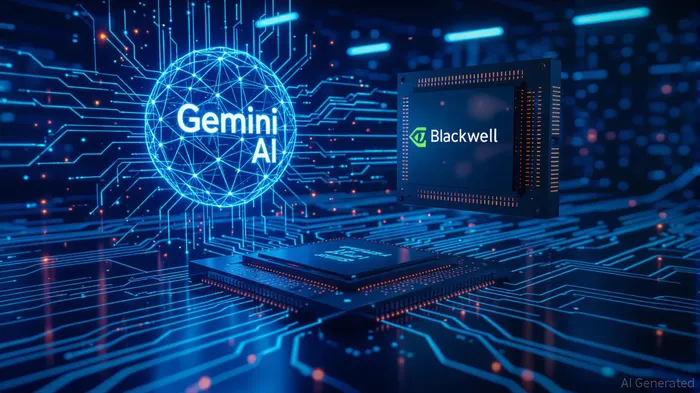 The strategic implications are profound. Unlike Nvidia's general-purpose GPUs, which prioritize flexibility across diverse workloads, Alphabet's TPUs are tailored for hyperscale AI deployment. This specialization allows Google Cloud to offer cost-optimized solutions for enterprises, particularly in high-volume inference and training scenarios. For instance, Anthropic has committed to deploying up to one million TPUs for its Claude models, citing a 2× improvement in price-performance metrics compared to GPU-based alternatives.
Technical Showdown: Ironwood vs. Blackwell
Nvidia's response to Alphabet's challenge has been the Blackwell platform, . While the H200 excels in single-device throughput-achieving -Alphabet's Ironwood TPUs shine in cluster-level scalability. Google's optical circuit switching (OCS) technology enables with shared memory pools, delivering multi-terabyte coherence for large-context workloads. This architecture is particularly advantageous for enterprises requiring distributed training or real-time inference on massive datasets.
Power efficiency further differentiates the two. Ironwood's liquid-cooled design achieves over its predecessors, . For hyperscalers like Alphabet, this translates to lower operational costs and a stronger value proposition in an era of rising energy prices.
Strategic Partnerships and Market Validation
Alphabet's ecosystem expansion is accelerating. Meta Platforms is reportedly in advanced talks to adopt TPUs in its data centers by 2027, signaling a potential shift in the hyperscaler market. Meanwhile, Google Cloud has secured long-term agreements with AI labs such as Safe Superintelligence and OpenAI, with nine of the ten leading AI research institutions now leveraging its infrastructure. These partnerships validate Alphabet's ability to compete with Nvidia's entrenched software ecosystem, which has historically been a barrier to entry for alternative architectures.
The company's Project Suncatcher, a solar-powered satellite initiative using TPUs, underscores its ambition to redefine AI deployment beyond traditional data centers. Such innovations position Alphabet to capture niche markets where energy constraints or latency requirements limit GPU adoption.
Market Sentiment and Investment Implications
Despite Alphabet's progress, the AI sector faces headwinds. Investor caution over inflated valuations has led to a sector-wide sell-off, with AI infrastructure stocks like AMD and C3.ai declining sharply. However, Alphabet's vertically integrated model offers a unique advantage: unit economics that scale with demand. By controlling both hardware and software, Google Cloud can pass cost savings to customers, a critical differentiator in a market where enterprises are increasingly price-sensitive.
For investors, the key question is whether Alphabet can replicate its internal success in the external market. While Nvidia's CUDA ecosystem remains unmatched in flexibility and developer adoption (https://medium.com/@aayushbhatnagar_10462/nvidia-blackwell-vs-google-tpu-trillium-the-battle-for-ai-compute-in-2025-23de5ea41a80), Alphabet's focus on hyperscale efficiency and strategic partnerships suggests a viable long-term challenge. The recent allocation of (https://www.reuters.com/business/ai-turned-google-cloud-also-ran-into-alphabets-growth-driver-2025-10-31/) demonstrates Alphabet's capacity to scale, but broader enterprise adoption will depend on software compatibility and developer support.
Conclusion
Alphabet's AI chip strategy represents a paradigm shift in the semiconductor industry. By combining cutting-edge silicon design, specialized AI models, and strategic ecosystem partnerships, the company is not only challenging Nvidia's dominance but also redefining the economics of AI compute. While the road to widespread adoption is fraught with challenges-particularly in software integration and developer inertia-Alphabet's focus on efficiency and scalability positions it as a formidable contender. For investors, the coming years will test whether this vertical integration can translate into sustainable market share gains in a sector still dominated by the "Nvidia effect."

Delivering real-time insights and analysis on emerging financial trends and market movements.
Latest Articles
Stay ahead of the market.
Get curated U.S. market news, insights and key dates delivered to your inbox.
AInvest
PRO
AInvest
PRO



Comments
No comments yet