
Alphabet's AI Breakthrough and Its Impact on the AI Hardware Ecosystem


 Aime Summary
Alphabet's Strategic Edge: Vertical Integration and AI Supremacy
Alphabet's vertical integration of AI hardware, software, and cloud infrastructure has emerged as a critical differentiator. The company's custom-designed TPUs, optimized for AI workloads, enable cost efficiencies and scalability that challenge traditional GPU-centric solutions. Recent reports indicate that Meta Platforms is in advanced talks to adopt Alphabet's TPUs in its data centers, potentially starting in 2027. This shift could capture up to 10% of NVIDIA's annual revenue, signaling a broader transition in AI computing preferences.
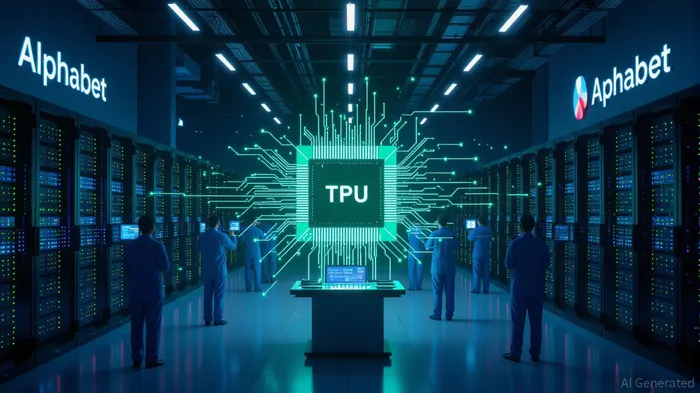 The launch of Gemini 3, a state-of-the-art AI model trained on TPUs, further underscores Alphabet's technological prowess. Analysts at Morningstar note that Gemini 3's benchmark performance has fueled investor optimism, positioning Alphabet as a "leading contender in the AI arms race." This momentum is reflected in Alphabet's stock price, which surged 3.9% in late 2025, pushing its market capitalization to $3.9 trillion-narrowing the gap with NVIDIA's $4.2 trillion valuation.
Competitive Pressures on NVIDIA and AMD
NVIDIA and AMD, long dominant in the AI chip market, face mounting challenges. NVIDIA's stock price fell 5.1% in November 2025 amid concerns over Alphabet's TPU adoption by Meta. The company's CEO, Jensen Huang, has defended its position by emphasizing the superiority of its CUDA software ecosystem and GPU flexibility for complex AI tasks. However, Alphabet's cost-effective TPUs, coupled with its cloud infrastructure, are gaining traction as a viable alternative, particularly for hyperscalers seeking to reduce dependency on third-party hardware.
AMD's Q4 2025 financial results highlight a mixed outlook. While the company exceeded revenue expectations ($9.6 billion forecast) and saw a 31.3% year-over-year stock gain, its shares fell sharply following Meta's TPU discussions with Alphabet. This volatility reflects investor anxiety over Alphabet's ability to disrupt the AI chip market. Analysts warn that AMD's growth trajectory could face headwinds if TPUs become a mainstream solution for large-scale AI deployments.
Financial and Market Implications
Alphabet's Q3 2025 financials underscore its AI-driven growth. Consolidated revenues reached $102.3 billion, with Google Cloud reporting a 34% year-over-year increase to $15.2 billion, driven by AI infrastructure and generative AI solutions. The segment's $155 billion backlog further signals robust demand for Alphabet's AI services.
For investors, Alphabet's ability to monetize TPUs beyond internal use is a key differentiator. The company's recent deal to supply up to one million TPUs to Anthropic PBC and its focus on developer accessibility highlight its long-term strategy to capture a larger share of the AI value chain. This vertical integration model contrasts with NVIDIA's and AMD's reliance on external sales, potentially giving Alphabet an edge in pricing and supply chain control.
Expert Forecasts and Investment Strategies
Looking ahead, 2026-2027 projections suggest a "winner-take-all" narrative in the AI chip market. Mizuho analyst Jordan Klein cautions that the sector remains fluid, with rapid shifts in momentum likely as companies invest heavily in compute infrastructure. Bank of America's Vivek Arya, however, maintains a cautiously optimistic outlook for NVIDIA and AMD, citing their strong market fundamentals and long-term growth potential.
Investors should also consider broader risks. As AI companies, including Alphabet, ramp up capital expenditures for data centers, there are concerns about reduced corporate buybacks-a historical driver of equity demand. Alphabet's disciplined approach to AI investment, however, has been praised for aligning spending with measurable monetization, a critical factor for sustaining investor confidence.
Conclusion: Balancing Opportunities and Risks
Alphabet's AI breakthroughs represent a paradigm shift in the hardware ecosystem, with profound implications for investors. While NVIDIA and AMD retain significant advantages, Alphabet's vertical integration and Gemini 3's performance position it as a formidable competitor. For tech equity bets, a diversified approach that balances exposure to Alphabet's AI ecosystem with NVIDIA's and AMD's resilience is prudent.
As the AI arms race intensifies, monitoring Alphabet's TPU adoption rates, Gemini model iterations, and cloud infrastructure expansion will be critical. Investors must also weigh the sector's capital intensity against its growth potential, ensuring strategies align with evolving market dynamics. In this high-stakes environment, agility and a deep understanding of technological and financial trends will define successful outcomes.

Delivering real-time insights and analysis on emerging financial trends and market movements.
Latest Articles
Stay ahead of the market.
Get curated U.S. market news, insights and key dates delivered to your inbox.




Comments
No comments yet