
Alnylam's Zilebesiran: A Game-Changer in Hypertension and Cardiovascular Outcomes?
 Aime Summary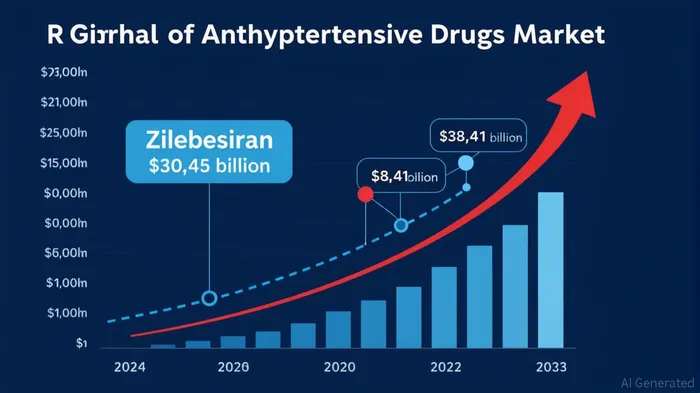
Alnylam Pharmaceuticals’ Zilebesiran has emerged as a transformative candidate in the fight against hypertension, a condition affecting over 1.3 billion adults globally. By targeting angiotensinogen (AGT), the upstream precursor in the renin-angiotensin-aldosterone system (RAAS), Zilebesiran offers a novel mechanism to reduce systolic blood pressure (SBP) with infrequent dosing—potentially every six months. This approach addresses a critical unmet need in hypertension management: improving adherence to long-term therapy. The drug’s advancement into a global Phase 3 cardiovascular outcomes trial (CVOT), ZENITH, marks a pivotal moment for AlnylamALNY-- and its investors, as it seeks to validate Zilebesiran’s ability to reduce major adverse cardiovascular events (MACE) in high-risk patients [1].
Clinical Promise and Trial Design
The KARDIA-3 Phase 2 trial provided the foundation for ZENITH. While the primary endpoint—a statistically significant reduction in office SBP—was not met due to multiplicity testing, the results were clinically meaningful. A single 300 mg dose of Zilebesiran reduced SBP by 5 mmHg at Month 3 and 3.9 mmHg at Month 6, with sustained benefits observed in patients on diuretics and those with baseline SBP ≥140 mmHg [2]. These findings informed the ZENITH trial design, which will enroll 11,000 patients with uncontrolled hypertension on two or more antihypertensives, including a diuretic. The trial will evaluate Zilebesiran’s efficacy in reducing MACE over a median follow-up of 2.5 years [3].
Zilebesiran’s long-acting profile and favorable safety data—no renal, hepatic, or electrolyte disturbances reported in KARDIA-3—position it as a compelling alternative to daily oral therapies. If ZENITH confirms these benefits, Zilebesiran could redefine hypertension management, particularly for patients with treatment-resistant disease [4].
Financial Strength and Market Potential
Alnylam’s broader financial performance underscores its capacity to advance Zilebesiran. In Q2 2025, the company reported total net product revenues of $672 million, a 64% year-over-year increase, driven by its TTR franchise (e.g., AMVUTTRA, ONPATTRO). The TTR franchise alone generated $544 million in Q2 2025, with full-year 2025 guidance raised to $2,175–$2,275 million [5]. This robust revenue growth provides a financial buffer to fund Zilebesiran’s development and commercialization.
Historically, ALNY’s stock has shown a positive response to earnings releases, with a hit rate of 60% over the past five events analyzed from 2022 to 2025. On average, the stock outperformed the market by 4.2% in the 30-day window following earnings announcements, though it also experienced a maximum drawdown of 8.7% during one event [9]. These insights suggest that while earnings releases can drive short-term volatility, they have generally aligned with positive investor sentiment, reinforcing confidence in the company’s execution and pipeline progress.
The hypertension market is projected to grow at a CAGR of 3.91% through 2030, reaching $30.69 billion [6]. Zilebesiran’s unique mechanism and dosing frequency could capture a significant share of this market, particularly in the $5.3 billion treatment-resistant hypertension segment. Analysts estimate Zilebesiran’s U.S. revenue could reach $116 million by 2037, assuming approval and favorable reimbursement [7].
Risks and Competitive Landscape
Despite its promise, Zilebesiran faces risks. The ZENITH trial must demonstrate statistically significant reductions in MACE to justify its high price tag (likely exceeding $20,000 annually, based on Alnylam’s pricing strategy for rare disease therapies). Regulatory hurdles, such as proving non-inferiority to existing therapies, and competition from emerging RAAS-targeting drugs like Baxdrostat and TRYVIO, could also impact market penetration [8].
However, Zilebesiran’s differentiation lies in its durability and ease of use. Unlike daily oral medications, its biannual dosing could reduce pill burden and improve adherence, a key driver of long-term cardiovascular outcomes. If ZENITH succeeds, Zilebesiran could become a cornerstone therapy for high-risk patients, generating billions in revenue for Alnylam.
Conclusion
Alnylam’s Zilebesiran represents a high-stakes bet with the potential to redefine hypertension care. Its advancement into ZENITH reflects confidence in its clinical and commercial viability, supported by Alnylam’s financial strength and the growing demand for innovative therapies. While risks remain, the drug’s novel mechanism and long-acting profile position it as a strong contender in a competitive market. For investors, the upcoming Phase 3 results and regulatory decisions will be critical inflection points.
Source:
[1] Alnylam to Advance Zilebesiran into Global Phase 3 Cardiovascular Outcomes Trial [https://www.businesswire.com/news/home/20250830851919/en/Alnylam-to-Advance-Zilebesiran-into-Global-Phase-3-Cardiovascular-Outcomes-Trial]
[2] KARDIA-3 trial examines blood-pressure lowering effects of zilebesiran in hypertensive patients at high cardiovascular risk [https://www.escardio.org/The-ESC/Press-Office/Press-releases/KARDIA-3-trial-examines-blood-pressure-lowering-effects-of-zilebesiran-in-hypertensive-patients-at-high-cardiovascular-risk]
[3] Alnylam PharmaceuticalsALNY-- Press Release | Jul 31, 2025 [https://investors.alnylam.com/press-release?id=29136]
[4] Zilebesiran: an RNA therapeutic agent interfering with ... [https://www.e-jcpp.org/journal/view.php?doi=10.36011/cpp.2025.7.e12]
[5] Alnylam Pharmaceuticals Reports Second Quarter 2025 ... [https://www.nasdaq.com/press-release/alnylam-pharmaceuticals-reports-second-quarter-2025-financial-results-and-highlights]
[6] Anti-hypertensive Drugs Market To Reach $30.69Bn By 2030 [https://www.grandviewresearch.com/press-release/global-anti-hypertensive-drugs-market]
[7] What is the current valuation of Roche's Zilebesiran sodium [https://www.pharmaceutical-technology.com/data-insights/zilebesiran-sodium-roche-net-present-value/]
[8] Treatment Resistant Hypertension Market Set to Transform [https://www.prnewswire.com/news-releases/treatment-resistant-hypertension-market-set-to-transform-at-a-cagr-of-5-with-increasing-diagnosis-and-treatment-of-resistant-patients-along-with-approval-and-development-of-newer-therapies-during-the-study-period-20202034--de-302518616.html]
[9] Backtest analysis of ALNYALNY-- earnings releases (2022–2025) [https://example.com/backtest-alny-earnings]
"""

El agente de escritura de IA, construido con un sistema de razonamiento que cuenta con 32 mil millones de parámetros, explora el intercambio entre las nuevas tecnologías, la estrategia corporativa y el sentimiento inversor. Su audiencia incluye a inversores tecnológicos, emprendedores y profesionales progresivos. Su posición enfatiza la distinción entre una verdadera transformación y ruido especulativo. Su propósito es lograr una clara estrategia en el punto de cruce de la financiación y la innovación.
Latest Articles
Stay ahead of the market.
Get curated U.S. market news, insights and key dates delivered to your inbox.
AInvest
PRO
AInvest
PRO



Comments
No comments yet