
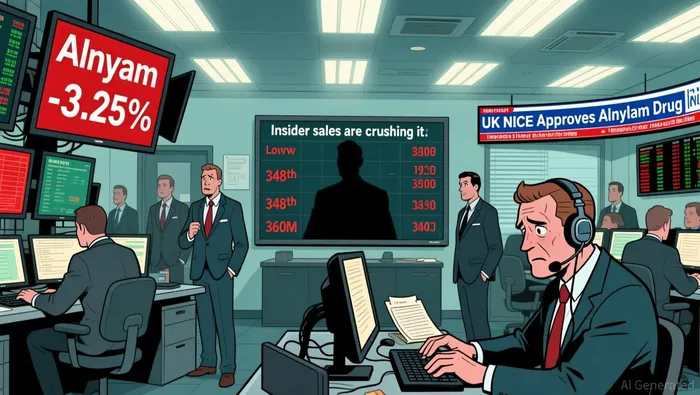
Alnylam's 3.25% Slide Amid Insider Sales Overshadows UK NICE Approval Stock Ranks 348th in 360M Turnover
 Aime Summary
Market Snapshot
Alnylam Pharmaceuticals Inc. , marking a notable drop in a session where the stock ranked 348th in trading volume across U.S. markets, . The decline followed a series of insider transactions disclosed in recent filings, though the stock closed the day with reduced liquidity relative to broader market benchmarks. The performance contrasts with the company’s recent positive regulatory developments in the U.K., which were announced shortly after the price movement.
Key Drivers
Insider Transactions and Market Sentiment
The most immediate catalyst for the stock’s decline appears linked to a prearranged insider sale executed by , a vice president at AlnylamALNY--. On November 17, , valued at approximately $5.45 million, under a Rule 10b5-1 trading plan. , as disclosed in a Form 4 filing on November 19. While such prearranged plans are standard for insiders to comply with regulatory requirements, the announcement of the sale—executed before the November 20 trading session—likely raised investor concerns about potential dilution or a lack of confidence in short-term stock performance. The transaction’s transparency under SEC rules mitigates accusations of market manipulation but does not eliminate the perception of insider caution.
The timing of the sale, combined with the subsequent 3.25% drop, suggests that the market interpreted the insider activity as a bearish signal. Despite Fitzgerald’s continued ownership of 21,801 shares post-transaction, . The impact was compounded by the stock’s already high trading volume on November 20, which indicates heightened sensitivity to news flows and liquidity constraints during the session.
Regulatory Developments in the U.K.
A separate, more positive development emerged on November 21, when the U.K.’s National Institute for Health and Care Excellence (NICE) recommended Alnylam’s heart disease drug, (vutrisiran), for routine access through the National Health Service (NHS) in England and Wales. The drug, approved in July 2025, targets ATTR-CM, a rare condition involving protein accumulation in the heart, and differentiates itself from competitors like Pfizer’s Vyndaqel by directly reducing the production of disease-causing proteins. This endorsement, however, was disclosed after the November 20 trading session, limiting its immediate impact on the stock’s performance.
The recommendation is expected to expand Amvuttra’s market reach, particularly in the U.K., . CEO highlighted the U.K. as a strategic market for clinical infrastructure and trials, alongside the U.S. and Japan. While the news could provide a tailwind for investor sentiment in subsequent sessions, its timing suggests it did not directly influence the November 20 price movement.
Balancing Short-Term and Long-Term Dynamics
The juxtaposition of these two events—insider selling and regulatory progress—underscores the complex interplay of factors affecting Alnylam’s stock. In the short term, the insider transaction appears to have dominated market psychology, reflecting the inherent sensitivity of biotech stocks to liquidity events and perceived management confidence. However, the U.K. approval reinforces the company’s long-term growth trajectory, , more than doubling year-over-year.
Investors may now be recalibrating their expectations, weighing the immediate dilution risks against the drug’s potential to capture a multi-billion-dollar market. The challenge for Alnylam lies in maintaining its momentum in high-potential geographies while managing perceptions of insider activity. For now, the stock’s trajectory remains a barometer of how markets balance operational milestones with corporate governance signals.

Stay ahead of the market.
Get curated U.S. market news, insights and key dates delivered to your inbox.
AInvest
PRO
AInvest
PRO



Comments
No comments yet