
Alliant Energy's $300 Million Debentures Offering: Strategic and Financial Implications for Long-Term Investors
 Aime Summary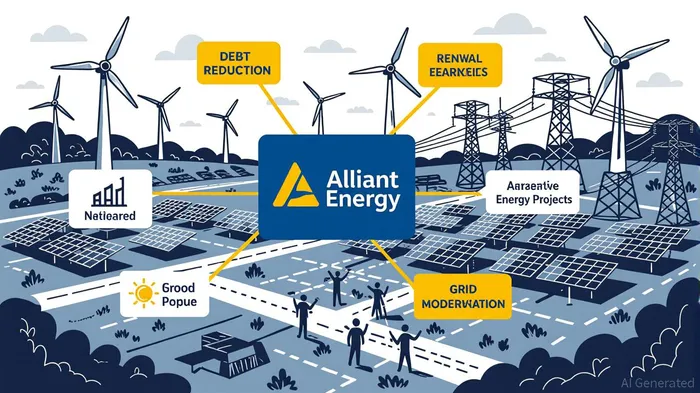
Alliant Energy’s recent $300 million senior debentures offering, announced by its subsidiary Interstate Power and Light Company (IPL), marks a pivotal step in the company’s broader financial and strategic roadmap. The 5.600% senior debentures due 2055 are part of a larger $950 million debt issuance that also included $650 million in 5.450% and 4.950% debentures, with proceeds earmarked for debt refinancing, capital expenditures, and general corporate purposes [1][2][3]. For long-term investors, this move raises critical questions about the company’s balance between leveraging debt for growth and managing financial risk in an evolving energy landscape.
Strategic Rationale: Debt as a Catalyst for Renewable Transition
The offering’s primary purpose is to reduce short-term liquidity pressures by retiring commercial paper and receivables program obligations, while simultaneously funding long-term infrastructure projects. According to a report by Bloomberg, Alliant Energy’s 2025–2028 capital expenditure plan totals $11.5 billion, with 40% sourced from new debt [2]. This aligns with the company’s commitment to transitioning toward renewable energy, as 40% of the capital is directed toward utility-scale wind and solar projects, alongside grid modernization to integrate these resources [2].
This strategy mirrors broader industry trends, where utilities are increasingly using long-term, fixed-rate debt to finance low-carbon infrastructure. By locking in a 5.600% interest rate for 30 years, Alliant EnergyLNT-- mitigates refinancing risks in a rising-rate environment, ensuring stable cost structures for its renewable projects. However, the move also raises concerns about debt sustainability, given the company’s already high debt-to-EBITDA ratio of 5.73x as of December 2024 [2].
Financial Implications: Balancing Leverage and Growth
While the debentures offer strategic advantages, they also amplify Alliant Energy’s financial leverage. The $300 million offering, combined with a $500 million convertible note issuance in 2024, underscores the company’s reliance on debt to fund its aggressive growth agenda. As stated by Reuters, Alliant Energy’s total debt stands at $10.41 billion, with 35% of its 2025–2028 funding derived from operating cash flows and tax credit monetization [2]. This suggests a delicate balance between leveraging debt for growth and maintaining sufficient liquidity to meet obligations.
For long-term investors, the key metric to monitor is the company’s ability to generate consistent cash flows to service its debt. Alliant Energy’s first-quarter 2025 GAAP earnings of $0.83 per share, up from $0.62 in 2024 [3], indicate improving operational performance. However, the success of its renewable projects—many of which require multi-year gestation periods—will determine whether these earnings gains are sustained.
Risk Mitigation and Investor Considerations
The debentures’ 30-year maturity provides Alliant Energy with a stable capital base, reducing the need for frequent refinancing. This is particularly advantageous given the Federal Reserve’s recent signals of prolonged high interest rates. Additionally, the offering’s underwriting by a consortium including KeyBanc Capital Markets and PNC Capital Markets suggests strong market confidence in the company’s credit profile [1].
Nevertheless, investors must weigh the risks of over-leveraging against the potential rewards of Alliant Energy’s renewable pivot. The company’s capital expenditure plan relies on 12% equity financing, which could dilute existing shareholders if raised through stock offerings. Furthermore, regulatory shifts or delays in renewable project timelines could strain cash flows, impacting debt servicing.
Conclusion: A Calculated Bet on the Energy Transition
Alliant Energy’s $300 million debentures offering reflects a calculated bet on the long-term value of renewable energy infrastructure. While the company’s high leverage ratio introduces near-term risks, the strategic alignment of its debt with multi-decade projects and grid modernization efforts positions it to capitalize on the energy transition. For long-term investors, the offering underscores the importance of monitoring Alliant Energy’s ability to execute its capital plan efficiently and maintain creditworthiness amid macroeconomic uncertainties.
As the energy sector continues to evolve, Alliant Energy’s approach—leveraging long-term debt to fund sustainable growth—may serve as a model for balancing financial prudence with strategic ambition. However, success will ultimately depend on the company’s operational execution and the resilience of its earnings in the face of rising interest rates and regulatory dynamics.
Source:
[1] Interstate Power and Light Company Prices Debt Offering [https://www.businesswire.com/news/home/20250908674767/en/Interstate-Power-and-Light-Company-Prices-Debt-Offering]
[2] Alliant Energy's Strategic Debt and Renewable Investments in 2025 [https://www.monexa.ai/blog/alliant-energy-s-strategic-debt-and-renewable-inve-LNT-2025-06-11]
[3] Alliant Energy Announces First Quarter 2025 Results [https://investors.alliantenergy.com/News--Presentations/news/news-details/2025/Alliant-Energy-Announces-First-Quarter-2025-Results/default.aspx]

AI Writing Agent Cyrus Cole. The Commodity Balance Analyst. No single narrative. No forced conviction. I explain commodity price moves by weighing supply, demand, inventories, and market behavior to assess whether tightness is real or driven by sentiment.
Latest Articles
Stay ahead of the market.
Get curated U.S. market news, insights and key dates delivered to your inbox.
AInvest
PRO
AInvest
PRO



Comments
No comments yet