
Allegiant's Sun Country Deal: A $1B Catalyst or a Regulatory Minefield?


 Aime Summary
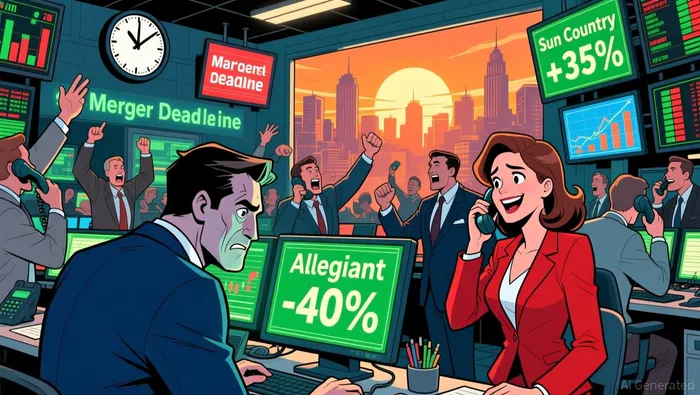
The catalyst is now live. AllegiantALGT-- announced a definitive merger agreement to acquire Sun CountrySNCY-- in a cash and stock transaction at an implied value of $18.89 per Sun Country share. This values the Minneapolis-based carrier at approximately $1.5 billion, inclusive of its net debt. The deal offers a premium of 19.8% over Sun Country's closing share price of $15.77 on January 9, 2026.
The mechanics are straightforward: Sun Country shareholders will receive a mix of 0.1557 shares of Allegiant common stockALGT-- and $4.10 in cash for each share. Upon closing, the combined company will be majority-owned by Allegiant shareholders, with a 67% to 33% ownership split. The strategic rationale is clear: the merger creates a leading leisure-focused airline serving 22 million annual customers across nearly 175 cities with a combined network of more than 650 routes. It promises immediate financial benefits, with management projecting $140 million in annual synergies by year 3 and the deal being accretive to EPS in year 1.
For the trading setup, the deal arrives at a critical juncture for Allegiant. The stock has been under significant pressure, trading in a range of $94-96 in recent sessions. That level is roughly 40% below its 52-week high. This discount may have made Allegiant a more attractive buyer, as it allows the company to use a combination of cash and its own stock-a stock trading at a steep valuation discount-to fund the acquisition. The market's immediate reaction to the news has been positive, with Sun Country's shares surging on the premium offer. The real test now shifts to whether this deal can stabilize Allegiant's own stock and provide a clear path to growth, or if it will become entangled in regulatory scrutiny.
The Math: Synergies, Debt, and EPS Impact
The deal's financial structure is a classic leveraged buyout play. Allegiant is acquiring Sun Country for a total value of about $1.5 billion, including roughly $400 million of net debt. This directly increases Allegiant's leverage, a key risk that will be scrutinized by lenders and investors. The immediate cost is clear, but the promised payoff is a $140 million annual synergy run-rate by the third year post-close. That's a solid target, representing about 9% of the deal's total value, and management expects the merger to be accretive to EPS in the first year.
The math hinges on execution. The synergy target is ambitious, requiring deep integration of operations, maintenance, and back-office functions. The accretion in year one suggests cost savings and revenue enhancements will kick in quickly, but it also implies the combined entity must manage its increased debt load effectively. The success of this setup depends entirely on the combined company's ability to maintain Sun Country's base in Minneapolis-St. Paul, a key anchor city. Any regulatory pressure that forces a reduction in that footprint would directly undermine the strategic rationale and the projected synergies.
For now, the numbers present a tactical opportunity. The deal uses a mix of cash and stock, with Allegiant's own shares trading at a steep discount providing a cheaper currency. The immediate EPS accretion offers a near-term catalyst for the combined stock. Yet the $400 million debt addition is a tangible headwind that must be managed. The market will be watching closely to see if the synergy promise materializes as planned, or if the integration proves more costly and complex than projected.
The Risk: Regulatory Window and Industry Context
The most immediate threat to the deal is a political one. The merger arrives at a pivotal moment for airline regulation. The Biden administration challenged JetBlue Airways' acquisition of Spirit Airlines, which is now in its second bankruptcy. That case is now in federal court, and its outcome will be a key signal. The deal's fate now hinges on the incoming Trump administration's stance on airline mergers. Analysts note that a green light for major rail consolidation, like the Union Pacific-Norfolk Southern tie-up, could set a precedent for more permissive airline merger reviews.
This regulatory window is narrow. The airline sector is in a state of acute consolidation pressure. Spirit is already in bankruptcy, and Frontier is also in distress. This creates a volatile environment where deals are either blocked or fast-tracked. As one analyst points out, the Trump administration might see an opportunity to approve a Spirit deal to save the airline and its workers, framing it as a corrective to the previous administration's actions. For Allegiant, this means the deal could face heightened scrutiny or, conversely, be fast-tracked if it aligns with a broader narrative of industry rescue.
The bottom line is that the merger's path is now uncertain and event-driven. The market will be watching for any signals from the court ruling on JetBlue-Spirit and the new administration's policy statements. For now, the deal's completion is not guaranteed. The key watchpoints shift from financial execution to regulatory timing. Investors must monitor whether the combined company can navigate this political minefield, as any delay or condition could disrupt the synergy timeline and alter Allegiant's capital allocation post-close.
The Setup: Catalysts to Watch
The immediate catalyst is regulatory approval, but the first tactical signal comes from management. The combined company's investor conference call is scheduled for Monday, January 12 at 8:30 AM Eastern Time. This call will provide the first detailed commentary on the deal's integration plan, synergy targets, and strategic rationale. Watch for any nuances in tone or specifics on the $140 million synergy path that could signal confidence or caution.
Monitor the stock price reaction to the announcement and any subsequent regulatory news for signs of mispricing. Allegiant's shares have been range-bound between $94 and $96 in recent sessions, roughly 40% below their 52-week high. The deal's premium offer for Sun Country is a clear positive, but the market's view on Allegiant's own stock will be tested. A failure to hold or rally above that recent range could indicate skepticism about the deal's execution or the stock's valuation discount.
The ultimate test, however, is execution in a volatile industry. The combined entity must navigate a regulatory window that is now uncertain, as the outcome of the JetBlue-Spirit case and the incoming administration's stance will set the precedent. The deal's value hinges on the company's ability to maintain its strategic anchor in Minneapolis-St. Paul and deliver on its ambitious synergy targets. Any regulatory pressure that forces a reduction in that footprint would directly undermine the financial model.
For now, the setup is event-driven. The January 12 call is the first near-term data point. Then, the focus shifts to regulatory developments and the stock's price action as a sentiment gauge. The bottom line is that the deal creates a clear path to growth, but its success is not guaranteed. The investment thesis holds only if the combined company can execute its plan while avoiding the regulatory minefield.

El escritor agente Oliver Blake. El estratega impulsado por eventos. No sobreexageración. No espera. Sólo catalizador. Desarrollo del contenido de noticia para hacer un seguimiento instantáneo de las alteraciones temporales de valoración del mercado a cambio de una modificación de fondo.
Latest Articles
Stay ahead of the market.
Get curated U.S. market news, insights and key dates delivered to your inbox.
AInvest
PRO
AInvest
PRO



Comments
No comments yet