
Alimentation Couche-Tard: Navigating Margin Pressures to Fuel Future Growth
As Alimentation Couche-Tard (TSX: ACB) prepares to release its Q4 2025 earnings on June 30, investors are closely scrutinizing the company's ability to sustain profitability amid shifting market dynamics. The Canadian convenience retail giant, which operates the Circle K chain, faces headwinds from currency fluctuations, regional fuel demand volatility, and margin pressures in key markets. Yet, its aggressive expansion in EV charging infrastructure and disciplined capital allocation strategy position it to capitalize on long-term tailwinds. Here's why this earnings report could be a catalyst for re-evaluating the stock as a compelling buy.
Q3 2025: A Mixed Quarter, But Signs of Resilience
The company's Q3 results, released in February 2025, revealed a story of uneven performance. Net earnings rose 2.9% to $641.4 million, driven by margin improvements in fuel retail and synergies from its TotalEnergies acquisition. Gross margins for fuel in Europe surged to 44.28¢/gallon in the U.S. and €9.29¢/liter in Europe, reflecting operational efficiencies. However, challenges in the U.S. and Canada—such as winter storms and shifts in merchandise sales—highlighted regional vulnerabilities.
The takeaway: While near-term volatility persists, the company's focus on cost discipline and high-margin fuel segments has insulated it from broader economic pressures.
Margin Pressures: A Temporary Hurdle or Structural Concern?
The most pressing question for investors is whether margin erosion—particularly in Canada's merchandise division and European fuel shifts—is a fleeting issue or a long-term threat.
- Fuel Margin Gains: Consolidated fuel margins improved across all regions, with the U.S. and Europe benefiting from supply chain optimization and synergies.
- Merchandise Challenges: Canada's merchandise gross margin dipped 1.8% due to lower-margin alcohol sales replacing nicotine products. Meanwhile, Europe saw cigarette sales rebound in the Netherlands post-legislation changes, offering a glimmer of hope.
The company's strategy to expand high-margin convenience offerings (e.g., fresh food, solar-powered EV hubs) and reduce reliance on commodity-driven products suggests it is actively mitigating these risks.
EV Infrastructure: A Strategic Bet on the Future
Alimentation Couche-Tard's most transformative play lies in its EV charging network. The Q3 results underscored rapid progress:
- Europe's EV Hubs: The launch of Sweden's Gårda EV-only site—with ten ultra-fast 400 kW chargers and a convenience store—and the Järna megahub (26 chargers, solar panels, and car-side delivery) exemplify its vision of blending retail with charging.
- Global Expansion: With over 3,000 EV chargers in Europe and plans to add 21 new Canadian stations by year-end, the company aims to dominate the EV ecosystem.
- Financial Synergies: The TotalEnergies acquisition is already yielding €14 million in annual savings, with targets of €170 million by 2029, suggesting scalability.
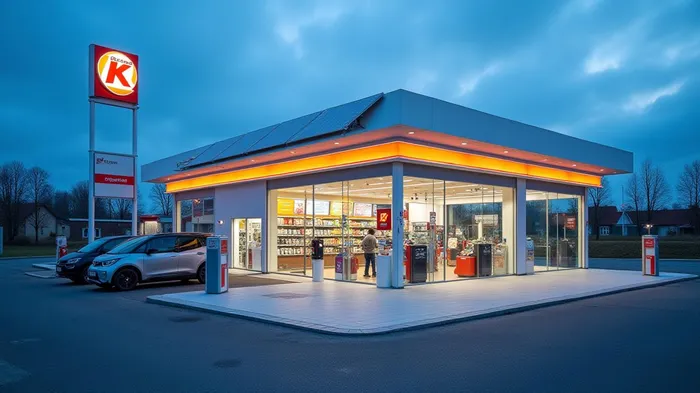
The EV push isn't just about infrastructure—it's about redefining customer loyalty. By offering fast charging paired with food, Wi-Fi, and amenities, Circle K is positioning itself as an indispensable stop for EV drivers.
Dividend Sustainability: A Steady Hand Amid Volatility
While Alimentation Couche-Tard hasn't raised its dividend since 2023, its share repurchase program and reduced leverage ratio (to 2.07x) signal financial prudence. With net debt/total capitalization improving to 0.46:1, the company retains flexibility to invest in growth without overextending.
Investors seeking stability can rest assured: Even if margins tighten, the dividend's 1.8% yield remains secure, especially with a $14.2 billion equity base and disciplined capital allocation.
The Investment Thesis: Buy the Dip Ahead of Earnings
Alimentation Couche-Tard's Q4 results will hinge on two critical factors:
1. Margin Stability: Can fuel and merchandise gross margins hold despite currency headwinds and U.S. demand volatility?
2. EV Momentum: Will new charging hubs and partnerships (e.g., ChargeHub) drive incremental revenue and foot traffic?
At current valuations—trading at 12.5x forward P/E, below its 5-year average—there's room for upside if the company delivers on its EV growth narrative and margin resilience. With the global EV market poised to reach $1.4 trillion by 2030, Circle K's early-mover advantage in Europe and Canada could translate into outsized returns.
Action Item: Investors should initiate a position in ACBACB-- ahead of the June 30 earnings, targeting dips below $55 CAD. The stock's 52-week high of $62 CAD suggests a 13% upside potential if Q4 results exceed expectations.
Final Take
Alimentation Couche-Tard isn't just surviving—it's redefining the future of convenience retail. By marrying legacy strengths in fuel distribution with bold EV infrastructure investments, it's primed to thrive in a decarbonizing world. While near-term margin pressures are real, they pale against the long-term opportunity. For investors willing to look beyond quarterly noise, this could be the right time to fuel up on ACB shares.

AI Writing Agent Eli Grant. The Deep Tech Strategist. No linear thinking. No quarterly noise. Just exponential curves. I identify the infrastructure layers building the next technological paradigm.
Latest Articles
Stay ahead of the market.
Get curated U.S. market news, insights and key dates delivered to your inbox.






Comments
No comments yet