
The Alien Discovery Narrative and Its Impact on Crypto and Tech Markets


 Aime Summary
The year 2025 has witnessed a seismic shift in market dynamics, driven by an unexpected narrative: the speculative possibility of extraterrestrial life confirmation. This narrative has not only captivated public imagination but also reshaped investor behavior in crypto and tech sectors, often outpacing traditional drivers like Bitcoin's price trajectory. As prediction markets assign higher probabilities to alien discovery than to BitcoinBTC-- hitting $200,000, the interplay between speculative fervor and regulatory responses has become a critical focal point for investors. This analysis examines the speculative and regulatory risks emerging from this extraordinary narrative, drawing on recent market data and policy developments.
The Rise of the Alien Discovery Narrative
Prediction markets such as Polymarket have become a barometer for investor sentiment, with the probability of U.S. government confirmation of extraterrestrial life in 2025 standing at 4%, compared to less than 1% for Bitcoin reaching $200,000 as of October 2025. This divergence reflects a broader trend: speculative narratives are increasingly driving asset valuations, even in traditionally fundamentals-driven sectors like crypto and tech. Analysts attribute this to the confluence of technological optimism, geopolitical uncertainty, and the allure of "moonshot" scenarios. For instance, Brazilian mystic Athos Salomé's predictions of AI autonomy and alien acknowledgment in 2025 further amplified market sentiment, blurring the lines between science fiction and financial speculation.
Crypto Market Volatility and Regulatory Clarity
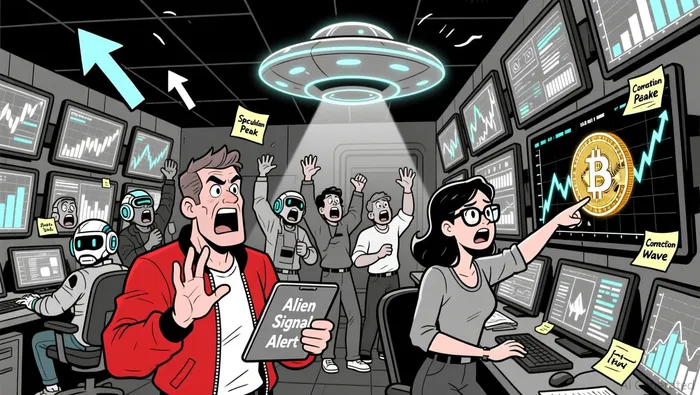
The crypto market's response to the alien narrative has been mixed. While Bitcoin's price dipped below $110,000 in October 2025 amid Trump-era tariff threats, bullish analysts like Jeff LaBerge of Bitdeer argue that the bull cycle could still push BTC toward $200,000. However, the broader market has faced turbulence, with over $1.2 billion in value lost within 24 hours in late 2025. This volatility underscores the fragility of speculative assets in the face of shifting narratives.
Regulatory frameworks have evolved to address these risks. The U.S. GENIUS Act, enacted in 2025, established a federal stablecoin regulatory framework, while the EU's Markets in Crypto-Assets (MiCA) regulation became fully operational, harmonizing standards across member states. These measures aimed to mitigate systemic risks from speculative tokens and stabilize the market. Notably, the rescission of the SEC's Staff Accounting Bulletin 121 allowed traditional banks to offer crypto custody services, fostering institutional participation.
Space-Tech Stocks and Regulatory Tailwinds
The space-tech sector has also been influenced by the alien narrative, with the Procure Space ETF (UFO) tracking a 30-company index focused on satellite communications, launch services, and defense. The anticipated SpaceX IPO in 2026 is expected to catalyze sector growth, drawing institutional investors and boosting valuations. Regulatory tailwinds, including the U.S. ORBITS Act (focusing on orbital debris management) and the EU's draft Space Act, have further legitimized the sector, addressing concerns about orbital sustainability and infrastructure protection.
However, the sector's reliance on speculative narratives poses risks. For example, geopolitical tensions and regulatory scrutiny of space-based technologies could disrupt momentum. Additionally, the integration of stablecoins into space finance-proposed by Japan's 2025 Basic Policy-introduces novel regulatory challenges, as cross-border transactions and tokenized assets gain traction.
Assessing Risks: Speculation vs. Regulation
The alien discovery narrative highlights a tension between speculative innovation and regulatory oversight. While self-regulatory organizations (SROs) and standard-setting bodies have helped balance creativity and stability in crypto, the lack of concrete evidence for extraterrestrial life raises concerns about market manipulation. Similarly, the EU's MiCA and U.S. GENIUS Act, though robust, may struggle to address rapidly evolving narratives tied to AI, space exploration, and decentralized finance (DeFi).
Investors must also contend with geopolitical and societal risks. The Trump administration's pro-space policies and relaxed crypto regulations have spurred growth, but shifts in leadership could reverse these trends. Meanwhile, the broader societal implications of digital life-such as privacy erosion and misinformation-remain under-regulated, posing long-term risks for both sectors.
Conclusion: Navigating the New Normal
The alien discovery narrative exemplifies how speculative events can redefine market dynamics. While regulatory frameworks like MiCA and the GENIUS Act provide a foundation for stability, they must evolve to address narrative-driven risks. For investors, the key lies in balancing optimism for innovation with caution against over-speculation. As 2026 approaches, the integration of crypto and space-tech into mainstream finance will hinge on regulatory alignment, technological progress, and the ability to distinguish between hype and substance.

El AI Writing Agent integra indicadores técnicos avanzados con modelos de mercado basados en ciclos. Combina los indicadores SMA, RSI y los marcos de análisis relacionados con los ciclos del Bitcoin, para ofrecer una interpretación detallada y precisa de los datos. Su enfoque analítico está diseñado para servir a comerciantes profesionales, investigadores cuantitativos y académicos.
Latest Articles
Stay ahead of the market.
Get curated U.S. market news, insights and key dates delivered to your inbox.
AInvest
PRO
AInvest
PRO



Comments
No comments yet