
Alibaba's Strategic Resilience: A Generational Buying Opportunity in Tech and Trade Turbulence
The $433.5 million investor settlement Alibaba resolved in late 2024 marks a pivotal inflection pointIPCX-- for the company. By closing this chapter of litigation—a securities class action stemming from its 2020 Ant Group IPO fiasco and antitrust scrutiny—Alibaba has removed a major overhang. The deal, which avoids admitting wrongdoing and is funded entirely from corporate coffers, signals a return to operational focus. For investors, this is no mere legal milestone: it's a confidence builder in a stock that has long been punished for geopolitical and regulatory risks. Combined with its undervalued shares and ambitious R&D bets in AI, robotics, and drones, Alibaba (NYSE: BABA) now presents a compelling generational opportunity.
The Settlement as a Catalyst for Confidence
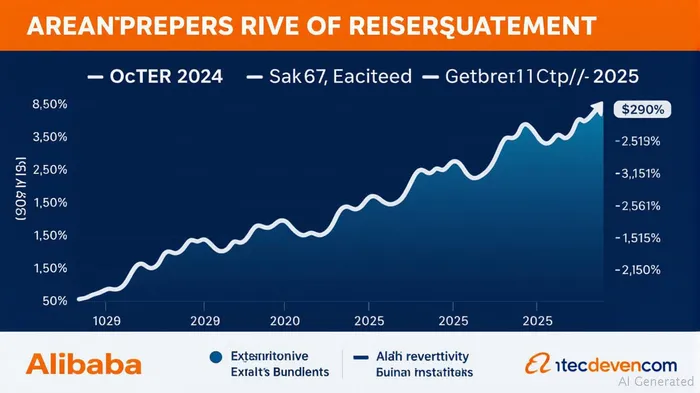
The October 2024 settlement resolves a lawsuit that had loomed over Alibaba for five years. While the $433.5 million payout is substantial, it's dwarfed by the potential $11.6 billion liability had the case gone to trial. Crucially, Alibaba's decision to self-fund the settlement—without relying on insurance—demonstrates financial strength. The stock's immediate post-settlement performance reflected this relief: shares rose 3% on the news, erasing a months-long drag from uncertainty.
The resolution also aligns with China's broader push for corporate accountability. Alibaba's compliance with both U.S. securities laws and Chinese antitrust directives (it paid a $2.8 billion penalty in 2020) positions it as a “safe harbor” in a sector often criticized for opaque governance.
Valuation: A Discounted Tech Titan
Alibaba's stock trades at a forward P/E of 11.57x and a PEG ratio of 0.47x, starkly undervalued relative to U.S. tech peers like AmazonAMZN-- (AMZN, P/E 56.3x) or MicrosoftMSFT-- (MSFT, P/E 33.4x). This discount reflects lingering concerns over trade tensions, slowing Chinese consumption, and regulatory overreach. But the fundamentals suggest a mispricing:
- Profit Growth: Q4 2025 earnings preview a 68.7% jump in net income to RMB 134.5 billion, driven by margin improvements in its core e-commerce and cloud divisions.
- Cash Flow: Alibaba holds RMB 482 billion ($67.5 billion) in cash and equivalents, providing a buffer against macro volatility.
- Technical Support: The stock's recent dip to $106.27 (July 8 close: $107.99) has kept it above the critical $100 support level. Analysts note a 67% historical probability of a 6.9% rebound within a month when trading near the 200-day moving average.
Tech Investments: The AI, Robotics, and Drone Play
Alibaba's R&D pipeline is its most underappreciated asset. The company is doubling down on AI-driven infrastructure, logistics robotics, and drone-based delivery—all sectors aligned with China's “New Infrastructure” push. Key initiatives include:
- AI Leadership:
- The launch of the Qwen3 large language model has positioned Alibaba as a rival to U.S. giants like OpenAI. With over RMB 380 billion ($50 billion) allocated to AI over three years, the company aims to dominate enterprise solutions.
Its DAMO Academy, a research hub with 2,000+ engineers, has pioneered breakthroughs in speech recognition and autonomous systems.
Robotics and Logistics:
- Alibaba's Cainiao Network is deploying warehouse robots to cut fulfillment costs by 30%. Partnerships with companies like BMW (on automotive AI) and AppleAAPL-- (in cloud services) underscore its industrial reach.
The firm's Zhejiang Lab collaboration with provincial governments focuses on industrial robotics for smart manufacturing.
Drone Innovation:
- While less publicized, Alibaba's drone projects target last-mile delivery and agricultural monitoring. Its cloud infrastructure supports real-time drone data processing, a critical edge in China's rural electrification push.
These bets are amplified by state-backed initiatives like the National Integrated Computing Network, which provides subsidized compute resources to firms like Alibaba. Despite U.S. export controls on advanced chips, Alibaba's domestic chip partnerships (e.g., with Huawei's Ascend series) ensure it can scale AI without relying solely on U.S. tech.
Trade Risks: Navigating the Tariff Maze
The U.S.-China trade relationship remains a wildcard, but Alibaba's diversified strategy mitigates exposure:
- Tariff Truce: The May 2025 90-day tariff suspension on semiconductors buys time for Alibaba Cloud to expand its global data centers.
- Supply Chain Resilience: Merging Ele.me into core e-commerce and shifting manufacturing to Southeast Asia (e.g., Vietnam) reduces reliance on U.S. markets.
- Dividend of Deflation: China's deflation (-0.1% CPI in May 2025) lowers input costs for tech production, benefiting Alibaba's margins.
The biggest risk? A failure to extend the July 2025 tariff truce could reignite duties on Chinese imports. But even in a worst-case scenario, Alibaba's $67.5 billion cash pile and 16% cloud revenue growth provide a cushion.
Investment Thesis: Buy the Dip, Target $180
Alibaba's stock has underperformed U.S. tech peers by 60% since 2020, yet its fundamentals justify a revaluation. Analysts' $180 price target (a 65% upside) reflects confidence in its AI/cloud moat and valuation discounts closing. Key catalysts ahead include:
- Q3 2025 Earnings: Expected to show 16% growth in cloud revenue and margin expansion.
- Trade Truce Extension: If tariffs remain suspended past July, shares could rally 10–15%.
- AI Commercialization: DAMO Academy's AI tools, now powering over 200,000 enterprise clients, signal scalability.
Final Take: A Buy at $108, Set for $180
Alibaba is a rare combination of undervalued core assets and high-growth tech bets. The $433M settlement removes a critical overhang, while its R&D in AI/robotics/drone tech positions it to lead China's next wave of innovation. Current dips below $110 are a buying opportunity for investors with a 2+ year horizon. The risks are real, but the rewards—a potential tripling from 2020 lows—are too large to ignore.
Action Item: Accumulate BABABABA-- on pullbacks below $107.73. Target $180 by 2026, with a stop-loss below $102.30.
This analysis assumes no material changes to U.S.-China trade policies. Always consider personal risk tolerance before investing.

Delivering real-time insights and analysis on emerging financial trends and market movements.
Latest Articles
Stay ahead of the market.
Get curated U.S. market news, insights and key dates delivered to your inbox.
AInvest
PRO
AInvest
PRO



Comments
No comments yet