
Alibaba Signals No AI Bubble and Prepares to Boost Capex
 Aime Summary
Alibaba reported results for its fiscal Q2 2026, corresponding to the third quarter of calendar year 2025. The market’s main focus was the cloud business, which significantly exceeded expectations.
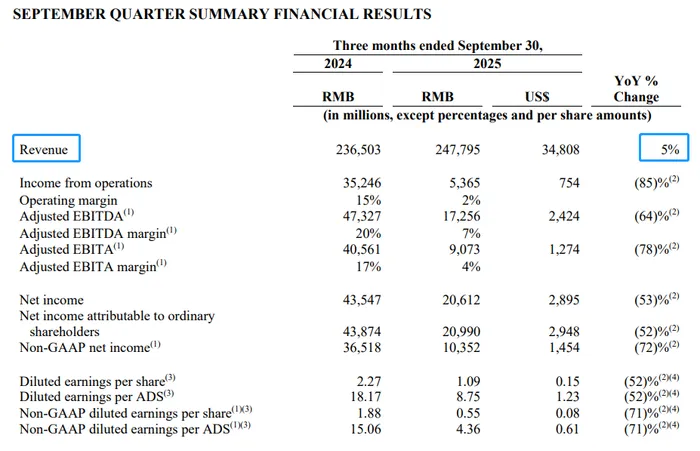
Alibaba posted Q2 revenue of RMB 247.8 billion, up 5% year over year and above the expected RMB 245.2 billion. Adjusted earnings per share came in at RMB 4.36, far below the forecasted RMB 6.34. Given the ongoing food-delivery subsidy battles, the market had already anticipated a sharp decline in profitability.
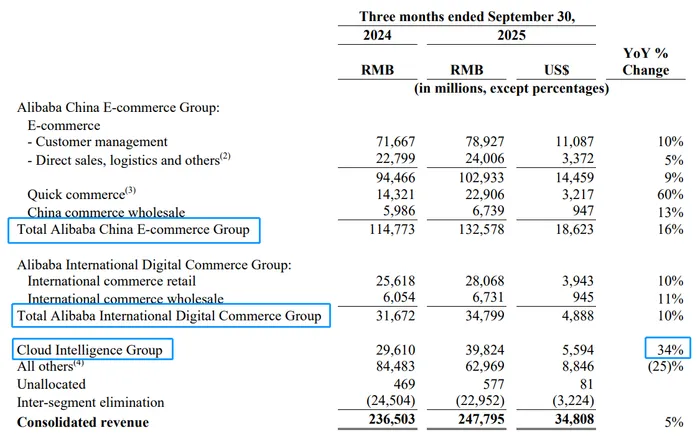
By segment, AlibabaBABA-- Cloud Intelligence Group led all business units with 34% revenue growth year over year, including a 29% increase from external customers—mainly driven by AI demand.
The Cloud Intelligence Group’s adjusted EBITA grew 35% year over year, showing that cloud services maintained healthy profitability alongside rapid expansion.

Alibaba’s China e-commerce operations—which consolidate Taotian Group, Ele.me, and Fliggy—remain the company’s core foundation. Supported by “Taobao Flash Sale,” the instant retail business saw revenue surge 60% year over year. Core customer-management revenue (mainly advertising and commissions from Taobao and Tmall) grew 10%, indicating that Alibaba’s domestic e-commerce fundamentals remain solid.
Alibaba International Digital Commerce Group (AIDC), focused on global expansion, generated RMB 162 million in profit this quarter, compared with a loss of RMB 2.91 billion a year earlier—a successful turnaround mainly driven by significant operational improvements at AliExpress.
On November 24, Alibaba Cloud and Singapore’s national AI program (AISG) jointly announced a major development: Singapore’s latest national-level large language model, Sea-Lion v4, will abandon the previous U.S.-based technology route and instead be built entirely on Alibaba’s open-source Qwen3-32B model.
_243e72861764083441838.jpg?format=webp&width=700)
Alibaba Earnings Call Highlights: No AI Bubble for Three Years, Capex Likely to Increase
CEO Wu Yongming stated on the earnings call that the deployment pace of Alibaba Cloud’s AI servers is far behind the growth of customer orders, and backlogs continue to expand. He emphasized that AI demand is highly predictable for at least the next three years, meaning there is no AI bubble in sight. (Editor’s note: Chinese tech giants traditionally give more conservative AI guidance than U.S. companies; Alibaba now explicitly saying “no bubble” further reduces bubble concerns.)
The previously mentioned RMB 380 billion capex plan now appears conservative, and additional capital expenditure is possible.
In China’s hybrid-cloud market, Alibaba Cloud grew more than 20% year over year, outpacing the industry average and steadily expanding market share. Recently, companies such as the NBA, Marriott China, UnionPay, and Bosch have begun AI collaborations with Alibaba Cloud.
The Qwen app surpassed 10 million downloads within its first week. It will gradually integrate e-commerce, maps and navigation, and local services, becoming an AI entry point for daily life.
China E-commerce Updates
During the earlier food-delivery price war, the Flash Sale business improved its order structure with a higher proportion of high-ticket orders; non-beverage orders now represent more than 75%. This pushed total GMV steadily upward, and Flash Sale losses have already been cut in half compared with July and August.
Flash Sale also boosted sales in health and food-related categories, showing clear synergy following integration efforts. Thanks to Cainiao logistics and scale effects, unit logistics costs declined.
Taobao Flash Sale is still in the investment phase, but Q3 marked the peak level of spending. Investment will shrink significantly in Q4, which may moderate future growth but supports healthier long-term expansion.
When asked which sectors within instant retail still offer strong investment potential, management said both Amap and Fliggy are engaged in strategic layouts. The priority is integration and synergy to improve market share. Amap’s newly launched “Street Ranking” feature has significantly boosted user engagement. In October, Amap’s Street Ranking averaged more than 70 million daily active users, with daily comment volume more than tripling from a year earlier, indicating strong growth potential.

Expert analysis on U.S. markets and macro trends, delivering clear perspectives behind major market moves.
Latest Articles
Stay ahead of the market.
Get curated U.S. market news, insights and key dates delivered to your inbox.




Comments
No comments yet