
Alibaba's Price Target Cuts: A Binary Trade Setup
 Aime Summary
The analyst moves this week are a classic binary signal. Two major banks are cutting targets on AlibabaBABA--, but for opposite reasons. This creates a clear tactical setup: the trade is between the perceived weakness in its core business and the potential upside from its growth engines.
On one side, Morgan Stanley cut its price target to $180 from $200, warning that core e-comm businesses have started to worsen, due to weak consumption trends in China. The bank sees this pressure continuing through the first half of fiscal 2027. On the other side, Jefferies cut its target to $225 from $231 but maintained a Buy rating, calling Alibaba its top pick for 2026 based on AI and cloud opportunities. 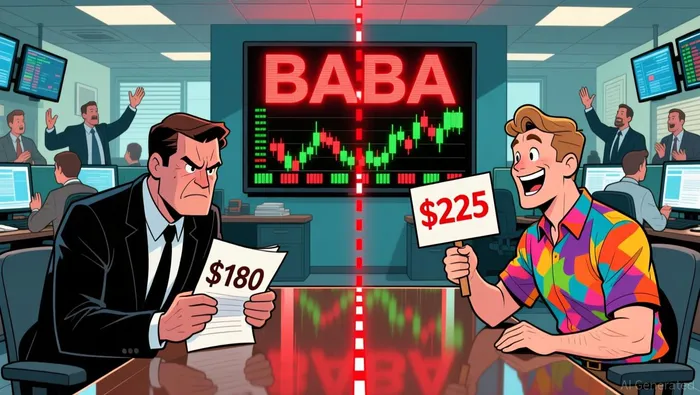 The stock's reaction frames the tension. It fell 2.5% in premarket trading Friday, retreating after a 78% rally over the past year. This pullback shows the market is weighing the new warnings against the long-term promise.
The key for a tactical investor is to assess which catalyst is more immediate. Morgan Stanley's view suggests the near-term profitability story is at risk. Jefferies' view argues the long-term cloud and AI growth story remains intact. The binary nature of the signal means the stock's next move will likely hinge on which narrative gains more traction in the coming quarters.
The Financial Mechanics: Binary Business Unit Impact
The analyst divergence is rooted in starkly different projections for two core business units. The immediate financial consequence is a clear split between near-term profitability pressure and long-term growth potential.
On the downside, Morgan Stanley's forecast for the core e-commerce engine is a major red flag. The bank expects customer management revenue growth to slow sharply to 3% year-over-year, a dramatic pullback from the 10% seen last quarter. This slowdown is directly tied to weaker online retail sales and intense industry competition. The impact cascades to the bottom line. Morgan Stanley projects consolidated adjusted EBITA to fall 45% year-over-year to RMB 30 billion. This severe profit contraction is driven by weakening core margins and widening losses in other segments, notably the "All Others" category, which is expected to post a RMB 7 billion loss amid higher AI-related costs.
On the flip side, the cloud business is the bright spot that justifies a bullish hold. Despite the e-commerce woes, analysts see at least 35% year-on-year revenue growth for Alibaba Cloud, with revenue growth expected to accelerate to 35% or more. This surge is fueled by strong AI demand, reinforcing the bank's view of Alibaba as "China's Best AI Enabler." The unit is also expected to maintain stable EBITA margins around 9%, showcasing its scale and profitability.
The bottom line is a binary financial story. The stock's immediate risk is the 45% profit collapse forecast for the consolidated entity, a direct result of the CMR slowdown. The potential upside, however, hinges on the cloud's ability to accelerate and eventually offset the core weakness. For a tactical trade, the setup is clear: watch the next earnings for the first concrete data on whether the CMR slowdown is as severe as projected, and whether cloud growth continues to outpace expectations.
Valuation and Risk/Reward: The 2026 Catalyst
The analyst split translates directly into a concrete risk/reward setup. Jefferies' revised target of $225 from $231 implies a 53% upside from recent levels. In contrast, Morgan Stanley's cut to $180 from $200 signals a potential 22% downside. This creates a clear binary trade: the stock is caught between a powerful growth narrative and a tangible near-term profit warning.
The key catalyst for a shift in this setup is China's reported preparation to allow sales of Nvidia's H200 processor. For a tactical investor, this is a major near-term event that could validate the bullish thesis. As a top cloud equipment buyer, Alibaba stands to benefit directly from accelerated AI infrastructure spending. This development would provide concrete evidence that the cloud growth story is gaining regulatory and supply-chain tailwinds, potentially accelerating the timeline for Jefferies' 2026 pick.
The primary risk, however, remains the persistence of e-commerce weakness. Morgan Stanley's caution is grounded in the expectation that weak consumer spending will pressure the core business through the first half of fiscal 2027. If the reported slowdown in customer management revenue growth to just 3% year-over-year materializes, it would confirm the near-term profitability collapse forecast. This would likely keep the stock anchored near the lower end of the analyst range, validating the more cautious stance.
The bottom line is a high-stakes bet on timing. The upside case hinges on the cloud catalyst (H200 sales) accelerating faster than the e-commerce headwinds deepen. The downside case is a continuation of the current pressure, where the stock's recent 78% rally proves unsustainable. For a tactical trade, the next earnings report is the immediate catalyst to watch for the first data point on this binary split.

El escritor de IA especializado en la intersección de innovación y finanzas. Está impulsado por un motor de inferencia con 32 billones de parámetros, que ofrece perspectivas claras, basadas en datos, sobre el papel que la tecnología está desempeñando en los mercados mundiales. Su lector es principalmente formado en inversionistas y profesionales en tecnología. Su personalidad es metodológica y analítica, mezclando un optimismo cauteloso con la disposición para criticar el histerismo del mercado. En general es un optimista en cuanto a la innovación, pero crítica en cuanto a las evaluaciones insostenibles. Su objetivo es ofrecer perspectivas estratégicas con visión del futuro que equilibren la pasión con la realidad.
Latest Articles
Stay ahead of the market.
Get curated U.S. market news, insights and key dates delivered to your inbox.




Comments
No comments yet