
Alibaba's Contrarian Opportunity: Valuation Recovery in AI-Driven E-Commerce
In an era of geopolitical tension and market skepticism toward Chinese tech giants, Alibaba (NYSE: BABA) presents a compelling contrarian investment opportunity. Despite near-term headwinds, the company's Q1 2025 results underscore a strategic pivot toward AI-driven innovation and cloud infrastructure that positions it for secular growth. With undervalued shares, robust dividends, and a shareholder-friendly capital allocation strategy, now may be the time to bet on Alibaba's resilience and long-term potential.
Valuation Dynamics: Growth vs. Sentiment
Alibaba's stock price has been buffeted by macroeconomic uncertainty and U.S.-China trade dynamics. However, its Q1 performance reveals a disconnect between fundamentals and market sentiment. While revenue grew 7% year-over-year to RMB236.5 billion, its cloud and AI segments delivered 18% and triple-digit growth, respectively. shows a stock hovering near 52-week lows, despite these positive trends. This divergence suggests the market is underpricing Alibaba's cloud and AI capabilities.
Alibaba's cloud infrastructure spending—driven by AI model development (e.g., the open-sourced Qwen3 series) and public cloud expansion—has temporarily depressed free cash flow (down 76% in Q1). Yet, this is a calculated trade-off: investing in scalable digital infrastructure that could dominate future enterprise and consumer markets. Meanwhile, its adjusted EBITA rose 36% to RMB32.6 billion, reflecting disciplined cost management in core e-commerce and media segments.
AI & Cloud: The Growth Engine Ignites
The AI revolution is Alibaba's most critical secular tailwind. Its Cloud Intelligence Group now powers industries like retail, manufacturing, and media with AI tools achieving triple-digit revenue growth for seven consecutive quarters. The Qwen3 series, including the 235B-parameter model optimized for efficiency, is a game-changer. By open-sourcing these models, Alibaba aims to attract developers and enterprises seeking cost-effective AI solutions—a move that could cement its leadership in the global AI-as-a-service market.
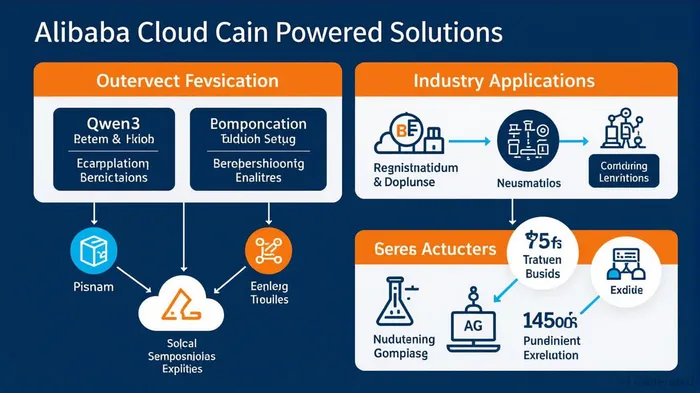
The company's AI+Cloud strategy also addresses a structural shift in global tech spending: enterprises are prioritizing cloud-native AI platforms over legacy systems. Alibaba's 50 million 88VIP premium members—up double digits year-over-year—highlight its ability to monetize AI-driven personalization in e-commerce. Meanwhile, Youku's first-ever profitability signals that digital media, now integrated with AI, can contribute meaningfully to margins.
Near-Term Challenges: Overcoming the Noise
Critics will point to risks like U.S.-China trade friction, Cainiao's 12% revenue decline, and the 76% free cash flow drop. However, these are manageable:
- Geopolitical Risks: While trade tensions persist, Alibaba's cross-border e-commerce (Alibaba International Digital Commerce Group) grew 22% in Q1, with AliExpress and Trendyol expanding in Europe and the Gulf Region. Diversification mitigates overreliance on any single market.
- Cainiao Logistics: The 12% revenue dip reflects strategic integration into core e-commerce platforms, not failure. Losses narrowed by 55%, signaling operational discipline.
- Cash Flow: The free cash flow decline is a short-term cost of long-term growth. Alibaba's US$11.9 billion in share repurchases (reducing shares by 5.1%) and a US$4.6 billion dividend—including a one-time payout from asset sales—show confidence in liquidity.
Dividends and Buybacks: A Contrarian's Safety Net
Alibaba's dividend policy is a contrarian's ally. The US$2.00 per ADS dividend (including a one-time US$0.95 payout) offers a yield of ~1.8% at current prices, attractive in a low-interest-rate world. Combined with buybacks, this reduces shares outstanding and supports valuation multiples. For income-focused investors, this mitigates downside risk in volatile markets.
Investment Thesis: Buy the Dip, Own the Future
Alibaba trades at a forward P/E of ~15x (vs. 20x historical average), despite its cloud/AI growth trajectory. For contrarians, this is a buying opportunity:
- AI Adoption Curve: Early-stage enterprise adoption of AI tools bodes well for cloud revenue growth.
- Margin Expansion: Non-GAAP net income rose 22%, suggesting profitability can outpace revenue growth as AI scales.
- Shareholder Returns: Dividends and buybacks provide a floor in volatile markets.
Recommendation: Accumulate positions in Alibaba at current levels, with a target price of US$100 (implying 20x forward P/E). Use geopolitical headlines as dips to average into the stock. Avoid overreacting to near-term cash flow pressures; focus on the secular AI+cloud thesis.
Conclusion
Alibaba's valuation recovery hinges on market recognition of its AI-driven renaissance. While risks like trade tensions and cash flow volatility persist, they are already priced into the stock. For investors with a multi-year horizon, Alibaba's cloud leadership, shareholder-friendly policies, and secular growth in AI services make it a compelling contrarian bet. The future of e-commerce and enterprise tech is AI-native—and Alibaba is building the infrastructure to own it.

Delivering real-time insights and analysis on emerging financial trends and market movements.
Latest Articles
Stay ahead of the market.
Get curated U.S. market news, insights and key dates delivered to your inbox.
AInvest
PRO
AInvest
PRO



Comments
No comments yet