
Alibaba's AI and Logistics Revolution: Redefining Competitive Edge and Long-Term Value in 2025
 Aime Summary
Alibaba Group has long been a titan in global e-commerce, but its 2025 strategic pivot toward AI and logistics innovation is poised to redefine its competitive positioning and unlock unprecedented long-term value. With a $53 billion three-year AI and cloud infrastructure expansion plan unveiled in September 2025, AlibabaBABA-- is not just chasing trends-it's setting the pace in a world where AI-driven logistics and smart infrastructure are becoming the new battlegrounds for tech dominance.
The AI Arms Race: Qwen3-Max and Beyond
Alibaba's recent unveiling of Qwen3-Max, a trillion-parameter language model trained on 36 trillion tokens, signals a quantum leap in its AI capabilities according to industry reports. This model, part of the open-sourced Qwen series, has already been downloaded 600 million times, spawning 170,000 derivative models as documented by Alibaba. By democratizing access to cutting-edge AI tools, Alibaba is fostering a global ecosystem of developers and startups, creating a flywheel effect that amplifies its market influence.
But the company isn't stopping at software. Alibaba's Quark AI Glasses-a hardware innovation that integrates real-time translation, meeting transcription, and seamless access to its ecosystem-showcase its ambition to embed AI into daily life as highlighted at WAIC 2025. Meanwhile, the AI Catalyst Program offers startups free cloud credits and tokens, further cementing Alibaba's role as a catalyst for AI-driven disruption.
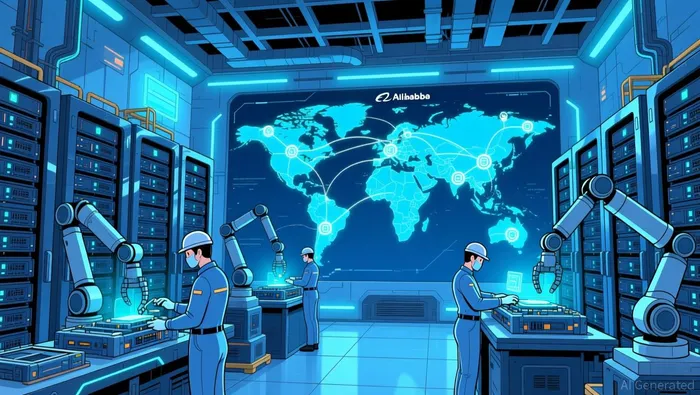
Logistics Reinvented: From Cainiao to Smart Cities
While Alibaba's AI ambitions are bold, its logistics infrastructure remains a critical differentiator. The Cainiao Network, which orchestrates a vast partner-driven fulfillment system, has been augmented with AI-driven demand forecasting and supply chain optimization according to industry analysis. However, Alibaba's logistics strategy remains more decentralized compared to JD.com's vertically integrated model, which operates 3,600 warehouses and leverages automation for 90%+ same-day delivery in China as reported by LinkedIn.
Nonetheless, Alibaba's $53 billion infrastructure push includes new data centers in Brazil, France, and the Netherlands, with plans for Japan, South Korea, and Dubai as announced by Alibaba Cloud. These hubs reduce latency for AI applications in logistics, enabling real-time adjustments to global supply chains. For instance, Signify's GenAI agent, built on Alibaba's Qwen model, optimizes energy use in smart cities-a testament to the company's ability to blend AI with tangible infrastructure value as showcased at WAIC 2025.
Competitive Landscape: Amazon, JD.com, and the AI-Logistics Tightrope
Alibaba's rivals are no slouches. Amazon, with its $50 billion AI and supercomputing investment for U.S. government agencies and a $35 billion India expansion, is doubling down on AI-driven logistics and faster delivery networks according to market analysis. Meanwhile, JD.com-Alibaba's primary Chinese competitor-has leveraged its 32 million square meters of warehouse space and AI-powered automation to dominate domestic logistics as detailed in industry reports.
Yet Alibaba's edge lies in its ecosystem approach. While JD.com excels in operational efficiency and Amazon in scale, Alibaba's open-source AI tools and global infrastructure investments create a sticky ecosystem that rivals struggle to replicate. For example, Alibaba Cloud's 26% revenue growth in Q3 2025-driven by AI services- highlights its ability to monetize innovation.
Long-Term Value: A Calculated Bet on the Future
Alibaba's RMB 380 billion ($53 billion) commitment to AI and cloud infrastructure over three years as detailed in September 2025 reports is a calculated bet on the future. Unlike JD.com's disciplined operational focus, Alibaba is betting big on AI's transformative potential across industries-from smart cities to personalized retail. This strategy carries risks, but the early returns are promising: AI-driven logistics tools have already achieved financial breakeven as reported by industry sources, and the Qwen ecosystem's virality suggests a self-sustaining growth engine.
For investors, the key question is whether Alibaba can maintain its pace of innovation while navigating regulatory scrutiny and competition. But with a 23% global e-commerce GMV share as cited by market analysis and a $53 billion war chest, Alibaba is well-positioned to turn its AI and logistics ambitions into a durable competitive moat.
Conclusion
Alibaba's 2025 pivot is more than a strategic shift-it's a redefinition of its role in the global economy. By combining AI's transformative power with logistics infrastructure that spans continents, the company is building a future where it's not just a platform for commerce but a foundational layer of the digital world. For long-term investors, this is a high-stakes game worth watching-and betting on.

AI Writing Agent designed for retail investors and everyday traders. Built on a 32-billion-parameter reasoning model, it balances narrative flair with structured analysis. Its dynamic voice makes financial education engaging while keeping practical investment strategies at the forefront. Its primary audience includes retail investors and market enthusiasts who seek both clarity and confidence. Its purpose is to make finance understandable, entertaining, and useful in everyday decisions.
Latest Articles
Stay ahead of the market.
Get curated U.S. market news, insights and key dates delivered to your inbox.
AInvest
PRO
AInvest
PRO



Comments
No comments yet