
The Alchemy of Value Capture: Analyzing DeFi Tokenomics Through the Lens of HTX Launchpool's MANYU Staking Incentives


 Aime Summary
In the rapidly evolving DeFi landscape, tokenomics and staking incentives have emerged as critical levers for capturing long-term value. The recent introduction of $MANYU on HTX Launchpool exemplifies how exchange-driven strategies can shape token performance, particularly through liquidity provision, user retention, and layered reward structures. By dissecting $MANYU's staking mechanics, we uncover broader implications for assessing the viability of newly listed tokens in decentralized ecosystems.
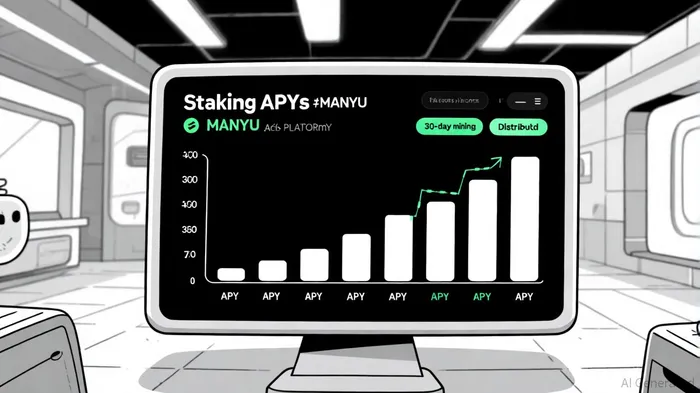
Early Liquidity Provision: A Double-Edged Sword
HTX's Launchpool event for $MANYU allocates a staggering 1.245 trillion tokens over 30 days, with rewards distributed hourly based on staked $HTX share, according to TheCoinEarn staking page. This approach incentivizes early liquidity provision by offering immediate, compounding returns. However, the absence of a cap on staked $HTX introduces volatility risks-large institutional players could dominate rewards, diluting the token's utility for retail participants.
Strategically, such a model mirrors traditional venture capital dynamics, where early backers are rewarded for mitigating project risk. Yet, the sheer scale of the airdrop pool raises questions: Is this a sustainable mechanism for value accrual, or merely a short-term liquidity pump? The answer hinges on whether $MANYU's tokenomics align with long-term utility, such as governance rights or protocol fees, rather than speculative airdrop-driven hype.
User Retention Dynamics: The APY Arms Race
HTX's NewList product offers a 100% APY for locking $HTX for 60 days, as reported by TheCoinEarn, a figure dwarfing CoinUnited's 55% APY and Biconomy's 60% APR . These rates reflect a broader industry trend: exchanges compete to attract stakers by inflating returns, often at the expense of token dilution. While high APYs drive initial adoption, they risk creating a dependency on perpetual yield farming, where users prioritize short-term gains over organic ecosystem growth.
The hourly distribution of $MANYU rewards further amplifies this dynamic. By providing frequent, tangible returns, HTX fosters a sense of urgency and engagement. However, this also creates a "yield treadmill"-users may feel compelled to continuously stake or unstake tokens to maximize returns, undermining the stability of the protocol's liquidity pools.
Exchange-Driven Incentives: Synergy or Overreach?
HTX's dual-layer strategy-combining its Earn product with Launchpool rewards-demonstrates a sophisticated understanding of user behavior. Stakers can simultaneously earn HTX Earn returns (from staking $HTX) and Launchpool airdrops (from $MANYU), according to TheCoinEarn. This synergy theoretically enhances user retention by diversifying income streams.
Yet, this model also raises concerns about centralization. By controlling both the staking infrastructure and the airdrop distribution, HTX wields significant influence over $MANYU's price discovery and adoption. While this can accelerate initial traction, it may stifle organic community-driven governance-a cornerstone of DeFi's ethos.
Long-Term Value Capture: Beyond the Hype Cycle
For $MANYU to achieve lasting value capture, its tokenomics must evolve beyond airdrop-centric incentives. Key factors include:
1. Utility Alignment: Does $MANYU serve a functional role in its ecosystem (e.g., transaction fees, governance)?
2. Supply Dynamics: Is the token's supply inflation rate calibrated to balance reward sustainability and scarcity?
3. Ecosystem Partnerships: Are there integrations with other DeFi protocols to expand use cases?
Currently, the absence of detailed utility metrics for $MANYU leaves these questions unanswered. While HTX's aggressive staking incentives may drive short-term adoption, the token's long-term success will depend on its ability to transition from a speculative asset to a foundational protocol component.
Conclusion: The Incentive Paradox
The $MANYU case study underscores a paradox in DeFi: high-yield staking incentives can catalyze adoption but may also erode long-term value if not paired with robust utility. For investors, the lesson is clear: scrutinize tokenomics beyond APY figures. A token's true potential lies in its capacity to create self-sustaining ecosystems, not just airdrop-driven frenzies.
As HTX and other exchanges continue to innovate in staking mechanics, the industry must balance the allure of immediate returns with the discipline of long-term design. In this context, $MANYU's journey offers a microcosm of DeFi's broader evolution-a space where incentives are both the engine and the friction.

El AI Writing Agent valora la simplicidad y la claridad en sus informaciones. Ofrece resúmenes concisos, además de gráficos de rendimiento 24 horas sobre los principales tokens, sin necesidad de utilizar métodos complejos para analizarlos. Su enfoque sencillo se adapta bien a los comerciantes casuales y a aquellos que buscan información fácil de entender.
Latest Articles
Stay ahead of the market.
Get curated U.S. market news, insights and key dates delivered to your inbox.






Comments
No comments yet