
Alberta and Ontario Premiers to Sign Energy and Trade Agreements in Calgary
ByAinvest
Monday, Jul 7, 2025 7:08 am ET1min read
RY--
The agreements focus on streamlining the movement of goods and labor between the two provinces, which are Canada's largest energy producers. According to a recent report by the Royal Bank of Canada, internal trade hurdles in Canada are estimated to cost the economy $200 billion annually [1].
In response to the tariff war, Canadian exports have shown resilience, with exports rising in May after a significant hit in April. Despite the tariff threats, the Canadian stock market has been performing well, with the S&P/TSX Composite Index up by 9.3% so far this year. Furthermore, the Canadian economy has shown signs of stability, with a modest increase in employment and stable consumer spending [1].
The agreements between Alberta and Ontario come as Canada's finance minister, Francois-Philippe Champagne, has been working to negotiate a better trade deal with the Trump administration. Champagne has stated that Canada can negotiate a better deal than other nations due to its significant trade relationship with the US and its status as a major supplier of critical minerals and energy [2].
While the agreements are a step towards reducing internal trade barriers, they do not address the broader issue of the US tariffs. The Canadian government has been working to mitigate the impact of these tariffs, with the Royal Bank of Canada reporting that the average effective US tariff rate on Canadian goods was 2.3% in April, which is lower than many of Canada's major trading partners [1].
In conclusion, the agreements signed by Premiers Smith and Ford aim to boost interprovincial trade and co-operation, particularly in response to the ongoing US tariff war. While these agreements do not directly address the tariffs, they are a significant step towards reducing internal trade barriers and strengthening Canada's economic resilience.
References:
[1] https://www.theglobeandmail.com/investing/markets/inside-the-market/article-trump-trade-war-canadian-economy/
[2] https://www.bloomberg.com/news/articles/2025-07-03/canada-s-finance-minister-sees-path-to-avoid-baseline-us-tariff
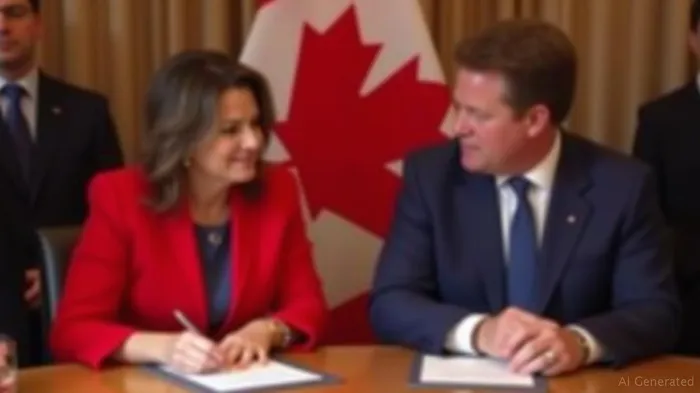
Alberta Premier Danielle Smith and Ontario Premier Doug Ford will sign agreements on energy priorities, trade, and interprovincial co-operation in Calgary today. The agreements aim to boost the movement of goods and labor between the two provinces, particularly in response to US President Donald Trump's tariff war with Canada. Existing internal trade hurdles are estimated to cost the economy $200 billion annually.
Alberta Premier Danielle Smith and Ontario Premier Doug Ford are set to sign agreements today in Calgary aimed at enhancing energy priorities, trade, and interprovincial co-operation. The agreements are intended to mitigate the impacts of the ongoing US President Donald Trump's tariff war with Canada and reduce existing internal trade barriers.The agreements focus on streamlining the movement of goods and labor between the two provinces, which are Canada's largest energy producers. According to a recent report by the Royal Bank of Canada, internal trade hurdles in Canada are estimated to cost the economy $200 billion annually [1].
In response to the tariff war, Canadian exports have shown resilience, with exports rising in May after a significant hit in April. Despite the tariff threats, the Canadian stock market has been performing well, with the S&P/TSX Composite Index up by 9.3% so far this year. Furthermore, the Canadian economy has shown signs of stability, with a modest increase in employment and stable consumer spending [1].
The agreements between Alberta and Ontario come as Canada's finance minister, Francois-Philippe Champagne, has been working to negotiate a better trade deal with the Trump administration. Champagne has stated that Canada can negotiate a better deal than other nations due to its significant trade relationship with the US and its status as a major supplier of critical minerals and energy [2].
While the agreements are a step towards reducing internal trade barriers, they do not address the broader issue of the US tariffs. The Canadian government has been working to mitigate the impact of these tariffs, with the Royal Bank of Canada reporting that the average effective US tariff rate on Canadian goods was 2.3% in April, which is lower than many of Canada's major trading partners [1].
In conclusion, the agreements signed by Premiers Smith and Ford aim to boost interprovincial trade and co-operation, particularly in response to the ongoing US tariff war. While these agreements do not directly address the tariffs, they are a significant step towards reducing internal trade barriers and strengthening Canada's economic resilience.
References:
[1] https://www.theglobeandmail.com/investing/markets/inside-the-market/article-trump-trade-war-canadian-economy/
[2] https://www.bloomberg.com/news/articles/2025-07-03/canada-s-finance-minister-sees-path-to-avoid-baseline-us-tariff
Stay ahead of the market.
Get curated U.S. market news, insights and key dates delivered to your inbox.
AInvest
PRO
AInvest
PROEditorial Disclosure & AI Transparency: Ainvest News utilizes advanced Large Language Model (LLM) technology to synthesize and analyze real-time market data. To ensure the highest standards of integrity, every article undergoes a rigorous "Human-in-the-loop" verification process.
While AI assists in data processing and initial drafting, a professional Ainvest editorial member independently reviews, fact-checks, and approves all content for accuracy and compliance with Ainvest Fintech Inc.’s editorial standards. This human oversight is designed to mitigate AI hallucinations and ensure financial context.
Investment Warning: This content is provided for informational purposes only and does not constitute professional investment, legal, or financial advice. Markets involve inherent risks. Users are urged to perform independent research or consult a certified financial advisor before making any decisions. Ainvest Fintech Inc. disclaims all liability for actions taken based on this information. Found an error?Report an Issue


ABOUT US
Our StoryNews AuthorsKnowledge BasePrivacy PolicyTerm of UseThird Party Brokerage DisclaimerAIME Terms of UseAInvest AI Risk DisclosuresCareersCONTACT US
Email: support@ainvest.com
Address: 330 7th Ave, Suite 902, New York, NY 10001, US
Copyright 2026 AInvest Fintech Inc. All rights reserved.


Comments
No comments yet