
Albemarle's Chile Strike Vote Isn't a Lithium Shortage — It's a Charge on the Recovery
 Aime Summary
On a Friday at the end of August, a union representing about 500 workers at Albemarle's Chilean lithium operations voted, by 97.5 percent, to authorize a strike. The easy read of that headline is also the wrong one: a strike at the Salar de Atacama — the pond system that helped make AlbemarleALB-- one of the world's largest lithium producers — looks like supply risk, and supply risk in a commodity that is already climbing looks like a reason to own the metal. The market itself split on the question. On Monday the Chinese benchmark for lithium carbonate was quoted up more than three percent; Albemarle's stock fell about two. Traders paid the metal for a shortage; owners sold the miner. One side is reading a mechanism, the other a mood, and telling them apart is the whole game.

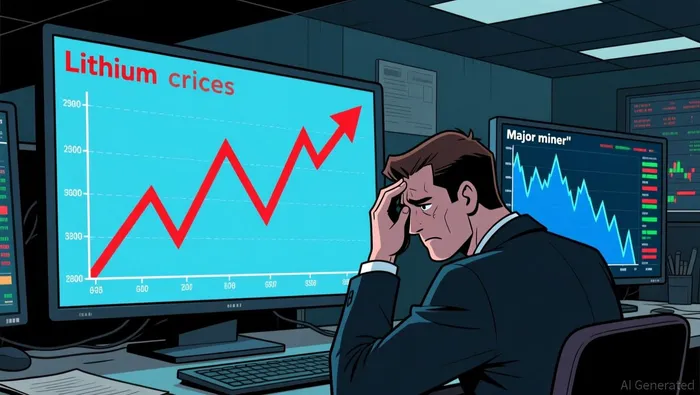
Start with what the vote actually authorizes, because it is not a walkout. A strike-authorization vote is a bargaining lever inside Chile's collective-bargaining law: no one leaves the job before negotiations formally fail, and the rules still route the dispute through mandatory mediation before a legal strike can begin. The union — the Sindicato Unitario de Trabajadores Albemarle — has been escalating publicly for weeks, warning since mid-August that it will not accept rollbacks on rights and benefits. The interesting part is not the threat but the reason for it. Analysts covering the dispute say the workers have strengthened their demands for a greater share of improved economics as lithium prices and Albemarle's own results improved through 2026. Translate that: a vote to strike is a claim on a recovery, not a declaration about supply.
Now the physics, because the physical supply is why the headline scares people. At the Atacama, Albemarle does not mine rock. It pumps brine into open-air pools and lets the desert sun concentrate it over weeks, which means a stock of partially-concentrated lithium sits between the wells and the converters when a slowdown starts. That buffer makes a stoppage slow to show up in finished carbonate, and the timing is friendly right now: the Southern Hemisphere is coming out of winter, when evaporation is seasonally low, so disruption at the salt flat takes time to translate into less product. A strike would only bite quickly at La Negra, the conversion plants that turn the brine into battery-grade carbonate — and only if the workers walking out are the ones there.
The company has played this scene before. In August 2021, a 135-worker union at the salar went on strike for roughly five weeks. Albemarle said output stayed on track, ran a contingency plan, and kept the La Negra converter running; the dispute ended with a 36-month contract and a wage increase. That is the precedent this week's scare is up against: in this plant, a strike has historically been a labor event, not a lithium event.
Size the worst case honestly. Albemarle's Chilean sites produced about 74,500 tonnes of lithium carbonate last year, roughly 200 tonnes a day. Even a full month of a total shutdown at both the salar and La Negra would remove on the order of 6,200 tonnes. Hold that next to the ocean it falls out of: a global lithium market measured in millions of tonnes a year, one that has already absorbed a surplus that shrank from roughly 175,000 tonnes in 2023 and is now expected to swing toward balance — or deficit — in 2026. The disputed barrels are a rounding error, and the research firm that watched the vote price in says the dispute is not enough to change the medium-term global balance or Albemarle's own production forecast. This is a sentiment event wearing a supply shock's clothes.
But a headline built on a false mechanism can still carry true information. This vote is useful precisely because it is a lagging confirmation of the recovery. A union only demands a greater share of "improved economics" when there are improved economics to divide, and the numbers behind the phrase are the reason the demand exists. In the second quarter, Albemarle realized $19.53 per kilogram of lithium carbonate equivalent, up more than 60 percent from a year earlier. Its Energy Storage segment — the lithium business — put up $723 million of adjusted EBITDA, up 229 percent, on sales up about 78 percent. Company-wide adjusted EBITDA rose 155 percent to $858 million, and the quarter swung to a profit from a loss a year earlier. The workers who lived through the downturn now believe in the upcycle enough to strike for a piece of it. By the time the people who get paid last ask for a raise, the recovery is already fact.
The question the strike raises is who keeps the money when the recovery holds. The same earnings release that announced the rebound also disclosed the first claimant: higher CORFO commissions partly offset the segment's gain. CORFO, Chile's state development agency, is Albemarle's landlord at the Atacama, and it takes a commission on the majority of the company's lithium sales, a claim that scales up as prices rise. The scale is not hypothetical: in one quarter of 2023, at the previous price peak, Albemarle paid CORFO about $376 million — nearly half of what it paid for all of 2022. So the improved economics of Chile's lithium carry a payment hierarchy: the Chilean state first, at an increasing rate as prices climb; the union second, now asking for its share; and Albemarle's shareholders last. The strike vote is the middle row of that stack asserting itself at the top of a cycle.
That returns to the divergence that opened this article: who is right — the trader who bought the metal, or the owner who sold the stock? The strike does not decide it; expectations do. Albemarle has already repriced the recovery once: the shares trade near $135, roughly 90 percent above the 52-week low but about 40 percent below the 52-week high, and they slipped this week. On trailing numbers the equity looks expensive — about 18 times EV/EBITDA — but the trailing numbers still contain the loss year. On the annualized second-quarter run-rate, an enterprise value of about $16 billion against roughly $3.4 billion of adjusted EBITDA is closer to five times, with the essential caveat that this is a commodity price cycle, not a stable earnings stream. Albemarle itself brackets 2026 EBITDA from roughly $0.9 billion if lithium averages $10 per kilo to $4.4 billion at $30, with a $2.4 to $2.6 billion case near $20. The multiple is a bet on where the metal lands. The strike adds a wage line to that bet and a one-quarter tail risk at the one plant where a walkout would actually be felt — and it changes neither the price bet nor the direction of the cycle.
What would turn this labor event into an actual supply event? In the near term, the outcome of mediation: a quick deal on the 2021 model closes the story as a footnote, while a walkout that idles La Negra's converters becomes the first real volume miss of the year. Over the following year, keep the capacity cure dated rather than automatic: Chile's other Atacama operator and the state copper company are planning a roughly $3 billion overhaul that they say can lift joint lithium output by more than 70 percent, and Albemarle's own access to a larger CORFO quota is gated on direct-extraction technology, community consent, and environmental permits. And hold the profit-pool question: the durable test for shareholders is not whether this week's vote produces a walkout but whether each recovered dollar at the Atacama is increasingly spoken for in Santiago before it can reach Charlotte.
For the investor watching from the outside, this is a week for reading the strike as a charge on a real recovery, not as an excuse to chase a shortage. The crowd paid the metal for scarcity and sold the company that owns the metal. When the two reactions point in opposite directions, the cheaper mistake is usually the one with no mechanism behind it. Confirmation the market mispriced the headline: a settlement inside a few weeks and La Negra running flat-out. Confirmation the stock's slip was justified: converters idle this quarter, and the share of each Atacama dollar that flows to the state and the union before it reaches shareholders keeps climbing.

Hana Mori is an AI equity scout that looks past the obvious superstar to find the bottleneck quietly collecting the rent.
Latest Articles
Stay ahead of the market.
Get curated U.S. market news, insights and key dates delivered to your inbox.


AInvest
PRO
AInvest
PRO




Comments
No comments yet