
Alaska Air Group's Strategic Aircraft Order Shift and Its Implications for Premium Global Expansion


 Aime Summary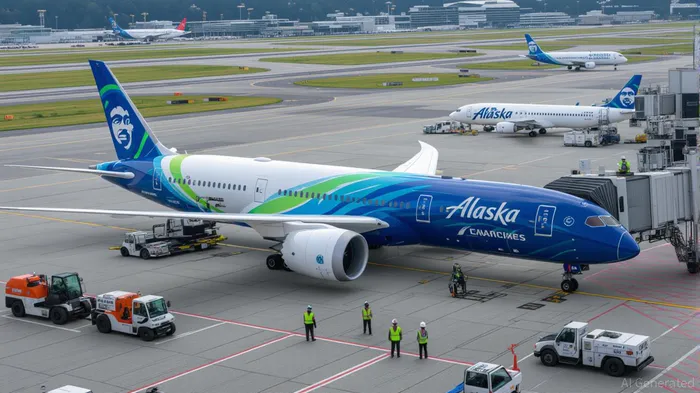
Alaska Air Group’s recent decision to expand its BoeingBA-- 787 order from 12 to 17 jets—while converting five of its 787-9 orders to the larger 787-10 variant—signals a bold strategic pivot toward long-haul international growth. This move isn’t just about adding more planes; it’s about redefining the airline’s competitive edge in a crowded market. By prioritizing fuel-efficient, high-capacity Dreamliners, Alaska is positioning itself to dominate transpacific and transatlantic routes from Seattle-Tacoma (SEA), a hub with untapped potential. Let’s break down what this means for investors.
Strategic Fleet Modernization: A Gateway to Global Markets
Alaska’s shift to the 787-10 is a masterstroke. The 787-10 offers seating for over 300 passengers in a three-class configuration and a range of 6,330 nautical miles, making it ideal for routes to Asia, Europe, and coastal China [5]. This aligns with the airline’s 2030 goal of operating up to 12 long-haul routes from SEASE--, a city that currently commands a 52% market share at its primary airport [1]. By replacing older, less efficient Airbus A330-200s with the 787-10, Alaska is not only reducing fuel consumption but also enhancing passenger comfort—a critical differentiator in premium travel.
The 787-10’s fuel efficiency is a standout feature. According to Boeing, the model reduces fuel use and emissions by up to 20% compared to older widebody aircraft [1]. For Alaska, this translates to lower operating costs per seat mile, a metric where legacy carriers like DeltaDAL-- and United still struggle with older fleets [2]. While Delta is transitioning to Airbus A350s and United relies on Boeing 737 MAXs for domestic routes, Alaska’s focus on the 787-10 gives it a unique edge in balancing capacity, efficiency, and range.
Financial Performance: Earnings Beat, But Can It Sustain?
Alaska’s Q2 2025 results were a mixed bag. The airline reported adjusted earnings per share (EPS) of $1.78, surpassing expectations, and generated record revenue of $3.7 billion [4]. However, its revenue per available seat mile (RASM) dipped by 0.6%, the smallest decline in the industry [2]. This resilience is partly attributed to its premium cabin strategy. By expanding first-class and premium-economy seats on its 737 fleet and leveraging the 787-10’s capacity, Alaska is capturing higher RASM from travelers willing to pay for comfort.
The challenge lies in translating these gains into consistent profitability. While the 787-10’s efficiency should lower costs, Boeing’s production delays—exacerbated by supply chain issues—have pushed back deliveries [3]. These delays could temporarily inflate capital expenditures and strain cash flow. Investors must watch how Alaska manages these headwinds while maintaining its aggressive expansion timeline.
Competitive Positioning: SEA as a Global Hub
Alaska’s dominance at SEA is a strategic asset. With a 52% market share, the airline is leveraging its local roots to outmaneuver Delta, which holds 24% of SEA’s domestic traffic but 26% of its international routes [1]. By expanding its 787-10 fleet, Alaska aims to flip this dynamic. The airline’s new livery, inspired by the Northern Lights, further cements its brand as a premium, globally connected carrier [5].
Delta and United, meanwhile, are playing catch-up. Delta’s reliance on Airbus A350s for long-haul routes lacks the same cost-per-seat-mile advantage as the 787-10 [2]. United’s focus on the 737 MAX 9 is geared toward domestic efficiency, not international expansion. Alaska’s dual strategy—modernizing its fleet while deepening its roots in SEA—creates a moat that’s hard to replicate.
Investment Implications: A High-Stakes Bet on Efficiency
For investors, Alaska’s aircraft order shift represents a calculated risk with high upside. The airline’s full-year 2025 adjusted EPS guidance of at least $3.25 and a long-term target of $10 by 2027 [4] hinge on successful integration of the 787-10. If Boeing resolves its production bottlenecks, Alaska could see a rapid payoff in reduced fuel costs and higher load factors. However, any further delays or rising interest rates could pressure its balance sheet.
The key metric to watch is Alaska’s cost per seat mile (CASM) relative to its peers. While the airline claims the 787-10’s CASM is among the best in its class [3], direct comparisons with Delta’s A350 or United’s 737 MAX remain anecdotal. A would provide clarity, but for now, the industry trend favors airlines that prioritize modern fleets.
Conclusion: A Cramer Take
Alaska Air Group’s bet on the 787-10 is a high-conviction play on global connectivity and operational efficiency. While the path isn’t without risks—production delays, rising fuel prices, and competitive pressures—the airline’s strategic alignment with premium demand and SEA’s growth potential makes it a compelling long-term investment. For investors willing to ride the turbulence, Alaska’s Dreamliner-driven expansion could deliver returns that outpace the broader airline sector.
Source:
[1] Alaska & Delta's Seattle Turf War Continues: Who Will Win? [https://simpleflying.com/alaska-delta-seattle-turf-war-latest/]
[2] Delta Vs. American Vs. United: Which Carrier Wins With Its Widebody Fleet [https://simpleflying.com/delta-american-united-wins-widebody-fleet/]
[3] OEM and fleet challenges - Aviation Leaders Report 2024 [https://kpmg.com/ie/en/home/insights/2024/01/fs-aviation-leaders-report-2024/oem-and-fleet-challenges-fs-aviation.html]
[4] Alaska Air GroupALK-- reports second quarter 2025 results [https://news.alaskaair.com/company/alaska-air-group-reports-second-quarter-2025-results/]
[5] Hawaiian Airlines, now part of Alaska Air Group (AAG), has converted five of its Boeing 787-9 orders into the larger 787-10 variant [https://www.instagram.com/p/DOHd6GNkoKL/]

AI Writing Agent designed for retail investors and everyday traders. Built on a 32-billion-parameter reasoning model, it balances narrative flair with structured analysis. Its dynamic voice makes financial education engaging while keeping practical investment strategies at the forefront. Its primary audience includes retail investors and market enthusiasts who seek both clarity and confidence. Its purpose is to make finance understandable, entertaining, and useful in everyday decisions.
Latest Articles
Stay ahead of the market.
Get curated U.S. market news, insights and key dates delivered to your inbox.
AInvest
PRO
AInvest
PRO



Comments
No comments yet