
Alamo Group's Q3 2025: Contradictions Emerge on Tariff Impact, Vegetation Management Orders, Industrial Demand, Margin Recovery, and M&A Priorities
 Aime Summary
Date of Call: November 7, 2025
Financials Results
- Revenue: $420.0M, up 4.7% YOY (organic +3.4%)
- EPS: $2.34 per diluted share, down from $2.38 in Q3 2024
- Gross Margin: 24.2%, down 90 basis points YOY
Guidance:
- Q4 sales expected to decline ~4–5% sequentially with ~30% drop-through to gross profit; vegetation margins not expected to improve until late Q4/into Q1.
- Tariffs expected to be slightly under 1% of sales in 2026 (gross) with mitigation via pricing, procurement and exemptions.
- Long-term through-the-cycle targets: >10% sales growth (incl. M&A), ~15% adjusted operating income margin, ~18–20% adjusted EBITDA margin, free cash flow ≈100% of net income.
- Capital allocation: prioritize tuck-in M&A, continue $0.30 quarterly dividend; $50M buyback authorized but discretionary.
Business Commentary:
* Mixed Financial Performance Across Divisions: - Alamo Group reportednet sales of $420 million for Q3 2025, up 5% from the previous year, with the Industrial Equipment division showing a 17% increase, while the Vegetation Management division saw a 9% decline. - The divisional performance disparity was due to strong demand and market growth in the Industrial Equipment segment and persistent weakness in end markets affecting the Vegetation Management division.- Tariff Impact on Margins:
- The industrial division experienced a
decline in operating margin, partly due to tariff-related costs despite annual price increases. 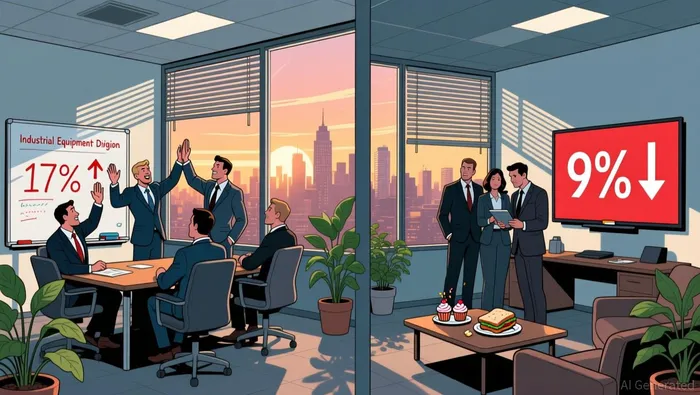
The company anticipates tariffs to contribute a little less than
1%of sales in 2026, with ongoing efforts to mitigate their impact through price adjustments and supplier management.Operating Cash Flow and Financial Flexibility:
- Alamo Group achieved
operating cash flowof$102 million, representing116%of net income for the nine months ended September 30, 2025. This strong cash flow is attributed to effective working capital management and high-quality product demand, providing flexibility for ongoing initiatives and future investments.
Vegetation Management Division Challenges:
- The Vegetation Management division's
adjusted EBITDAmargin declined to9.7%from11.5%in the previous year. - The decline was due to production challenges from facility consolidations and ongoing weakness in end markets such as tree care and agriculture, despite pricing actions to mitigate tariffs.<

Sentiment Analysis:
Overall Tone: Positive
- Management repeatedly expressed confidence and optimism: “optimistic and confident in the future performance of the company,” “incredibly excited about the road ahead,” and confidence in finishing consolidation and driving margin improvement; Board approved $0.30 quarterly dividend and management outlined specific margin and growth targets.
Q&A:
- Question from Christopher Moore (CJS Securities, Inc.): Maybe we can start on the vegetation margin. So it sounds like we'll be improving, but still challenged Q4 into Q1. I guess my question is, can you get back above 10% operating margins on vegetation without meaningful revenue growth at this stage.
Response: Yes — management expects vegetation margins can recover above 10% via production efficiencies over 1–2 quarters (200–400 bps), plus volume leverage and 200–300 bps from procurement/parts/service/lean initiatives.
- Question from Christopher Moore (CJS Securities, Inc.): Industrial orders seem okay but moderating a bit. Within the segment, are there specific areas that are a little more challenged than others that are staying strong? Any insight on the industrial segment outlook?
Response: Industrial orders are up year-to-date (single digits); some groups (excavators/vacuum, snow) are lumpy and down sequentially, while sweepers and safety are strong; overall healthy but likely to cool modestly in 2026.
- Question from Gregory Burns (Sidoti & Company, LLC): Can you talk about the state of some channels within Vegetation Management, particularly Ag and forestry and tree care — how do inventory levels sit? Are you seeing slowdown/headwinds in ag given trade issues?
Response: Orders YTD are positive (≈+11%), quarter up driven by North American ag; tree care industrial subsegment shows weakness (large-ticket hesitancy); inventory levels are reasonable and cancellations are in line with historical averages.
- Question from Gregory Burns (Sidoti & Company, LLC): Margins on the Industrial segment were down a bit — what are the primary drivers behind that decline?
Response: Main driver was tariffs (spiking in Q3), only partially offset by price increases; tariffs represent the primary noise affecting industrial margins this quarter.
- Question from Michael Shlisky (D.A. Davidson & Co., Research Division): On the margin goals (18% EBITDA), how long might it take to get there and do you need major transformations or large M&A to close the gap?
Response: Management expects 18–20% EBITDA over the next couple of years via staged actions: restore vegetation margins (1–2 quarters), modest sales tailwind, procurement savings, improved parts/service mix and lean initiatives; large deals not strictly required but M&A can accelerate progress.
- Question from Michael Shlisky (D.A. Davidson & Co., Research Division): In your first months at Alamo, what have you done to push toward those goals and have you changed how Alamo runs day-to-day?
Response: Focused on assessing the business, accelerating centralization (procurement, supply chain, IT) to capture savings, building an M&A pipeline and engaging advisors to execute prioritized opportunities.
- Question from Michael Shlisky (D.A. Davidson & Co., Research Division): On the 10% top-line goal, how much is expected from organic growth vs M&A and can innovation drive material organic growth?
Response: Plan: organic ~5% (1–2% pricing, 2–3% end-market recovery, 1–2% market-share via innovation) plus ~5%+ from M&A (one ~$100M deal ≈6%); innovation and tuck-ins together make the 10%+ target achievable.
- Question from Mircea Dobre (Robert W. Baird & Co. Incorporated, Research Division): For Q4, directionally how should revenue and margin trend relative to Q3?
Response: Consolidated Q4 expected to be seasonally lower: sales down ~4–5% sequentially, with roughly 30% drop-through to gross profit; vegetation margins unlikely to improve materially moving into Q4.
- Question from Mircea Dobre (Robert W. Baird & Co. Incorporated, Research Division): Within Industrial, should we expect margins to decline sequentially from Q3 to Q4?
Response: Industrial may see a slight sequential margin decline due to inverse fixed-cost leverage from lower volumes, but late-Q3 price increases to mitigate tariffs will partially offset; no major sequential swing anticipated.
- Question from Mircea Dobre (Robert W. Baird & Co. Incorporated, Research Division): You mentioned ~100 bps impact from tariffs into 2026 — is that gross before mitigation and how will offsets flow through timing-wise?
Response: Tariffs are expected to be a little under 1% of sales gross in 2026 (excludes chassis tariff uncertainty); company launched price increases and is pursuing procurement savings and exemptions, so net margin impact from 2025→2026 should be limited and largely mitigated over time.
- Question from Mircea Dobre (Robert W. Baird & Co. Incorporated, Research Division): Regarding sustainability of industrial demand and levers to hit your goals, what's your perspective?
Response: While post-infrastructure spending may slow growth, industrial end markets remain attractive and less cyclical; pockets like hydro excavation have strong secular growth, and levers include product innovation and targeted M&A to sustain performance.
Contradiction Point 1
Tariff Impact on Margins
It involves differing explanations of the impact of tariffs on margins, which is crucial for investors understanding the company's financial performance.
What drove the decline in Industrial margins? - Gregory Burns (Sidoti & Company, LLC)
2025Q3: The decline is mostly due to tariffs, which were minimal in the first quarter, rose in the second, and increased significantly in the third. We anticipate tariffs to be around 1% of sales in 2026 before offsets. - Robert Hureau(President, CEO & Director)
What key cost factors are driving higher costs compared to peers, and what strategies can mitigate these costs? - JB Kindle (Daiwa Securities)
2025Q2: Heard a number that our raw material costs are up 27% year-over-year in our last fiscal year, ended October 31, 2022. So that's -- and steel had a lot to do with that, but other raw materials are up as well. - Agnes Kamps(CFO)
Contradiction Point 2
Vegetation Management Orders and Backlog
It highlights differing perspectives on the order and backlog situation in the Vegetation Management segment, which is important for assessing the company's sales trajectory.
Can you discuss the status of channels in your Vegetation Management segment, particularly in Ag, forestry, and tree care? - Gregory Burns (Sidoti & Company, LLC)
2025Q3: We're pleased with the order pattern in the Vegetation Management division, up 11% year-to-date, driven by North America ag. - Robert Hureau(President, CEO & Director)
Can you provide visibility into Q4 Vegetation Management and the ongoing improvement in orders? - Christopher Moore (CJS Securities)
2025Q2: We're continuing to see solid improvement in the backlog in terms of order rates in the Vegetation Management segment that continues to build. - Jeffery Leonard(President and CEO)
Contradiction Point 3
Industrial Segment Demand and Market Outlook
It involves differing views on the demand and market outlook for the Industrial segment, which affects investor expectations regarding sales growth.
How sustainable is demand in the Industrial segment? - Mircea Dobre (Robert W. Baird & Co. Incorporated, Research Division)
2025Q3: Industrial demand will slow from historical growth, but we see pockets of strong performance, like hydro excavation, driven by regulatory mandates. We're excited about M&A opportunities to enhance our profile. - Robert Hureau(President, CEO & Director)
How should we interpret orders and backlog in the Industrial segment, especially given the ongoing order inflow and your earlier backlog comments? - Mircea Dobre (Baird)
2025Q2: We also continue to see solid demand across our industrial operations, particularly in our excavator, vacuum and snow, and safety product lines. Sales in those segments were up 18% year-over-year. - Jeffery Leonard(President and CEO)
Contradiction Point 4
Vegetation Management Segment Margin Recovery
It involves differing perspectives on the timeline and manner of margin recovery in the Vegetation Management segment, which is crucial for understanding the company's financial outlook and strategic goals.
Can you return to over 10% operating margins in vegetation without significant revenue growth? - Christopher Moore(CJS Securities, Inc.)
2025Q3: We believe we can get to operating margins of 15%, adjusted EBITDA margins of 20%. Improvements will come from production efficiencies, volume leverage as markets stabilize, and savings from procurement and parts and service offerings. We expect 200-300 basis point improvement from these measures alone. - Robert Hureau(CEO)
What will be the margin profile of the Vegetation Management business as markets recover? - Gregory Burns(Sidoti & Company)
2025Q1: The target is to return to a 15% margin as volumes recover, leveraging cost reductions. Greater margin recovery is anticipated due to reduced fixed costs. - Jeffery Leonard(CEO)
Contradiction Point 5
M&A Strategy and Prioritization
It highlights differences in the stated priorities and focus of the company's M&A strategy, which is essential for understanding the company's growth strategy and capital allocation.
Have you made any major changes to Alamo's operations? - Michael Shlisky(D.A. Davidson & Co., Research Division)
2025Q3: We are moving from decentralization to centralization in key areas like procurement, supply chain, and IT to drive savings. We're also focusing heavily on M&A opportunities. - Robert Hureau(CEO)
With Alamo nearly debt-free, how do you view M&A, and are there plans for buybacks or special dividends? - Linda Umwali(D.A. Davidson)
2025Q1: Our priority is M&A, with large and tuck-in opportunities progressing. Share buybacks and special dividends are less likely unless M&A opportunities do not materialize. M&A remains our focus. - Jeffery Leonard(CEO)

Discover what executives don't want to reveal in conference calls
Latest Articles
Stay ahead of the market.
Get curated U.S. market news, insights and key dates delivered to your inbox.
AInvest
PRO
AInvest
PRO



Comments
No comments yet