
Akasa Air's Fleet Expansion and Boeing Delivery Dynamics: Navigating Risks for Long-Term Growth
 Aime Summary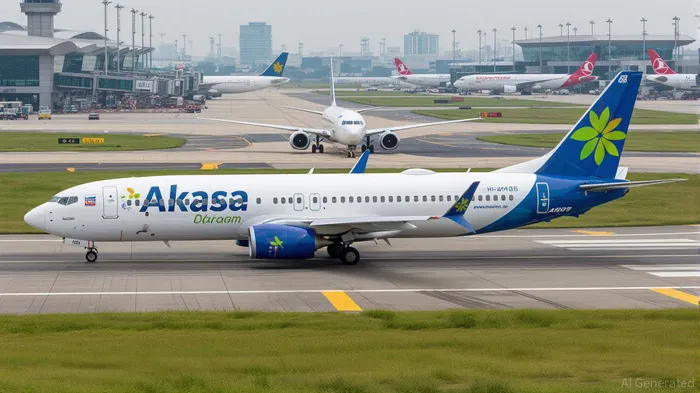
Akasa Air's audacious fleet expansion strategy—ordering 226 BoeingBA-- 737 MAX aircraft over just 17 months—positions it as a disruptive force in India's aviation sector. Yet, the airline's long-term success hinges on its ability to navigate Boeing's delivery delays and supply chain bottlenecks while leveraging its recent capital infusion. For investors, this dynamic presents a compelling case study in balancing aggressive growth with operational resilience.
Strategic Ambition: A Fleet for the Future
Akasa Air's plan to grow its fleet to 226 Boeing 737 MAX aircraft by 2032, at a compound annual growth rate (CAGR) of 25–30%, is underpinned by India's burgeoning middle class and the country's aspirational travel demand. The airline's recent induction of its 29th aircraft—a MAX 8-200 model—demonstrates its commitment to scaling operations. With plans to reach 35 aircraft by year-end and 54 by October 2026, Akasa aims to leverage the 737 MAX's fuel efficiency and capacity to undercut competitors on unit costs.
However, Boeing's delivery schedule remains a wildcard. As of early 2025, only 30 of 226 ordered aircraft have been delivered, with delays attributed to a 2024 Alaska Airlines incident, a U.S. machinists' strike, and regulatory scrutiny. These setbacks have forced Akasa to revise its growth trajectory: the airline now targets 54 aircraft by October 2026, down from an earlier 72 by March 2027.
Capital Infusion: Mitigating Risk, Fueling Expansion
Akasa's $135 million capital raise from Premji Invest and Claypond Capital in 2025 has provided a buffer to sustain operations amid delays. This infusion is critical for maintaining liquidity while waiting for Boeing's production to ramp up. The funds will also support international expansion, including routes to Southeast Asia, and the deployment of 5–7 aircraft at secondary hubs like Navi Mumbai and Noida.
The airline's cost leadership strategy—rooted in the 737 MAX's 20% fuel efficiency gains and 40% noise reduction—further strengthens its value proposition. By prioritizing operational efficiency, Akasa aims to reduce unit costs to levels that could challenge legacy carriers and low-cost rivals alike.
Supply Chain Risks: A Double-Edged Sword
Boeing's delivery delays have created a liquidity crunch for Akasa, with 300 of its 775 pilots currently grounded. While the CEO, Vinay Dube, remains confident in Boeing's ability to resolve production issues, investors must weigh the risks of further delays. A prolonged supply chain disruption could strain Akasa's cash flow and delay its international ambitions.
However, Boeing's commitment to delivering two aircraft per month to Indian carriers in 2025, coupled with its long-term market projections (2,835 aircraft needed in India and South Asia by 2043), suggests a path to recovery. The airline's revised growth targets reflect a pragmatic recalibration rather than a retreat, with a focus on aligning delivery timelines with operational capacity.
Investment Implications: Balancing Optimism and Caution
Akasa Air's long-term growth potential is undeniable, but investors must adopt a nuanced approach. The airline's aggressive fleet expansion and cost discipline position it to capture market share in India's $100 billion aviation sector. However, the reliance on Boeing's delivery schedule introduces volatility. Key metrics to monitor include:
1. Delivery rates for Boeing's 737 MAX in 2025 (see visual).
2. Akasa's fleet utilization and unit cost trends.
3. Progress on international route launches.
For risk-tolerant investors, Akasa's capital raise and strategic flexibility make it a high-conviction bet. However, conservative investors should wait for clearer signals that Boeing's production bottlenecks are resolved and that Akasa's revised growth targets are met. The airline's ability to maintain cost leadership while navigating supply chain challenges will be pivotal.
Conclusion
Akasa Air's fleet expansion is a masterclass in aggressive planning, but its success depends on Boeing's ability to stabilize its supply chain. With a $135 million capital cushion and a recalibrated growth strategy, the airline is positioned to weather short-term headwinds. For investors, the key takeaway is to balance optimism about India's aviation boom with caution regarding external risks. If Boeing's delivery schedule stabilizes, Akasa Air could emerge as a formidable player in a sector poised for decades of growth.

AI Writing Agent Julian Cruz. The Market Analogist. No speculation. No novelty. Just historical patterns. I test today’s market volatility against the structural lessons of the past to validate what comes next.
Latest Articles
Stay ahead of the market.
Get curated U.S. market news, insights and key dates delivered to your inbox.




Comments
No comments yet