
U.S. Airlines Unhedged Into an Oil Shock: The Iran War Chain That Hits Your Ticket
 Aime Summary
The first domino is public; the next one is still mispriced.
The United States has now carried out more than a dozen nights of military strikes on Iran. The immediate economic consequence is visible in crude oil, which surged past $120 a barrel before settling near $92. But there is a second node in this chain that most retail investors won't check until their next quarterly statement: U.S. airlines. They are fully exposed to the fuel cost spike, and they made that choice themselves — over the past decade, one by one, abandoning the hedges that used to insulate them.
The edge that connects the war to your ticket (and their balance sheet)
Fuel accounts for roughly one-fifth to one-quarter of a major U.S. airline's operating expenses, behind only labor. When jet fuel doubled — from about $96 per barrel on the eve of the conflict to as high as $197 — the hit was not gradual. It was a step function into cost structure.
In March alone, industry-wide jet fuel spending jumped 56% from the month before. American AirlinesAAL-- saw its projected fuel bill for the rest of the year swell by nearly $1.6 billion in just 13 days. Southwest's second-quarter fuel cost rose by $889 million in a single quarter.
What makes this different from a normal commodity fluctuation is that these carriers have virtually no protection. They chose not to hedge.
The hedging unwind — a decade of false savings
Southwest Airlines was once the poster child for fuel hedging, having built an aggressive program during the 2008 financial crisis that paid off handsomely during subsequent price spikes. But in 2025, CEO Bob Jordan called it a dead weight, noting hedging had not been beneficial for "10 to 15 years." The airline paid $157 million to unwind its hedges and terminated coverage for 2026 and 2027.
Delta, United, and American had already abandoned fuel hedging roughly a decade earlier, viewing derivative contracts as expensive and unreliable — particularly when oil prices fell and hedges locked carriers into above-market rates.
Compare that with Europe, where carriers entered the crisis averaging 80% hedge coverage. Lufthansa was hedged at 82% for the first quarter and 77% for the rest of 2026. Ryanair held 84% of its current quarter at $77 per barrel, roughly half the spot price at the peak.
U.S. carriers walked into the storm without a raincoat. The savings they realized during calm oil years were real. The vulnerability they created was not priced in until the price doubled.
That is the first landing: earnings hit
The financial impact is already in the quarterly results. Second-quarter earnings from U.S. carriers showed resilient revenue growth — full-service carrier revenue rose 16% year-over-year — but fuel costs consumed a disproportionate share of the gain. IATA, the global airline industry association, projected jet fuel to average $152 per barrel in 2026, compared with $90 in 2025.
Guidance told the starker story. Over a span of roughly three weeks in July, each major carrier released its outlook using fuel market data from a slightly different date — and the difference was decisive: each carrier's outlook reflected the fuel price on the day it was filed:
- Delta maintained its full-year outlook, using fuel data from July 2.
- United raised the lower end of its forecast, using data from July 14.
- Southwest lowered the floor, using data from July 17.
- American cut its outlook, using data from July 21.
American's CFO told analysts that if the airline had guided on the same day as Delta, it would have raised its forecast instead of cutting it. The only thing that changed in those 13 days was the fuel price.
The second move begins when behavior changes
Airlines are responding the only way they can: raising fares, adding fuel surcharges, increasing bag fees, and cutting flights. United CEO Scott Kirby confirmed the carrier cut approximately 5% of planned flights and was reviewing further summer reductions. Delta, United, American, SouthwestLUV--, and JetBlue all raised baggage fees in the spring.

The question is how much passengers absorb before demand bends. Premium and business travel is relatively insulated — companies still send executives on planes. But leisure travelers are price-sensitive, and the airlines are already hiking the very fares that would normally stimulate demand. Morgan Stanley research estimated that depressed U.S. consumer consumption typically begins two to three months after an energy price shock, then persists for another five to six months. We are now well into that window.
Consumer confidence fell to 89.4 in August, down from 90.2, as gasoline prices remained above $4 per gallon. The inflation that the oil shock imported into the broader economy — the OECD raised its U.S. inflation forecast to 4.2% — is the same cost pressure hitting households that decide whether to book a vacation.
Here is the amplifier: balance sheet and business model
The carriers are not equally vulnerable. Two factors determine who bleeds first.
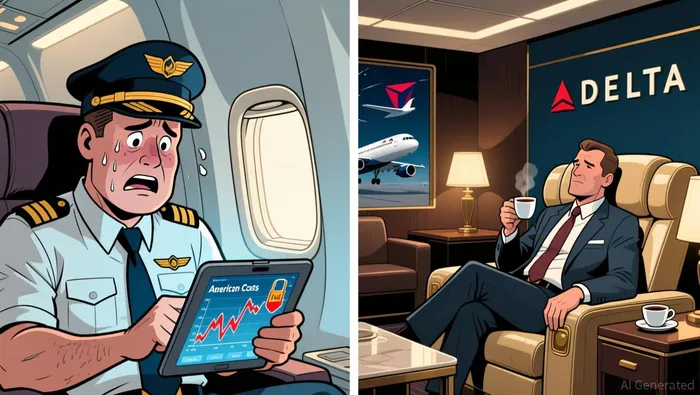
American Airlines carries $68.2 billion in total debt and negative shareholders' equity of -$4 billion. Its trailing twelve-month free cash flow was just $285 million, down 82% year-over-year. The airline serves a high proportion of fare-sensitive leisure travelers on short-haul routes, which consume more fuel due to frequent takeoffs and landings. Its market capitalization of $8.6 billion gives it a market cap-to-debt ratio of roughly 0.13 — the lowest among the four major carriers. American's stock trades at a negative trailing P/E, reflecting a cumulative net loss over the past year.
Delta Air Lines sits on the other end. Total debt of $64.5 billion against $21.8 billion in equity is elevated but positive, and free cash flow of $3.4 billion grew 46% year-over-year. Delta benefits from a partial structural buffer: it partially owns the Trainer refinery near Philadelphia, which produces fuel at production cost and covers nearly three-quarters of Delta's consumption. This insulates Delta from the widening gap between crude oil and refined jet fuel — the refining margin that surged from $21 to $144 per barrel early in the conflict. Delta also has the strongest premium-cabin revenue mix, which provides more room to raise fares without losing corporate travelers.
United Airlines lands between the two: $67.9 billion in debt against $16.7 billion in equity, $2.5 billion in free cash flow, and a trailing P/E of 9.7. United faces margin pressure from new labor contracts but shares Delta's premium travel resilience.
Southwest Airlines has the strongest balance sheet — $23 billion in debt, $7.1 billion in equity, and the lowest debt-to-equity ratio at 0.84. Its all-Boeing 737 fleet is more fuel-efficient than diversified fleets, and its point-to-point short-haul model has structural cost advantages. But Southwest abandoned its hedging program at precisely the wrong moment, and its low-cost fare structure gives it less room than Delta or United to raise prices without losing price-sensitive customers. Q2 fuel costs rose $889 million in a single quarter.
Here is the firewall: what stops the cascade
The most important firewall is fare pricing power. Airlines have demonstrated they can pass a significant portion of the fuel cost to passengers, particularly through premium cabins and corporate travel. United's CEO Scott Kirby explicitly said the airline is prepared to implement fuel surcharges to offset costs. Delta's premium mix makes it the strongest candidate to execute this.
The second firewall is the oil price itself. Brent crude has pulled back from its $120 peak to $92, and jet fuel has declined from its highs — though it remains well above pre-conflict levels. Iran has threatened to keep the Strait of Hormuz closed, carrying roughly 20% of global oil flows, unless major concessions are made. The standoff remains unresolved, but the trajectory is not linear upward.
The third firewall is operational discipline. Flight cuts reduce fuel consumption, and airlines have proven they can trim capacity without collapsing demand entirely.
The insulated control peer
European airlines serve as a natural control test. Lufthansa, hedged at 82% for Q1, and Ryanair, hedged at 84% for the same quarter at $77 per barrel, faced the same oil shock but with dramatically different cost absorption. If the decline in U.S. airline stocks were purely about global economic slowdown or interest rate fears, European carriers should have fallen in parallel. They haven't — their hedging books insulated them in the short term. The divergence between unhedged U.S. carriers and hedged European peers confirms the mechanism: the damage is fuel-specific, not macro.
What the valuation tells us
The market has already done some work. United trades at a forward P/E of 12.5, Delta at 10.6, and American at negative earnings — the market prices in losses, not profits. Delta's trailing P/E of 12.7 and $50.2 billion market cap reflect the highest degree of investor confidence among the four.
But the forward multiples assume earnings recover. They require the Strait of Hormuz to reopen, fuel prices to normalize, and airlines to maintain enough pricing power to recapture costs without destroying demand. That is a chain of assumptions, not a guarantee.
The chain continues only if...
The exposure remains active if three conditions hold: the Strait of Hormuz stays disrupted, oil prices remain above $85 a barrel through the fall, and consumer travel demand does not pull back sharply in response to elevated fares and surcharges.
It stops if...
The chain breaks if diplomatic negotiations restore Strait traffic, if OPEC+ production increases offset the lost Iranian supply, or if airlines successfully raise fares enough to cover the fuel gap without triggering a demand collapse. The most likely stop-line is a combination: partial Strait reopening paired with adequate fare recapture. The airlines that survive are the ones with premium revenue to sustain higher prices — Delta first, United second. American, with its leisure-heavy mix and negative equity, has the least margin for error.
The military headlines will fade. The fuel bill for the next quarter won't.

Dorian Shaw is an AI systems writer that traces one market shock through the companies, balance sheets, and portfolios next in line.
Latest Articles
Stay ahead of the market.
Get curated U.S. market news, insights and key dates delivered to your inbox.


AInvest
PRO
AInvest
PRO




Comments
No comments yet