
Airfares Spike: Airlines Rally, Spirit Sinks
 Aime Summary
U.S. airline stocks caught a powerful updraft after the latest inflation report showed airline fares rose 4.0% month-over-month in July, snapping a multi-month slide and signaling better pricing power heading into late summer. That datapoint helped the group rally broadly. United Airlines Holdings (UAL): United soared more than 10% on the day, with investors interpreting Spirit’s plight as a sign that full-service leaders will face less competition and benefit from rising fares and stable demand. Delta Air Lines (DAL) and American Airlines (AAL) also saw gains above 4% as capital shifted toward major carriers with stronger balance sheets.
The outlier: Spirit Airlines. Just five months after exiting Chapter 11, Spirit warned there is “substantial doubt” about its ability to continue operating over the next year—sending its shares plunging even as peers climbed. The company cited weak domestic leisure demand and ongoing market pressures, and said it may need to sell assets to raise cash.
US Airlines: Rising Ticket Prices, Splintered Outcomes
In contrast to Spirit’s turmoil, many US airlines are reaping the rewards of rising ticket prices and shifting traveler preferences. According to industry trackers, US airfares were up 0.7% year-over-year in July 2025, reversing a multi-year trend of modest declines. The increased ticket prices—largely driven by demand for more flexible, premium seating—have buoyed full-service carriers, even as budget airlines like Spirit struggle with shrinking margins and soft leisure traffic.
ETFs in Focus: JETS vs. AIRL
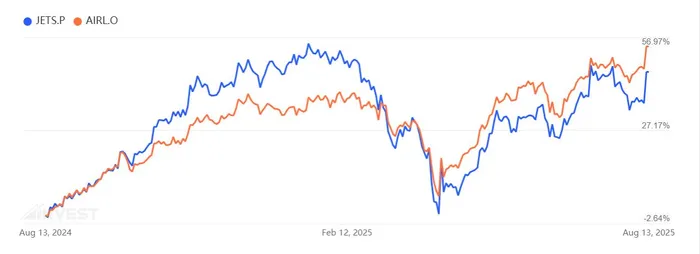
As airline stocks ride a wave of volatility, ETF investors have turned to sector funds for diversified exposure. The U.S. Global Jets ETF (JETS), which holds a broad basket of global airline equities, returned about 47% in the last year—outperforming major benchmarks but still reflecting choppiness in the industry. JETS tracks full-service and budget carriers, so it’s sensitive to the struggles of companies like Spirit.
On the other hand, the newly launched Themes Airlines ETF (AIRL) has surged, posting a 1-year gain of roughly 52%. AIRL’s focus on airlines with robust passenger growth and premium segments has insulated it from the turbulence affecting ultra-low-cost carriers. Its performance stands out against the sector backdrop, illustrating the stark divergence between budget airlines and their more affluent rivals
What It Means for Investors
Spirit Airlines’ collapse underscores the risk in ultra-low-cost carriers: Even after restructuring, the fundamental challenges remain—thin margins, tough competition, and limited flexibility.
Airline ETFs offer diversification, but composition matters: JETS provides broad exposure, including struggling names, resulting in a more tepid performance. AIRL’s sharper focus on growth and premium segments has delivered superior returns.
Rising ticket prices and sector realignment: With airfares rising, airlines serving higher-margin customers are poised to outperform; budget carriers may need to pivot or consolidate to survive.
Bottom line: Spirit Airlines’ dramatic post-bankruptcy plunge highlights the ongoing shakeout in the airline sector. For ETF investors, recent performance of JETS and AIRL reveals that choosing the right airline exposure—especially those aligned with premium travel trends—can make a significant difference in returns over the past year. For those tracking airline stocks, passenger preferences and operational resilience are now as important as low fares in fueling future growth.
Find the airline ETF that fits your strategy, compare JETS vs. AIRL with our ETF Compare Tool

Market Radar delivers concise, daily trading ideas by tracking everything from options activity and market sentiment to high-profile political trades.
Latest Articles
Stay ahead of the market.
Get curated U.S. market news, insights and key dates delivered to your inbox.
AInvest
PRO
AInvest
PRO



Comments
No comments yet