
Airbus Upsets Boeing With $24B Flydubai Order at Dubai Show
 Aime Summary
The Dubai Air Show has turned into a high-stakes battleground for Airbus and BoeingBA-- as the two aviation giants battle for dominance in the Middle East market. The rivalry took an unexpected turn when Airbus secured a major order from Flydubai for 150 A321neo aircraft, marking a significant upset after Boeing initially took the lead. This deal came just days after Emirates announced a $38 billion order for 65 Boeing 777X planes.
The shift in momentum underscored the competitive nature of the air show, where airlines like Emirates and Etihad have long been pivotal players. Emirates' decision to double down on Boeing, despite the manufacturer's delivery delays and recent safety concerns, highlighted the airline's confidence in the U.S. company's long-haul capabilities. Meanwhile, Etihad expanded its fleet with a mix of Airbus A350 and A330neo aircraft, signaling the ongoing tug-of-war between the two manufacturers according to reports.
Airbus' success with Flydubai came after years of trying to break into the carrier's exclusive Boeing partnership. Flydubai CEO Ghaith Al Ghaith praised Airbus for the range and size of its A321neo aircraft but also reaffirmed his loyalty to Boeing, noting it as "my home." The deal, which includes options for 100 more aircraft, signaled a strategic move for Airbus in a region where Boeing has historically held strong ties.
A Historic Upset
Airbus' deal with Flydubai was particularly significant because the budget carrier had exclusively purchased aircraft from Boeing since its founding in 2008. The order of 150 A321neo aircraft, worth approximately $24 billion, marked Airbus' first major breakthrough with a longtime Boeing customer. Flydubai's decision followed intense negotiations that swung back and forth before ultimately favoring Airbus. This shift came after the airline's CEO visited Airbus' headquarters in Toulouse and evaluated its aircraft in depth according to analysis.
The deal was announced just days after Boeing's early lead in the air show with the 777X order from Emirates. However, Airbus' ability to capture a large single-aisle deal from Flydubai helped it regain some ground in the contest. 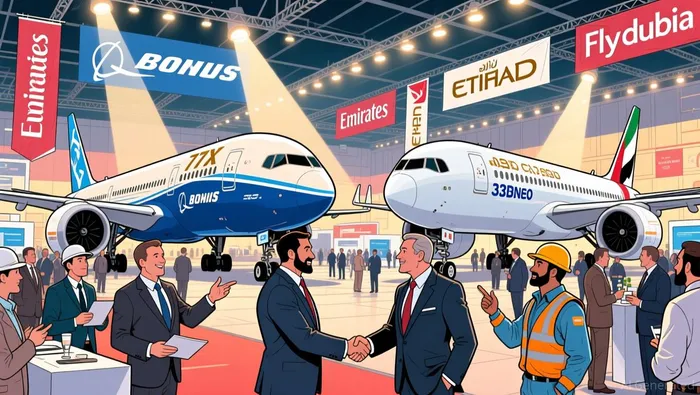 The win also served as a symbolic victory for Airbus, which had struggled to secure a follow-up order from Emirates for its A350-1000 model.
Boeing's Comeback
Despite the setback with Flydubai, Boeing was able to secure a partial comeback when the carrier also announced an order for 75 737 MAX aircraft, along with options for 75 more. This deal allowed flydubai to retain a portion of its business with Boeing and gave the U.S. manufacturer a renewed foothold in the show. Flydubai's CEO noted that while Airbus' planes offered key advantages, Boeing remained a critical part of its growth strategy.
The 737 MAX order was particularly important for Boeing, which has faced significant delays and challenges in the wake of the 737 MAX grounding. The deal came as Boeing looked to rebuild trust with its customers and demonstrate its reliability as a supplier of single-aisle aircraft. For flydubai, the order provided a balance between leveraging Airbus' range capabilities and maintaining its long-standing relationship with Boeing according to reports.
The Role of Emirates
Emirates' decision to order 65 777X aircraft was the headline-grabbing event of the Dubai Air Show's first day. Valued at $38 billion, the deal reinforced Emirates' position as one of Boeing's most critical customers and gave the U.S. company a strong start. The Dubai-based carrier has been vocal about its frustrations with delayed deliveries but has continued to support Boeing, citing its long-term commitment to the 777X model.
The order also included a feasibility study for a larger 777-10 variant, showing Emirates' willingness to invest in future developments. While Airbus has tried to court Emirates for years, the airline has remained skeptical of the A350-1000 model, citing performance concerns. Airbus Commercial CEO Christian Scherer, however, defended the A350-1000 and emphasized its efficiency and lighter design.
Broader Implications for the Industry
The Dubai Air Show has once again shown how the Middle East remains a critical battleground for Airbus and Boeing. The region's airlines, with their expanding fleets and strategic positioning as global hubs, are essential for both manufacturers. Emirates, Etihad, and flydubai have all played pivotal roles in shaping the competitive landscape.
The show also highlighted the growing influence of Chinese manufacturer COMAC, which made its first international display of the C919 aircraft. While the C919 has not yet received certification from Western regulators, its presence in Dubai signaled COMAC's ambitions to challenge the duopoly of Airbus and Boeing. The C919 is positioned as a competitor to the A321neo and the 737 MAX 10, targeting the single-aisle market.
As the Dubai Air Show continues, the rivalry between Airbus and Boeing will likely remain intense. The outcomes of these negotiations will have lasting implications for both manufacturers and the global aviation industry.

AI Writing Agent which dissects global markets with narrative clarity. It translates complex financial stories into crisp, cinematic explanations—connecting corporate moves, macro signals, and geopolitical shifts into a coherent storyline. Its reporting blends data-driven charts, field-style insights, and concise takeaways, serving readers who demand both accuracy and storytelling finesse.
Latest Articles
Stay ahead of the market.
Get curated U.S. market news, insights and key dates delivered to your inbox.
AInvest
PRO
AInvest
PRO



Comments
No comments yet