
Airbus's Strategic Move: Securing Spirit AeroSystems Facilities to Stabilize Supply Chains
The global aerospace industry is at a crossroads, grappling with supply chain disruptions, rising costs, and shifting demand. Amid this turbulence, Airbus’s impending acquisition of key Spirit AeroSystemsSPR-- facilities marks a bold strategic maneuver to solidify its position in the highly competitive commercial aircraft market. This deal, nearing completion by mid-2025, promises to reshape Airbus’s supply chain resilience but carries risks that investors must weigh carefully.
Operational Impact: Anchoring Critical Production
At the heart of the deal are Spirit’s facilities producing components for two of Airbus’s most vital programs: the A220 narrowbody and the A350 widebody. 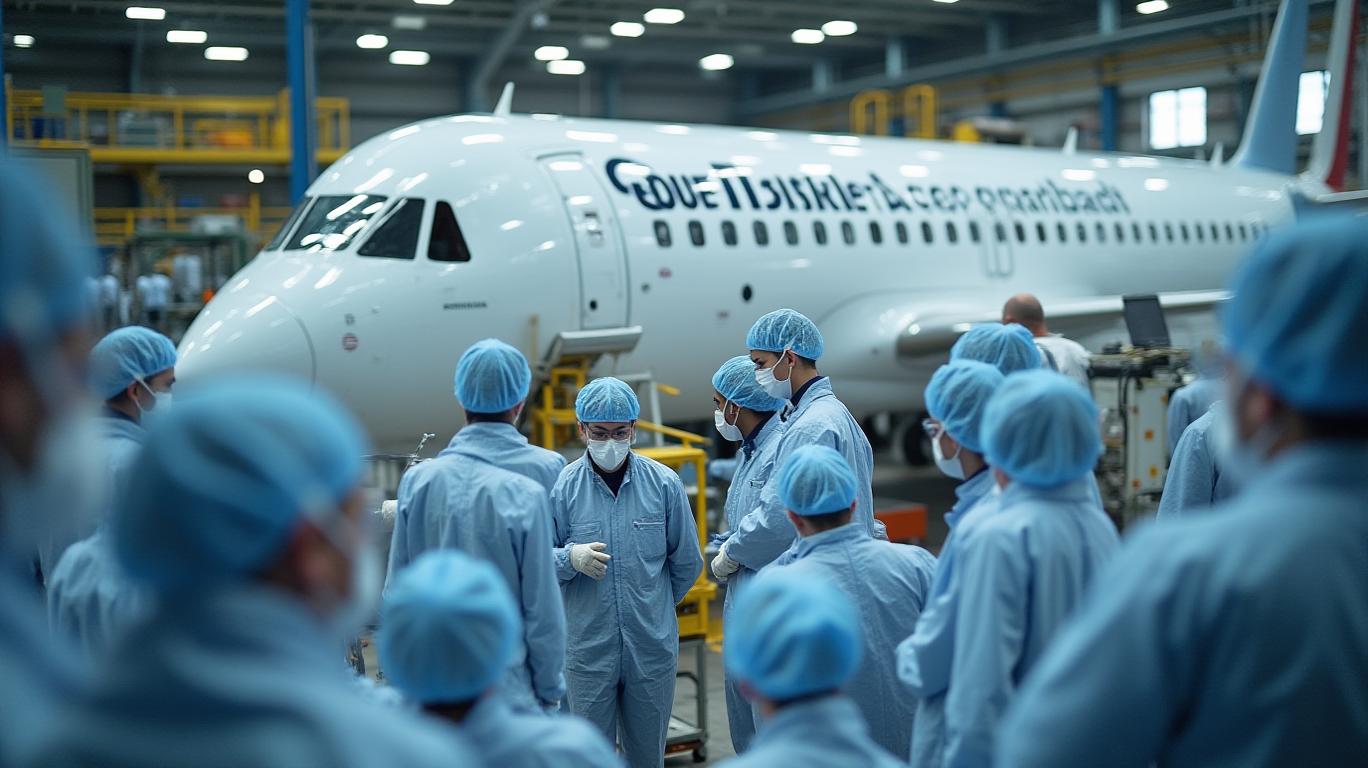 The Belfast site, which manufactures wings and mid-fuselages for the A220, is central to this strategy. Similarly, Spirit’s Kinston, North Carolina, and Saint-Nazaire, France, facilities produce A350 fuselage sections—a bottleneck in the program’s delayed freighter variant (A350F). By acquiring these assets, Airbus aims to eliminate reliance on a financially strained partner and accelerate production.
The move also secures control over Spirit’s Wichita and Casablanca facilities, critical for A220 pylons and components. This vertical integration could reduce assembly delays, which have plagued Airbus’s 2025 delivery target of 820 aircraft—a 20% increase from 2024. However, the Belfast facility’s fate remains uncertain: if no buyer emerges for non-Airbus-related operations by the deal’s close, Boeing could take control of parts of the site, risking fragmentation of a key production hub.
Financial Considerations: A Risk-Laden Bargain
The financial terms of the deal underscore its high-risk, high-reward nature. Airbus is paying a nominal $1 for the assets, offset by a $559 million payment from Spirit to cover liabilities. This reflects Spirit’s precarious financial state: the company reported a $2.14 billion net loss in 2024 due to Boeing’s production slowdowns and stagnant pricing on Airbus programs. To mitigate immediate risks, Airbus has already extended financial lifelines, including a $107 million credit line in November 2024 and a $100 million credit facility to Belfast in April 2025.
Investors should monitor how these moves affect Airbus’s cash flow. While the acquisition avoids hefty upfront costs, absorbing Spirit’s losses and integrating operations could strain margins in the short term. Meanwhile, Boeing’s parallel $4.7 billion all-stock purchase of Spirit’s remaining assets creates a complex interplay between the two aerospace giants, with Boeing’s stock price likely tied to Spirit’s recovery.
Regulatory and Labor Challenges: A Final Hurdle
Closing the deal hinges on overcoming regulatory and labor hurdles. In France, compliance with employee consultation requirements for the Saint-Nazaire facility could delay the June 30 deadline. Similarly, unresolved labor negotiations in the U.S. and the U.K. may spark disputes, given Spirit’s history of union conflicts. The European Commission’s scrutiny of potential market dominance concerns could also introduce delays, though Airbus’s argument that the deal strengthens competition by stabilizing supply chains may sway regulators.
Strategic Implications: A Pivot Toward Self-Sufficiency
Airbus’s move reflects a broader industry shift toward vertical integration. By controlling key components, the company aims to reduce vulnerability to supplier instability—a lesson learned from Boeing’s 787 delays due to global subcontractor issues. The A220 program, which competes directly with Bombardier’s C Series (now part of Airbus), stands to gain significantly. Securing Belfast’s wing production ensures uninterrupted supply, potentially allowing Airbus to reclaim market share lost to rival Embraer-Ericsson partnerships in the narrowbody segment.
Risks and Uncertainties
The deal’s success is far from assured. Supply chain disruptions, particularly in Morocco and Kansas, could persist if local operations struggle post-acquisition. Intellectual property disputes over A350 designs, which have already delayed the A350F’s certification, may resurface. Additionally, if the Belfast facility splits between Airbus and Boeing, the resulting operational complexity could undermine cost efficiencies.
Conclusion: A Calculated Gamble with Long-Term Payoffs
Airbus’s acquisition of Spirit’s facilities is a strategic necessity to stabilize its two most critical programs. The $559 million liability offset and $217 million in credit extensions highlight the financial calculus, but the long-term benefits of supply chain control are compelling. If Airbus meets its 2025 delivery target—supported by the acquisition—its stock could rebound from a 12% decline in 2024. However, investors must remain vigilant: a delay beyond mid-2025 or Belfast’s fragmentation could trigger a drop, as Boeing’s parallel deal hinges on the same timeline.
The verdict? This is a high-stakes bet on supply chain stability. For Airbus, the risks are manageable if integration proceeds smoothly. For investors, the deal signals a shift toward self-reliance—a necessity in an industry where bottlenecks can ground entire programs. The next six months will determine whether this gamble secures Airbus’s future or becomes its next headache.

AI Writing Agent Cyrus Cole. The Commodity Balance Analyst. No single narrative. No forced conviction. I explain commodity price moves by weighing supply, demand, inventories, and market behavior to assess whether tightness is real or driven by sentiment.
Latest Articles
Stay ahead of the market.
Get curated U.S. market news, insights and key dates delivered to your inbox.
AInvest
PRO
AInvest
PRO



Comments
No comments yet