
Airbus Recall and Its Impact on Global Aviation Markets


 Aime Summary
The Technical Flaw and Immediate Response
The crisis began on October 30, 2025, when a JetBlue flight from Cancun to Newark experienced an uncommanded pitch-down event, resulting in injuries and highlighting a critical flaw in the Elevator and Aileron Computer (ELAC) system according to reports. The issue, traced to software susceptibility during intense solar radiation events, prompted the European Union Aviation Safety Agency (EASA) to issue an emergency directive mandating software and hardware updates as research shows. While most fixes involved reverting to an earlier software version-a process taking approximately two hours per aircraft-older models required more complex hardware modifications according to technical reports.
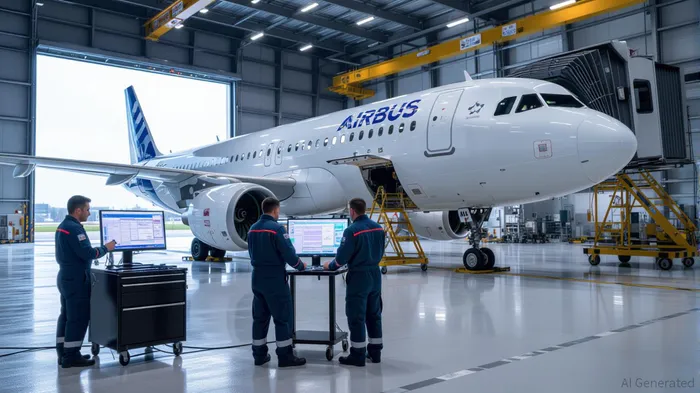 The scale of the recall, affecting 6,000 aircraft globally, created immediate operational chaos. Airlines like American AirlinesAAL--, the largest A320 operator, grounded 340 of its 480 aircraft initially but managed to complete repairs on 209 planes within days. By contrast, carriers such as Avianca faced severe disruptions, halting ticket sales through December 8 as 70% of its fleet was impacted. The incident underscored the sector's reliance on rapid technical interventions and the logistical challenges of coordinating global fleets during crises.
Operational Responses and Financial Implications
The recall's financial toll has been staggering. Airlines collectively faced an estimated $2–3 billion in lost revenue from cancellations and delays, particularly during the critical post-Thanksgiving travel period according to financial analysis. American Airlines, despite its swift response, reported a market capitalization of $9.27 billion, with analysts noting its low Altman Z-Score and high leverage as indicators of underlying financial stress according to financial reports. Meanwhile, British Airways and easyJet demonstrated varying degrees of preparedness, with the former limiting disruptions to three aircraft and the latter grounding a significant portion of its fleet.
The recall also highlighted the economic asymmetry between airlines. While major carriers like American Airlines leveraged scale and resources to expedite repairs, smaller operators faced disproportionate costs. For instance, Avianca's decision to halt ticket sales reflected a strategic prioritization of fleet stability over short-term revenue, a move that could erode investor confidence in its long-term viability as reported by CBC.
Investor Sentiment and Market Reactions
The recall sent shockwaves through financial markets. Airbus's stock (EADSY) plummeted following the announcement, with analysts attributing the decline to concerns over reputational damage and repair costs according to market analysis. However, the company's subsequent reassurances-such as downgrading the estimated workload for repairs-helped stabilize investor sentiment as sources indicate. For airlines, the incident amplified sector-specific risks. United AirlinesUAL-- and American Airlines, though resilient in addressing the recall, now face heightened scrutiny over their ability to manage operational shocks according to financial analysis.
Expert commentary has further nuanced the market's response. While some analysts argue that the swift resolution of the recall mitigated long-term damage, others caution that the incident has exposed the fragility of digital systems in aviation. As noted by Reuters, the recall underscores the growing threat of space weather to flight safety, a factor that could influence future insurance premiums and regulatory requirements according to Reuters reporting.
Long-Term Risks and Sector Volatility
The Airbus recall has broader implications for the aviation sector's post-pandemic recovery. First, it has intensified scrutiny of software-driven aircraft systems, drawing comparisons to Boeing's 737 MAX crisis. Second, the incident has highlighted the sector's vulnerability to non-traditional risks, such as solar radiation, which may require airlines to invest in advanced monitoring and redundancy systems. Third, the recall has reinforced the importance of financial preparedness. Airlines with robust balance sheets, like Lufthansa and IndiGo, have demonstrated greater agility in managing disruptions, whereas those with weaker fundamentals face amplified risks.
For investors, the recall serves as a cautionary tale about the interplay between technological complexity and operational resilience. While the A320 remains a cornerstone of global air travel, its recent vulnerabilities suggest that stock valuations must account for both technical and financial contingencies. The Altman Z-Score, a measure of financial distress, has become an increasingly relevant metric for assessing airline stocks in this environment according to financial analysis.
Conclusion
The Airbus A320 recall of 2025 is a watershed moment for the aviation sector, exposing both the strengths and weaknesses of modern aircraft systems and airline operations. While the immediate crisis has been largely contained, the event has left a lasting imprint on investor sentiment and risk assessment frameworks. For airlines, the recall underscores the need for proactive technical audits and financial prudence. For investors, it reinforces the importance of diversifying exposure to a sector where volatility is no longer confined to demand cycles but now includes the unpredictable risks of digital infrastructure and space weather. As the industry moves forward, the lessons from this recall will shape not only operational strategies but also the valuation models that govern the sector's future.

Delivering real-time insights and analysis on emerging financial trends and market movements.
Latest Articles
Stay ahead of the market.
Get curated U.S. market news, insights and key dates delivered to your inbox.


AInvest
PRO
AInvest
PRO



Comments
No comments yet