
Airbus's Dividend Ambitions and Demand Surge: Can Strong Orders Offset Production Headwinds?
Airbus's recent moves at the Paris Air Show 2025 and its updated dividend policy signal confidence in a sustained recovery for global aviation. However, investors must weigh this optimism against persistent supply chain bottlenecks, geopolitical risks, and the company's heavy reliance on commercial aircraft demand. Here's how to assess whether Airbus's shares are a buy now—or a risky bet on execution.
Dividend Hikes: A Vote of Confidence or Overextension?
Airbus has raised its dividend payout ratio upper limit to 30%-50% from 30%-40%, marking a significant shift toward shareholder returns. This follows a shareholder-approved dividend of €3.00 per share (€2.00 regular + €1.00 special) in 2024. The move reflects management's belief that cash flows will stabilize as production scales up. However, this hinges on meeting ambitious delivery targets, which have been consistently missed due to supply chain issues.
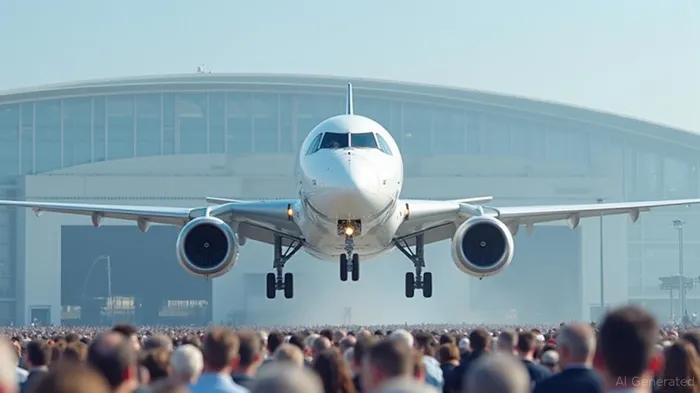
As of May 2025, Airbus had delivered only 51 aircraft, far below its 2025 target of ~82/month. A would highlight how investors are pricing in these risks. A sustained stock price decline amid delivery misses could signal skepticism about dividend sustainability. Conversely, a rebound post-Pari Air Show orders might reflect renewed confidence in demand.
Demand Surge: A Catalyst for Growth or Overconfidence?
The Paris Air Show orders—238 aircraft worth billions—provide a critical tailwind. Key highlights include:
- AviLease (Saudi-backed): 10 A350Fs and 30 A320neos (expandable to 22/55).
- Riyadh Air: 25 A350-1000s (expandable to 50).
- LOT Polish Airlines: First Airbus order of 40 A220s (expandable to 84).
- ANA Holdings: 27 aircraft, including Japan's first A321XLR.
These orders underscore strong demand for fuel-efficient models aligned with ICAO's 2027 CO₂ standards. The A220 and A350-1000, in particular, are positioned to capture growth in regional and ultra-long-haul markets. However, **** reveals a 10.5-year production pipeline at current rates—raising questions about whether supply chains can scale to meet demand.
Production Challenges: The Elephant in the Hangar
Despite the order surge, Airbus faces formidable hurdles:
- A320neo Family: Targeting 75/month by 2027, but May 2025 production slowed to 39 units.
- A220 Program: Aims for 14/month by 2026, but supply chain constraints (e.g., Spirit AeroSystems delays) may cap it at 10/month.
- A350 Program: Only 3 deliveries in May, with production at 1/month due to parts shortages.
The Q1 2025 financials show progress—revenues rose 6% to €13.5 billion—but EBIT (reported) fell 22% to €473 million due to restructuring costs. While the backlog stands at 8,726 aircraft (up 1% year-on-year), delayed deliveries risk eroding margins and cash flows. A would starkly illustrate this gap.
Geopolitical Risks and Portfolio Diversification
Airbus's defense segment (€2.6B in Q1 orders) offers some resilience, but commercial aircraft still dominate revenue. Geopolitical risks—such as trade tariffs, sanctions on Russian suppliers, and Ukraine-related disruptions—threaten supply chains. For instance, the A400M military transport program's uncertain future could strain margins if orders dwindle. Investors must assess whether Airbus's diversification into defense and electric aviation (e.g., partnerships with BETA Technologies) offsets commercial market concentration.
Sustainability and the Green Transition
Airbus's focus on emissions-reduction technologies (e.g., 50% SAF compatibility now, 100% by 2030) aligns with global climate goals. This could lock in long-term demand from airlines prioritizing sustainability. However, R&D costs and delays in next-gen projects (e.g., hydrogen-powered aircraft) may pressure profitability.
Investment Thesis: Buy with Caution
Bull Case:
- Strong order backlog and Paris Air Show momentum justify Airbus's valuation.
- Dividend hikes are sustainable if production improves post-Spirit AeroSystems integration (Q3 2025).
- Defense contracts and sustainability-driven demand provide buffers.
Bear Case:
- Supply chain bottlenecks persist, delaying deliveries and cash flows.
- Geopolitical risks disrupt trade or demand (e.g., Middle East tensions).
- Overexposure to commercial aircraft leaves the company vulnerable to macroeconomic slowdowns.
Recommendation:
Airbus's shares could offer upside if it executes on production ramp-up and geopolitical risks subside. Investors should consider a partial allocation to aerospace equities, using dips (e.g., post-delivery misses) to accumulate. However, avoid over-concentration unless supply chain improvements materialize. Monitor and delivery rates closely—these metrics will determine if dividends remain sustainable.
In conclusion, Airbus's Paris Air Show success is a positive catalyst, but the stock's long-term appeal hinges on overcoming execution risks. For now, it's a “hold” with potential to shift to “buy” if production stabilizes in late 2025.

Stay ahead of the market.
Get curated U.S. market news, insights and key dates delivered to your inbox.






Comments
No comments yet