
Airbus Crisis and Aviation Sector Volatility: Assessing the Investment Implications of a Global Fleet Recall on Aerospace Stocks and Travel-Dependent Industries


 Aime Summary
Operational Disruptions and Immediate Financial Fallout
The root cause of the recall lies in a software issue affecting the Elevator and Aileron Computer (ELAC), which governs pitch control. Intense solar radiation can corrupt critical flight data, leading to uncommanded maneuvers-most notably demonstrated by a JetBlueJBLU-- flight that nosedived in October 2025, resulting in an emergency landing and 15 injuries according to Reuters. Regulatory bodies, including the European Union Aviation Safety Agency (EASA) and the U.S. Federal Aviation Administration (FAA), mandated urgent software updates or hardware modifications for affected aircraft. While 4,000 planes can be fixed in two hours, 1,000 older models face extended groundings due to hardware replacements.
The operational impact has been severe. American Airlines reported 340 affected aircraft, while Avianca halted ticket sales for two weeks and canceled flights at its Bogotá hub. Air France and British Airways also experienced localized disruptions, compounding the strain on an industry already reeling from the U.S. government shutdown's air traffic control delays. For airlines, the financial toll is stark: Frontier Airlines, for instance, reported a $77 million net loss in Q3 2025, partly attributed to the recall's operational costs and fuel inefficiencies from older aircraft.
Aerospace Stock Market Reactions: Airbus vs. Boeing
The recall has sent shockwaves through aerospace stocks. Airbus's shares (EADSY) initially fell following the November 2025 announcement, reflecting investor concerns over safety and operational reliability. Analysts raised the consensus price target for Airbus to €221.65, citing strong Q3 2025 revenues of €17.9 billion and sustained demand despite industry headwinds. In contrast, Boeing's stock (BA) has traded at a 48% discount to its intrinsic value of $350.79, according to a discounted cash flow analysis, as it contends with lingering issues from the 737 MAX grounding and 787 production flaws. Yet, Boeing's Q3 results showed signs of recovery, including a 38% increase in commercial deliveries and a $636 billion order backlog, suggesting a potential rebalancing of the aerospace duopoly.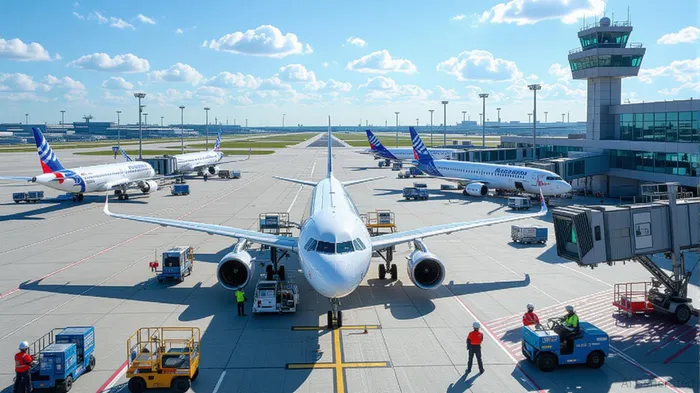
The divergent trajectories highlight a critical investment consideration: while Airbus's recall has eroded short-term confidence, its robust delivery volumes and adjusted EBIT margins position it for long-term resilience. BoeingBA--, meanwhile, faces a steeper uphill battle but may benefit from its improving production rates and supply chain stabilization.
Ripple Effects on Travel-Dependent Industries
The recall's impact extends beyond aerospace stocks, reverberating through airports, travel agencies, and fuel suppliers. Airports, already strained by the U.S. government shutdown's flight delays, now face additional workload managing rebookings and accommodating stranded passengers. For example, Charles de Gaulle Airport saw Air France cancel 40 flights, while Wizz Air deferred 100 A320 deliveries, complicating infrastructure planning.
Travel agencies are grappling with a surge in cancellations and rescheduling requests, as airlines like Avianca and JetBlue temporarily halt new bookings. Fuel suppliers, meanwhile, face volatile demand. While low oil prices have offered some margin relief, the recall's grounding of aircraft for maintenance has created unpredictable consumption patterns. Airlines operating older, less fuel-efficient A320s are also incurring higher costs, with IATA estimating $4.2 billion in excess fuel expenses for 2025.
Investment Risks and Opportunities
For investors, the Airbus crisis underscores the sector's vulnerability to technical and regulatory shocks. Aerospace stocks remain high-risk, with Airbus's recall potentially delaying its 2025 delivery targets and Boeing's recovery hinging on its ability to clear backlogs. However, the crisis also presents opportunities. Airlines with diversified fleets or strong liquidity-such as DeltaDAL-- and American AirlinesAAL--, which reported improved Q3 2025 profitability-may emerge stronger.
Travel-dependent industries, though indirectly affected, could benefit from long-term sector stabilization. Airports with flexible infrastructure and fuel suppliers adapting to fluctuating demand may outperform. Conversely, travel agencies reliant on rigid booking systems face heightened exposure to operational disruptions.
Conclusion
The Airbus A320 recall is a stark reminder of the interconnected risks in the aviation sector. While the immediate financial and operational fallout is severe, the crisis also highlights the importance of resilience and adaptability. For investors, the key lies in balancing short-term volatility with long-term fundamentals-whether in aerospace stocks, airlines, or ancillary industries. As the sector navigates this turbulence, those who anticipate and adapt to the shifting landscape will be best positioned to capitalize on emerging opportunities.

Delivering real-time insights and analysis on emerging financial trends and market movements.
Latest Articles
Stay ahead of the market.
Get curated U.S. market news, insights and key dates delivered to your inbox.
AInvest
PRO
AInvest
PRO



Comments
No comments yet