
Airbus's Challenge to Boeing's Dominance in Single-Aisle Jetliners
 Aime Summary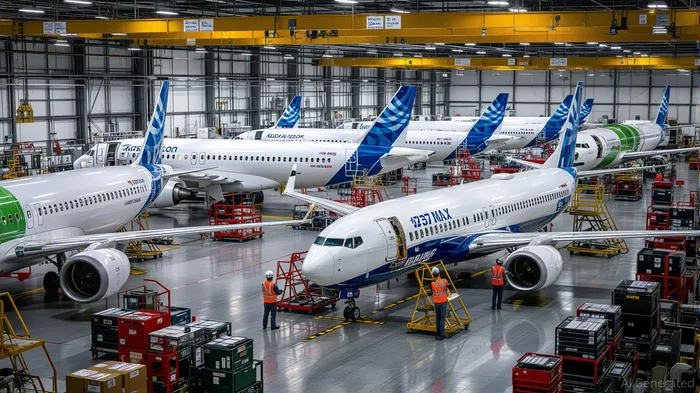
The aerospace industry is witnessing a seismic shift as Airbus accelerates its production of the A320neo family, challenging Boeing's long-standing dominance in the single-aisle jetliner market. This strategic disruption, driven by operational efficiency, technological innovation, and market agility, is reshaping the competitive landscape and redefining equity valuation dynamics for both manufacturers. For investors, the stakes are high: understanding the interplay of production scalability, financial resilience, and regulatory risks is critical to navigating this evolving sector.
Strategic Disruption: Production and Innovation
Airbus's A320neo program has emerged as a linchpin of its narrowbody strategy, with production rates surging to 58 units per month in July 2025—a 48% increase over Boeing's 38-unit-per-month output for the 737 MAX. This production gap is not merely a function of scale but a reflection of Airbus's ability to stabilize supply chains and optimize manufacturing processes. The A320neo's LEAP-1A engines, which offer a 1-2% fuel efficiency advantage over the 737 MAX's LEAP-1B engines, have further cemented its appeal to airlines prioritizing cost savings. By June 2025, Airbus had secured 203 firm orders for the A320neo at the Paris Air Show, compared to Boeing's 116, underscoring a shift in industry confidence.
Boeing, meanwhile, faces a dual challenge: stabilizing its 737 MAX production while addressing technical delays for the MAX 7 and MAX 10 variants. Despite achieving a consistent 38-unit-per-month rate, the company's inability to resolve certification bottlenecks—particularly with the LEAP-1B de-icing system—has constrained its ability to compete on volume. Analysts at BarclaysBCS-- note that Boeing's production ramp-up to 42 units per month, pending FAA approval, remains contingent on resolving these issues by mid-2026.
Financial and Operational Risks
The financial health of both firms reveals stark contrasts. Airbus reported a net profit of €4.2 billion in 2025, supported by a robust balance sheet and a 75% order capture rate for the A320neo. Its R&D investments in hydrogen-powered aircraft and hybrid-electric propulsion signal a forward-looking strategy to maintain dominance in a decarbonizing industry. In contrast, Boeing's net loss of $11.8 billion in 2025, coupled with $38 billion in net debt, highlights its precarious financial position. While the company projects a recovery by 2029, its reliance on asset sales and operational improvements introduces uncertainty.
Operational risks further complicate Boeing's outlook. Supply chain disruptions, exacerbated by U.S. tariffs and geopolitical tensions, have delayed component deliveries for the 737 MAX. Meanwhile, Airbus grapples with its own supply chain bottlenecks, particularly for LEAP engines and U.S.-sourced parts. These challenges underscore the fragility of global aerospace manufacturing ecosystems and the need for diversified supplier networks.
Investment Opportunities and Valuation Dynamics
For investors, the divergent trajectories of Airbus and BoeingBA-- present distinct opportunities. Airbus's stock (AIR) has attracted a "Buy" consensus from 19 analysts, with a 12-month average price target of €195.63 (a +8.61% upside from its current price). The company's strong earnings growth, dividend consistency, and production momentum position it as a high-conviction play in the aerospace sector. However, its premium valuation (P/E ratio of 37.69) reflects elevated expectations, necessitating close monitoring of production scalability and supply chain resilience.
Boeing's equity valuation, while more volatile (beta of 1.48), offers a compelling case for long-term investors. Analysts at BofA Securities upgraded the stock to "Buy" with a $260 price target, citing its potential to generate free cash flow by 2027 and its strategic focus on the 737 MAX. Yet, Boeing's path to recovery hinges on resolving regulatory hurdles and restoring stakeholder trust—a process that could take years.
Strategic Implications for the Future
The aerospace sector's future will be defined by its ability to adapt to sustainability mandates and technological disruption. Airbus's early investments in hydrogen and hybrid-electric technologies position it to lead the next generation of narrowbody aircraft, while Boeing's reliance on incremental improvements to the 737 MAX may leave it lagging. For investors, this divergence suggests a preference for Airbus in the near term, though Boeing's potential turnaround could offer asymmetric upside for risk-tolerant portfolios.
In conclusion, Airbus's strategic disruption of Boeing's dominance in single-aisle jetliners is not merely a production race but a battle for the future of commercial aviation. While both firms face operational and financial headwinds, Airbus's current momentum and innovation pipeline make it a stronger candidate for long-term equity appreciation. Investors seeking aerospace exposure should prioritize Airbus's A320neo program while maintaining a watchful eye on Boeing's regulatory and technical progress. The skies are no longer calm—only the most agile will thrive.

Stay ahead of the market.
Get curated U.S. market news, insights and key dates delivered to your inbox.




Comments
No comments yet