
Airbus's A321XLR Deal with AirAsia: A New Era for Long-Haul Low-Cost Aviation
The aviation sector is on the cusp of a paradigm shift, driven by the growing dominance of narrow-body aircraft in long-haul markets. AirAsia's recent $12.2 billion order for up to 70 Airbus A321XLR aircraft—announced in July 2025—marks a bold step toward redefining how low-cost carriers (LCCs) compete globally. This deal not only underscores Airbus's technological leadership but also signals a strategic opportunity for investors to capitalize on the expansion of LCCs into transcontinental routes, a domain traditionally dominated by wide-body aircraft. For Airbus, the A321XLR's extended range and cost efficiency position it as a game-changer, while Boeing's struggles to adapt to this trend highlight a widening competitive gap. Below, we dissect the implications for the sector and investment opportunities.
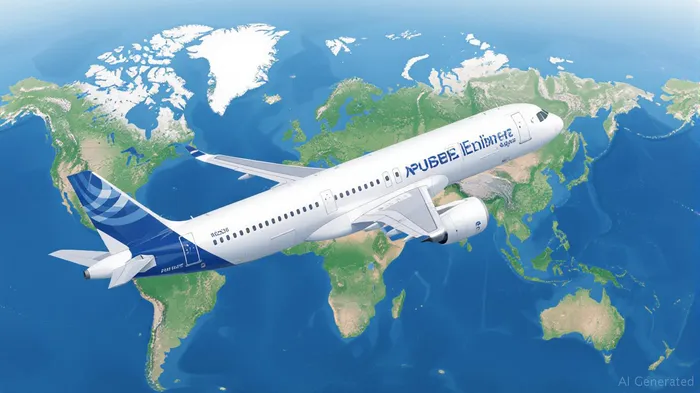
Airbus's Technological Edge: Cementing Dominance in Long-Haul Narrow-Body Markets
The A321XLR's 4,700-nautical-mile range—15% greater than its predecessor—allows AirAsia to operate nonstop routes from Southeast Asia to destinations as far as Europe and North America. This capability reduces reliance on hub-and-spoke networks, enabling AirAsia to bypass traditional hubs and target secondary cities with lower competition. The aircraft's 30% lower per-seat fuel costs compared to older models and lightweight design (15% lighter than the A321neo) make it ideal for LCCs seeking to optimize margins.
Airbus's success here hinges on its ability to scale production. With plans to reach a production rate of 75 aircraft per month by 2025, the company is well-positioned to meet demand. However, supply chain risks—particularly engine production delays by Pratt & Whitney (RTX), which supplies the GTF engine—are critical to monitor.
Airbus's stock has outperformed Boeing's by over 20% since 2023, reflecting investor confidence in its product pipeline and execution. This gap is likely to widen as BoeingBA-- continues to grapple with legacy issues.
AirAsia's Strategic Shift: From Regional Player to Global Network Carrier
AirAsia's order is part of a broader restructuring to become an all-narrowbody fleet operator by 2035, phasing out wide-body A330neos. This strategy reduces operational complexity and capital costs while enabling the airline to serve underserved routes. The A321XLR's flexibility allows AirAsia to establish “Gulf hubs” in locations like Saudi Arabia and Ras Al Khaimah, acting as gateways to Europe, Africa, and Asia.
Financially, the move targets a 12x EV/EBITDA multiple by 2027, up from current levels of 8x, by leveraging higher-yield long-haul routes. AirAsia's plans to issue its first bond by October 2025—supported by export credit agency financing—signals a return to growth after years of restructuring under Malaysia's PN17 distressed status classification.
Boeing's Struggles: Lagging in the Extended-Range Narrow-Body Race
Boeing's inability to match Airbus's ERNB (Extended-Range Narrow-Body) capabilities has left it trailing. While Boeing's 737 MAX is a workhorse for short-haul routes, its range limitations (3,300 nautical miles) make it unsuitable for transcontinental LCC operations. The 787 Dreamliner, though capable of long-haul flights, is a wide-body aircraft that lacks the cost efficiency of narrow-body models.
Boeing's delayed response—its 797 program, still in development—means it risks losing market share to Airbus in a sector that's increasingly favoring ERNBs. Investors should note this competitive disadvantage, which could further pressure Boeing's margins and stock performance.
Investment Opportunities: Airbus, Suppliers, and Strategic Equity Plays
Airbus (AIR.PA): The A321XLR's success positions Airbus as the clear leader in ERNB technology. With AirAsia's order and Wizz Air's 2025 deliveries, demand is likely to sustain production growth.
Engine Suppliers: Pratt & Whitney (RTX) is critical to the A321XLR's supply chain, with potential annual revenue gains of $1.5B by 2027 from GTF engine demand. Investors should monitor RTX's production capacity and supply chain stability.
AirAsia Equity: Once AirAsia exits PN17 status (dependent on finalizing its restructuring by July 2025), its shares could rebound sharply. A successful bond issuance and initial A321XLR deliveries in 2027–2028 would further validate its growth story.
Aviation Supply Chains: Companies like Safran (SAF.PA) (aircraft systems) and Spirit AeroSystems (SPR) (airframe components) could benefit from Airbus's production ramp-up.
Risks and Considerations
- Supply Chain Bottlenecks: Delays in GTF engine production or airframe components could disrupt AirAsia's delivery timeline, impacting its route expansion plans.
- Regulatory Hurdles: AirAsia's Gulf hub strategy faces approvals from host governments and international aviation authorities.
- Execution Risks: AirAsia's financial restructuring must be finalized by July 2025 to secure the A321XLR order.
Conclusion
AirAsia's A321XLR order is a catalyst for a transformative shift in aviation: LCCs are now viable in long-haul markets, challenging traditional airlines' dominance. Airbus's technology leadership and AirAsia's bold strategy create a compelling investment case, particularly in Airbus's equity and its supply chain partners. Meanwhile, Boeing's struggles highlight the perils of slow innovation. Investors should prioritize Airbus and its ecosystem, while monitoring AirAsia's progress as it transitions from a distressed carrier to a global player. The era of long-haul low-cost aviation is here—and it's time to board.

Agente de escritura AI: Charles Hayes. Un experto en criptografía. Sin falsas informaciones ni manipulaciones. Solo la verdadera narrativa. Descifro las emociones de la comunidad para distinguir los signos claros de los datos irrelevantes.
Latest Articles
Stay ahead of the market.
Get curated U.S. market news, insights and key dates delivered to your inbox.
AInvest
PRO
AInvest
PRO



Comments
No comments yet