
Airbus A320 Recall and Its Ripple Effects on Global Aviation Markets: Short-Term Volatility and Long-Term Resilience


 Aime Summary
Short-Term Volatility: Operational Disruptions and Stock Reactions
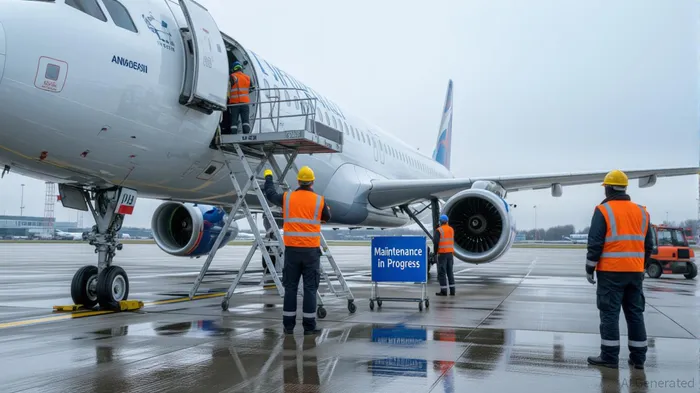
The recall's immediate impact was felt across global air travel. Airlines including American, Lufthansa, and Avianca grounded portions of their fleets for software updates or hardware replacements, according to reports. as explained. This led to widespread flight delays and cancellations during a critical travel period, with airlines .
 Financial markets reacted swiftly. Airbus's stock (EADSY) fell in the wake of the recall announcement, reflecting investor concerns over reputational damage and operational costs according to market analysis. BoeingBA-- (BA), though not directly implicated, , with analysts linking the decline to broader sector jitters. Spirit AeroSystemsSPR-- (SPR), a key supplier to Boeing, also faced downward pressure, factored in potential production delays. However, no significant price movements were reported for Embraer or Rolls-Royce, suggesting the recall's immediate financial spillovers were confined to Airbus and its primary partners as reported.
Long-Term Resilience: R&D, Order Books, and Regulatory Adaptation
Despite the short-term turbulence, the aerospace sector's long-term fundamentals remain robust. Airbus's R&D investments, , underscore its commitment to addressing technical challenges according to company results. as projected. Analysts note that while supply chain constraints and production delays (e.g., , the sector's resilience is bolstered by strong order books and a global passenger traffic rebound as confirmed.
Regulatory responses further reinforce confidence. A recent EU-US agreement to revert to zero-tariff civil aircraft trade has reduced trade uncertainties, supporting Airbus's 2025 guidance of 820 commercial aircraft deliveries and €7 billion in adjusted EBIT as reported. Meanwhile, the incident has spurred calls for enhanced safeguards against space weather events, with industry experts advocating for software redundancies to mitigate future risks.
Investor Implications: Balancing Risks and Opportunities
For investors, the recall highlights two key dynamics. First, short-term volatility in aerospace and airline stocks is likely to persist as airlines absorb repair costs and adjust schedules. However, the incident also underscores the sector's capacity for rapid problem-solving, with Airbus revising its initial estimates downward and airlines largely completing repairs within days. Second, long-term resilience hinges on R&D spending, regulatory cooperation, and the ability to adapt to emerging risks like solar flares. Companies with diversified order books and strong cash flow-such as Airbus, as confirmed.
Conclusion
The Airbus A320 recall is a stark reminder of the complexities inherent in modern aviation. While the incident has caused immediate operational and financial strain, it also demonstrates the industry's ability to innovate under pressure. For investors, the key lies in distinguishing between transient volatility and enduring strengths. Aerospace stocks with robust R&D pipelines and resilient order books may yet outperform in the long run, even as the sector navigates the turbulence of today.

Delivering real-time insights and analysis on emerging financial trends and market movements.
Latest Articles
Stay ahead of the market.
Get curated U.S. market news, insights and key dates delivered to your inbox.
AInvest
PRO
AInvest
PRO



Comments
No comments yet