
Airbus's A320 Recall and Its Implications for Global Aviation Stocks


 Aime Summary
The A320 Recall: Scope and Immediate Impact
The recall followed an incident on a JetBlueJBLU-- flight from Cancún to Newark, where intense solar radiation caused a sudden pitch-down event, leading to an emergency landing. The European Union Aviation Safety Agency (EASA) and the U.S. Federal Aviation Administration (FAA) issued emergency directives, requiring airlines to revert to an earlier software version or replace hardware on older models. Major carriers like American AirlinesAAL--, DeltaDAL--, and Lufthansa reported cancellations and delays, though most aircraft were repaired within days. For example, , with repairs expected to be completed by the weekend.
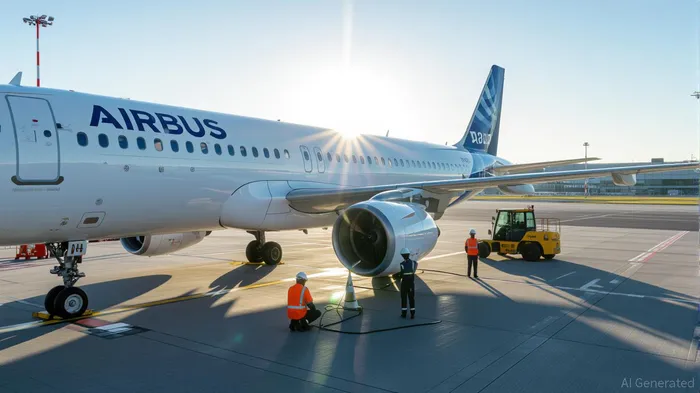
The recall's timing-during peak travel season-exacerbated challenges. Avianca, , temporarily halted ticket sales, while . Despite these hiccups, the swift implementation of fixes. This contrasts sharply with the BoeingBA-- 737 MAX crisis, where a flawed flight control system led to a 14-month grounding .
Market Response and Analyst Sentiment
The A320 recall's impact on Airbus's stock (EADSY) remains nuanced. While no specific percentage drop was reported immediately post-announcement, analysts adjusted price targets, reflecting a mix of caution and optimism. JPMorgan and RBC Capital raised their targets , maintaining "Overweight" and "Outperform" ratings, respectively. UBS upgraded Airbus to "Buy," citing confidence in its cost control and long-term growth prospects. Conversely, Kepler Cheuvreux downgraded to "Hold," arguing that much of Airbus's growth was already priced in.
This divergence highlights the market's balancing act between short-term risks and long-term confidence. Unlike Boeing's 737 MAX crisis, , Airbus's situation appears less severe. The A320's dominant market share-. Boeing's 737 MAX struggles) suggest that Airbus's financial and operational position is stronger. Analysts note that the recall's fixes, while urgent, are less disruptive than hardware-intensive recalls, mitigating long-term reputational damage.
Operational Resilience in the Post-Pandemic Era
The A320 recall underscores the aviation industry's evolving resilience. Airlines demonstrated agility in addressing the crisis, with carriers like Air India and IndiGo implementing updates with minimal disruption. This contrasts with the 737 MAX crisis, where Boeing's delayed response and regulatory scrutiny prolonged recovery. Post-pandemic, airlines have invested in robust maintenance protocols and diversified supplier relationships, enabling quicker responses to disruptions.
However, vulnerabilities persist. The recall exposed gaps in software resilience against environmental factors like solar radiation, a concern as climate-related risks grow. For investors, this highlights the importance of monitoring technological safeguards and supply chain adaptability. Airbus's ability to reassure regulators and customers-such as the Indian aviation authority's high compliance rate with updates-will be critical in maintaining trust.
Broader Implications for Aviation Stocks
The A320 recall serves as a stress test for the sector's post-pandemic recovery. While the incident caused temporary turbulence, the broader market's focus remains on long-term trends: sustainability, fuel efficiency, and demand for narrow-body aircraft. The A320neo's dominance- over the 737 MAX-reinforces Airbus's competitive edge. , , signaling a structural shift in market dynamics.
For investors, the key takeaway is that operational resilience is now a non-negotiable. Airlines and manufacturers that prioritize proactive risk management-whether through software redundancies or diversified production networks-will outperform peers. The A320 recall, while significant, has not dented Airbus's trajectory. Instead, it underscores the sector's capacity to adapt, a trait that will define its recovery in the coming years.

Delivering real-time insights and analysis on emerging financial trends and market movements.
Latest Articles
Stay ahead of the market.
Get curated U.S. market news, insights and key dates delivered to your inbox.




Comments
No comments yet