
The Airbus A320 Grounding and Its Implications for Global Aviation Stocks


 Aime Summary
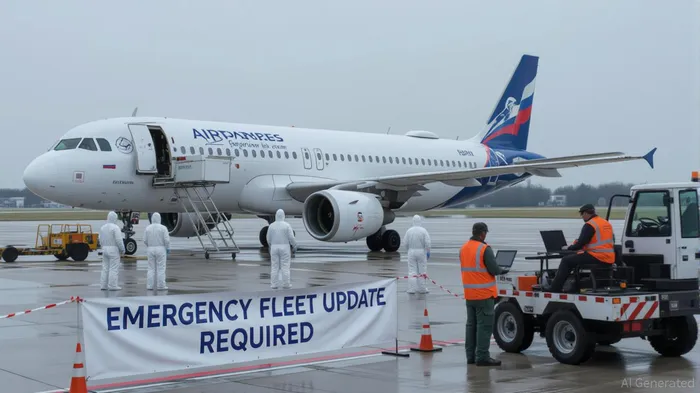
The grounding of Airbus's A320-family aircraft in late 2025 has sent shockwaves through the aviation sector, exposing vulnerabilities in operational risk management and testing the resilience of both airline and original equipment manufacturer (OEM) stocks. Triggered by a software flaw linked to solar radiation interference with flight control systems, the recall of over 6,000 aircraft-nearly half the global fleet-has disrupted holiday travel, strained maintenance capacity, and forced airlines to revise financial forecasts. This analysis examines the operational and financial fallout for key stakeholders, including American AirlinesAAL--, JetBlueJBLU--, DeltaDAL--, and ANA, while assessing the broader implications for market stability and OEM sector dynamics.
Operational Risks: A Systemic Challenge
The root cause of the grounding lies in the Elevator and Aileron Computer (ELAC) system, which governs pitch and roll adjustments. Intense solar radiation was found to corrupt critical flight data, potentially leading to uncommanded maneuvers such as the sudden nose dive experienced by a JetBlue flight in October 2025
according to reports. The European Union Aviation Safety Agency (EASA) and the Federal Aviation Administration (FAA) issued emergency directives, requiring airlines to implement software updates or hardware replacements
as per the official statement.
For airlines, the operational risks are twofold: immediate disruptions to flight schedules and long-term reputational damage. American Airlines, the largest A320 operator, initially identified 340 aircraft requiring fixes, later revised to 209
according to live updates. Delta Air LinesDAL-- reported fewer than 50 affected A321neo aircraft, with updates expected to be completed within 48 hours
as confirmed by the airline. Meanwhile, Japan's ANA Holdings canceled 65 flights in a single day, stranding 13,200 passengers during the peak travel season
according to official reports. These disruptions highlight the fragility of airline operations when faced with large-scale technical recalls, particularly during periods of high demand.
Financial Impacts: Stock Volatility and Revenue Losses
The grounding has directly impacted airline revenues and stock valuations. American Airlines, despite reporting record third-quarter revenue of $13.7 billion,
posted a net loss of $114 million due to cost pressures and operational challenges. The airline, however, projects a return to profitability in Q4 2025, with adjusted earnings per share (EPS) expected to exceed analyst expectations
as stated in investor communications.
JetBlue, on the other hand, has faced sharper headwinds. Its stock price plummeted 43% year-to-date in 2025, driven by capacity cuts, engine-related groundings, and the A320 recall
according to financial reports. The airline withdrew its full-year earnings forecast in April 2025, citing an "unlikely" path to break-even operations
as reported by industry sources. Delta, while less severely impacted, revised its financial guidance amid broader economic uncertainties, including stalled travel demand linked to geopolitical tensions
as reported by market analysts.
For ANA, the grounding compounded existing challenges. The airline's flight cancellations and delays during the holiday season likely resulted in significant revenue losses, though precise figures remain undisclosed
according to financial analysts. Analysts note that ANA's response-prioritizing safety over short-term profitability-reflects a strategic shift toward risk mitigation in an increasingly volatile market
as detailed in industry reports.
OEM Sector Implications: Airbus's Resilience and Investor Sentiment
The recall, the largest in Airbus's 55-year history, has tested investor confidence in the OEM sector. Airbus's stock price initially dipped following the announcement, as the scale of the recall raised concerns about repair costs and long-term brand reputation
according to market analysis. However, the company's swift response-including collaboration with regulators and transparency in communicating fixes-has helped stabilize sentiment
as reported by industry sources.
Analysts emphasize that Airbus's long-term outlook remains robust. The company's Global Market Forecast 2025–2044 anticipates demand for 43,420 new aircraft over the next two decades, driven by rising passenger traffic and fleet modernization
according to official forecasts. While the A320 recall is a short-term setback, the broader industry's structural growth-particularly in emerging markets-suggests resilience in the OEM sector
as noted by financial analysts.
Market Resilience: Navigating Short-Term Turbulence
Despite the grounding's immediate disruptions, the aviation sector has demonstrated adaptability. Airlines have leveraged capacity cuts, premium fare strategies, and loyalty program strength to offset losses. For example, American Airlines raised its 2025 profit forecast, citing strong premium demand and cost discipline
as reported by financial sources. Similarly, Delta's focus on international routes and its robust loyalty program position it to weather the storm
according to industry analysis.
Investor reactions have been mixed. While JetBlue's stock remains under pressure, Delta and American Airlines have attracted cautious optimism, with analysts projecting upside potential for both in 2026
as stated in market reports. The broader S&P 500's outperformance (12.26% year-to-date in 2025) compared to Delta's 2.03% total return underscores the sector's uneven recovery
according to financial data.
Conclusion: Strategic Considerations for Investors
The Airbus A320 grounding underscores the interconnectedness of operational risk and market resilience in the aviation sector. For airlines, the incident highlights the need for agile risk management frameworks and diversified fleet strategies. For OEMs like Airbus, it reinforces the importance of proactive safety protocols and transparent communication.
Investors should monitor key metrics: repair timelines, regulatory responses, and airlines' ability to maintain profitability amid disruptions. While short-term volatility is inevitable, the long-term fundamentals of air travel-driven by population growth, urbanization, and technological innovation-remain intact. As the industry navigates this crisis, resilience will be defined not by the absence of challenges, but by the capacity to adapt and innovate in their wake.

Stay ahead of the market.
Get curated U.S. market news, insights and key dates delivered to your inbox.




Comments
No comments yet