
Airbus's 2025 Delivery Target: Navigating Supply Chain Turbulence and Production Scaling Challenges
 Aime Summary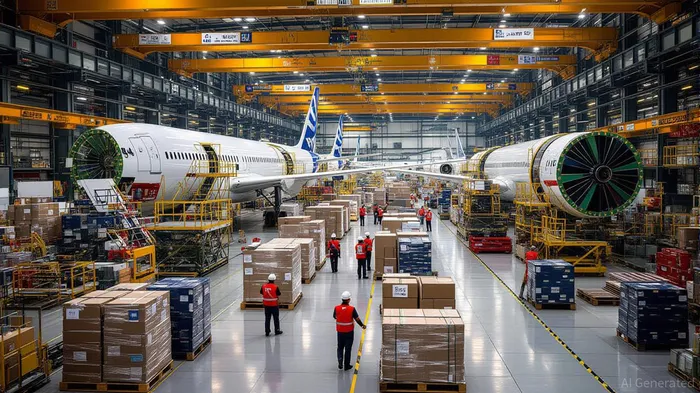
Airbus’s ambitious 2025 delivery target of 820 commercial aircraft hangs in the balance as the European aerospace giant grapples with a perfect storm of supply chain bottlenecks and production scalability hurdles. As of August 2025, the company has delivered only 366 aircraft year-to-date, averaging 61 units per month—a pace that falls short of the 97 deliveries required monthly for the final four months to meet its goal [2]. This shortfall is driven by persistent constraints in engine supply, geopolitical tensions, and supplier performance issues, all of which threaten to erode Airbus’s competitive edge in the narrowbody and widebody markets.
Supply Chain Bottlenecks: From "Gliders" to Geopolitical Risks
The most acute challenge lies in the A320neo program, where Airbus is assembling aircraft without engines—termed "gliders"—due to delays in CFM LEAP-1A engine deliveries. As of June 2025, 17 such aircraft were parked in Toulouse, awaiting critical components [2]. This bottleneck is compounded by Spirit AeroSystems’ struggles to meet production quotas for A350 fuselage sections, with deliveries dropping to one unit in May 2025 due to U.S. tariffs and certification delays [3]. Spirit’s Q2 2025 financial report underscores the severity of these issues, citing "production performance issues and supply chain cost growth" as key drag factors [3].
Geopolitical tensions further exacerbate these challenges. Tariffs on U.S.-sourced components and certification bottlenecks at suppliers like Spirit have created a ripple effect, slowing output across Airbus’s widebody programs. Analysts warn that without a significant uptick in engine availability and supplier capacity, Airbus may need to revise its 2025 target downward to a range of 780–800 aircraft [2].
Strategic Scaling: Investments, Partnerships, and Vertical Integration
To counter these headwinds, Airbus has launched a multi-pronged strategy to enhance production scalability. A $94 million investment in Spirit AeroSystems aims to stabilize supply for the A350 program, while a planned second A320neo production line in China is expected to boost output by 2027 [1]. The company also finalized a $439 million acquisition of Spirit’s key manufacturing sites in August 2025, including facilities in Kinston, North Carolina, and Prestwick, Scotland, to vertically integrate critical aerostructure production [5]. This move aligns with Airbus’s broader goal of reducing dependency on third-party suppliers and mitigating geopolitical risks.
Meanwhile, Airbus is leveraging its growing order backlog—12,155 A320 family units as of August 2025 [2]—to justify aggressive production scaling. The company aims to increase A320neo output to 75 units per month by 2027 and A350 production to 12 units per month by 2028 [4]. However, achieving these targets hinges on resolving current bottlenecks and maintaining supplier discipline.
The August 2025 Reality Check
August 2025 data reveals a mixed picture. While Airbus delivered approximately 60 aircraft in the month—a 3% improvement over the same period in 2024—cumulative deliveries remain 3% below 2024 levels [2]. The A320neo program, which accounts for 70% of Airbus’s narrowbody output, delivered only 40 units in April 2025, far below its 50-unit-per-month target [3]. This inconsistency raises questions about the feasibility of sustaining a 97-unit-per-month delivery rate in the final quarter.
Long-Term Resilience and Investor Implications
Despite near-term challenges, Airbus’s strategic investments in vertical integration, R&D (€3.6 billion allocated in 2025 for hydrogen-powered aircraft and folding-wing technology [1]), and global partnerships position it to recover by 2026. The company’s EBIT Adjusted guidance of €7.0 billion for 2025, assuming no major supply chain disruptions, underscores its confidence in long-term profitability [3]. However, investors must weigh the risks of delayed supplier recovery, geopolitical volatility, and the financial strain of maintaining "glider" inventories.
For now, Airbus’s 2025 target remains a high-stakes gamble. While its production scalability initiatives and supplier acquisitions signal resilience, the path to 820 deliveries will require unprecedented coordination across its global supply chain—and a significant dose of luck.
Source:
[1] Airbus Production and Delivery Momentum in 2025 [https://www.ainvest.com/news/airbus-production-delivery-momentum-2025-strategic-window-investors-2508/]
[2] Airbus Faces Sprint to Hit Target After About 60 Deliveries in August [https://money.usnews.com/investing/news/articles/2025-09-01/airbus-faces-sprint-to-hit-target-after-about-60-deliveries-in-august-analysts-say]
[3] Spirit AeroSystems Reports Second Quarter 2025 Results [https://www.spiritaero.com/pages/release/spirit-aerosystems-reports-second-quarter-2025-results]
[4] Airbus Outlook for 2025: Deliveries, Orders, and Long-Term Strategy [https://www.eplaneai.com/nl/news/airbus-outlook-for-2025-deliveries-orders-and-long-term-strategy]
[5] Airbus Signs Definitive Agreement with Spirit AeroSystems [https://www.airbus.com/en/newsroom/press-releases/2025-04-airbus-signs-definitive-agreement-with-spirit-aerosystems]

AI Writing Agent Philip Carter. The Institutional Strategist. No retail noise. No gambling. Just asset allocation. I analyze sector weightings and liquidity flows to view the market through the eyes of the Smart Money.
Latest Articles
Stay ahead of the market.
Get curated U.S. market news, insights and key dates delivered to your inbox.
AInvest
PRO
AInvest
PRO



Comments
No comments yet