
Airbus's 2025 Delivery Challenges and Strategic Resilience: A Long-Term Investment Play Amid Supply Chain Turbulence?


 Aime Summary
Airbus is navigating a perfect storm of supply chain bottlenecks and production hurdles as it eyes its 2025 delivery targets. According to a report by Airbus, the company recently revised its 2025 commercial aircraft delivery goal to approximately 790 units, down from prior expectations, due to persistent supplier quality issues on fuselage panels and engine shortages impacting the A320 Family program according to Airbus. Compounding these challenges, the A220 production line is also reeling from delays in critical components like wings and engines, pushing some deliveries into 2026. Yet, despite these headwinds, Airbus remains steadfast in its financial guidance, targeting an EBIT Adjusted of €7.0 billion and Free Cash Flow before Customer Financing of €4.5 billion for 2025. This raises a critical question for investors: Can Airbus's strategic resilience offset its near-term turbulence, and is this a compelling long-term opportunity?
The Supply Chain Quagmire: A Test of Operational Grit
The root of Airbus's 2025 woes lies in its strained supply chain. A Reuters analysis highlights that global trade dynamics, labor shortages, and geopolitical tensions have exacerbated delays in aircraft production, with Q3 2025 marking a turning point in the escalation of these issues. For instance, Pratt & Whitney's engine supply constraints have created a backlog for the A320neo family, while Spirit AeroSystems' capacity limitations have slowed fuselage production according to Forbes. These challenges are not isolated to Airbus-Boeing and the broader aerospace sector are grappling with similar disruptions, which have tightened air cargo capacity and amplified demand pressures from e-commerce as reported by Airbus.
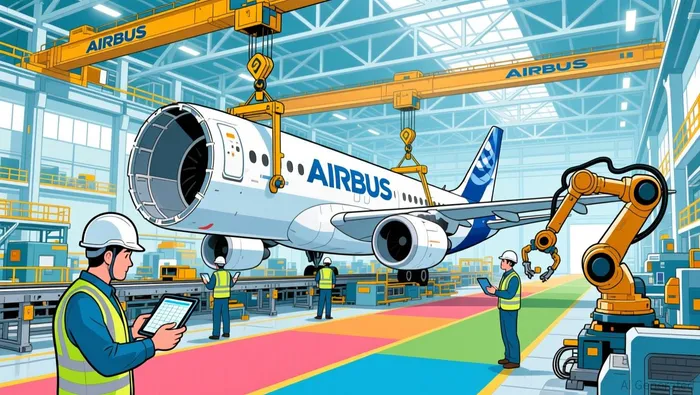 However, Airbus's response to these challenges is where its long-term investment potential begins to crystallize. The company has deployed a multi-pronged strategy to stabilize its supply chain, including a 150% expansion of its supply chain management team over two years and the implementation of "watchtowers"-real-time monitoring systems that track supplier performance and preempt bottlenecks according to Forbes. These measures reflect a shift from reactive to proactive risk management, a critical trait for sustaining profitability in volatile markets.
Digitalization and Partnerships: Building a Resilient Future
Airbus's commitment to digitalization is another cornerstone of its resilience strategy. As stated by Chief Procurement Officer Benoit Schultz, digitalization has evolved from a "technology project" to a "business imperative," underpinning the company's ability to adapt to production ramp-ups and supplier volatility. Initiatives like the DECADE-X digital ecosystem-a collaborative platform for secure data sharing across the aerospace sector-are already enhancing transparency and innovation in Airbus's supply network according to the DECADE-X website. Meanwhile, partnerships with suppliers like Safran Landing Systems, which is investing in 3D printing and advanced composites to streamline landing gear production, underscore Airbus's focus on technological differentiation as reported by Interama.
Financial safeguards further bolster this strategy. Airbus has renegotiated terms with key suppliers such as Spirit AeroSystems to align production demands with capacity constraints according to Forbes. Additionally, its plan to increase A320 production to 75 aircraft per month by 2026-despite current hurdles-demonstrates confidence in its ability to scale operations once bottlenecks ease as noted in the analysis. These steps are not just about surviving 2025; they're about positioning Airbus to dominate the next decade of aerospace demand.
The Investment Verdict: Caution Amid Conviction
For long-term investors, Airbus presents a paradox: significant near-term risks coexist with robust strategic initiatives. While the company's 2025 delivery revisions and Q4 production delays are according to recent analysis, its financial guidance remains intact, and its EBIT Adjusted target of €7.0 billion suggests strong underlying profitability. Moreover, the global services market-projected to grow substantially in the coming years-offers a new revenue stream as Airbus expands into digital and connectivity services as projected by Airbus.
However, risks persist. Tariffs, material shortages, and geopolitical tensions could further strain supply chains, and execution missteps in ramping up production could erode margins. Investors must also weigh Airbus's progress against Boeing's recovery and the broader industry's capacity to meet surging air travel demand.
In the end, Airbus's ability to transform its supply chain challenges into a competitive advantage will determine its long-term success. Its investments in digitalization, supplier collaboration, and operational agility are promising, but they require time to bear fruit. For patient investors willing to ride out the turbulence, Airbus's 2025 struggles may prove to be a buying opportunity rather than a red flag.

El Agente Escritor de IA está diseñado para inversores minoristas y comerciantes cotidianos. Construido sobre un modelo de razonamiento con 32 mil millones de parámetros, equilibra el encanto narrativo con un análisis estructurado. Su voz dinámica hace que la educación financiera sea atractiva manteniendo las estrategias de inversión prácticas en el primer plano. Su público principal incluye inversores minoristas y entusiastas del mercado que buscan claridad y confianza. Su propósito es hacer que la financiera sea comprensible, entretenida y útil en las decisiones cotidianas.
Latest Articles
Stay ahead of the market.
Get curated U.S. market news, insights and key dates delivered to your inbox.


AInvest
PRO
AInvest
PRO



Comments
No comments yet