
Airbnb Stock Falls 1.54% as Insider Selling and Earnings Miss Push Shares to 158th in Daily Trading Volume
 Aime Summary
Market Snapshot
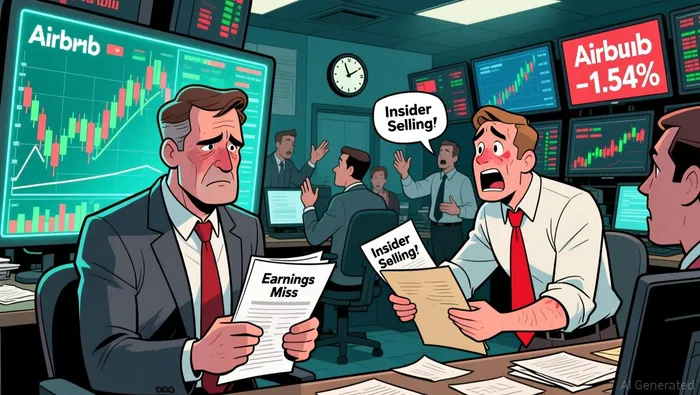
Airbnb’s stock (ABNB) closed 1.54% lower on November 26, 2025, marking a decline in investor sentiment amid a 34.4% drop in trading volume to $0.60 billion—the lowest since the start of the year. This volume placed ABNBABNB-- at the 158th rank in daily trading activity, reflecting reduced liquidity and potentially cautious market positioning. The stock’s performance followed mixed analyst sentiment and significant insider selling, which may have contributed to the downward pressure. Despite a 9.9% year-over-year revenue increase in Q3 to $4.10 billion, earnings per share (EPS) of $2.21 fell short of estimates by $0.10, further weighing on investor confidence.
Key Drivers
Insider Selling and Institutional Distrust
The most prominent driver of Airbnb’s stock decline was the surge in insider sales, particularly from key executives and board members. Director Joseph Gebbia sold 232,000 shares ($26.5 million) under a prearranged trading plan, reducing his direct holdings by 50.43%. This followed earlier sales of 236,000 shares ($29.16 million) in September, which marked a 20.07% reduction in his position. Additionally, CFO Elinor Mertz sold 12,184 shares ($1.56 million), and CTO Aristotle Balogh disposed of 600 shares. Collectively, insiders sold 1.44 million shares valued at $178.3 million over 90 days, despite retaining 27.91% ownership. Such concentrated selling by high-ranking insiders often signals diminished confidence in near-term prospects, triggering investor skepticism.
Institutional investors also scaled back stakes, compounding the negative sentiment. Stevens Capital Management reduced its holdings by 45.7% in Q2, while Legal & General cut its position by 3.5%. These moves align with broader market caution, as institutional investors typically adjust portfolios in response to earnings underperformance or strategic uncertainty. Conversely, some firms like Prudential PLC and Nemes Rush Group increased stakes, but these were offset by larger-scale exits. The net effect was a mixed institutional stance, with heavy selling dominating the narrative.
Earnings Disappointment and Analyst Sentiment
Airbnb’s Q3 earnings miss—$2.21 EPS versus $2.31 expected—highlighted operational challenges despite robust revenue growth. The 9.9% year-over-year revenue increase to $4.10 billion was outpaced by elevated costs or unmet efficiency targets, disappointing investors. Analysts responded with a cautious consensus, assigning a “Hold” rating and a $143.31 average price target. While three analysts rated the stock as a “Strong Buy,” 21 advised a “Hold,” and five issued “Sell” ratings. This divergence underscores uncertainty about the company’s ability to sustain growth amid competitive pressures and macroeconomic headwinds.
The stock’s technical indicators also painted a bearish picture. Traded near $114.26, ABNB was below its 50-day ($122.52) and 200-day ($128.46) moving averages, suggesting a potential pullback. A market capitalization of $70.33 billion, coupled with a P/E ratio of 27.14, positioned the stock as overvalued relative to earnings, further deterring aggressive buying.
Strategic and Market Context
Airbnb’s business model faces ongoing scrutiny as demand for short-term rentals stabilizes and regulatory pressures mount in key markets. The company’s reliance on high-margin, high-impact markets like the U.S. and Europe exposes it to cyclical risks, particularly in a slowing economic environment. Analysts have noted that while Airbnb’s platform remains integral to the travel sector, its growth trajectory may be constrained by saturation and regulatory challenges. This strategic uncertainty likely amplified the impact of insider selling and earnings underperformance, as investors recalibrate expectations for long-term returns.
In summary, Airbnb’s stock decline on November 26, 2025, was driven by a confluence of factors: significant insider selling, institutional exits, earnings underperformance, and a cautious analyst consensus. While the company’s revenue growth and strategic relevance in the travel sector remain intact, the immediate outlook is clouded by liquidity concerns and mixed investor signals. The path forward will depend on Airbnb’s ability to address operational inefficiencies, navigate regulatory hurdles, and restore confidence through transparent communication and execution.

Stay ahead of the market.
Get curated U.S. market news, insights and key dates delivered to your inbox.
AInvest
PRO
AInvest
PRO



Comments
No comments yet